Hansard Summary
Senators debated the County Governments Cash Disbursement Schedule for FY 2019/2020, highlighting widespread allegations of misused funds and corruption in county administrations. They called for stronger oversight by the CPAIC, possible constitutional amendments to clarify revenue‑sharing powers, and urged direct investigations and prosecutions of errant governors. The discussion combined criticism with proposals for reform and accountability. Senate members welcomed the delegation from the Forum of Parliaments of the ICGLR and a Migori County Assembly delegation, highlighting the ICGLR's role in peace, security and democratic development in the Great Lakes region. Speakers emphasized cooperation between parliaments, benchmarking of committee operations, and the importance of shared best practices on health, social issues and governance. The tone was collegial and supportive, underscoring regional solidarity and parliamentary engagement. Senators criticised the unequal allocation and opaque handling of conditional grants, warning that the Treasury’s unchecked agreements threaten devolution and fiscal accountability. They called for a clear policy framework and opposed a proposed amendment that would limit county receipts to 15% of audited revenue, deeming it inadequate. The debate combined strong criticism with constructive proposals for legislative safeguards.Sentimental Analysis
MixedTHE PARLIAMENT OF KENYA
THE SENATE
THE HANSARD
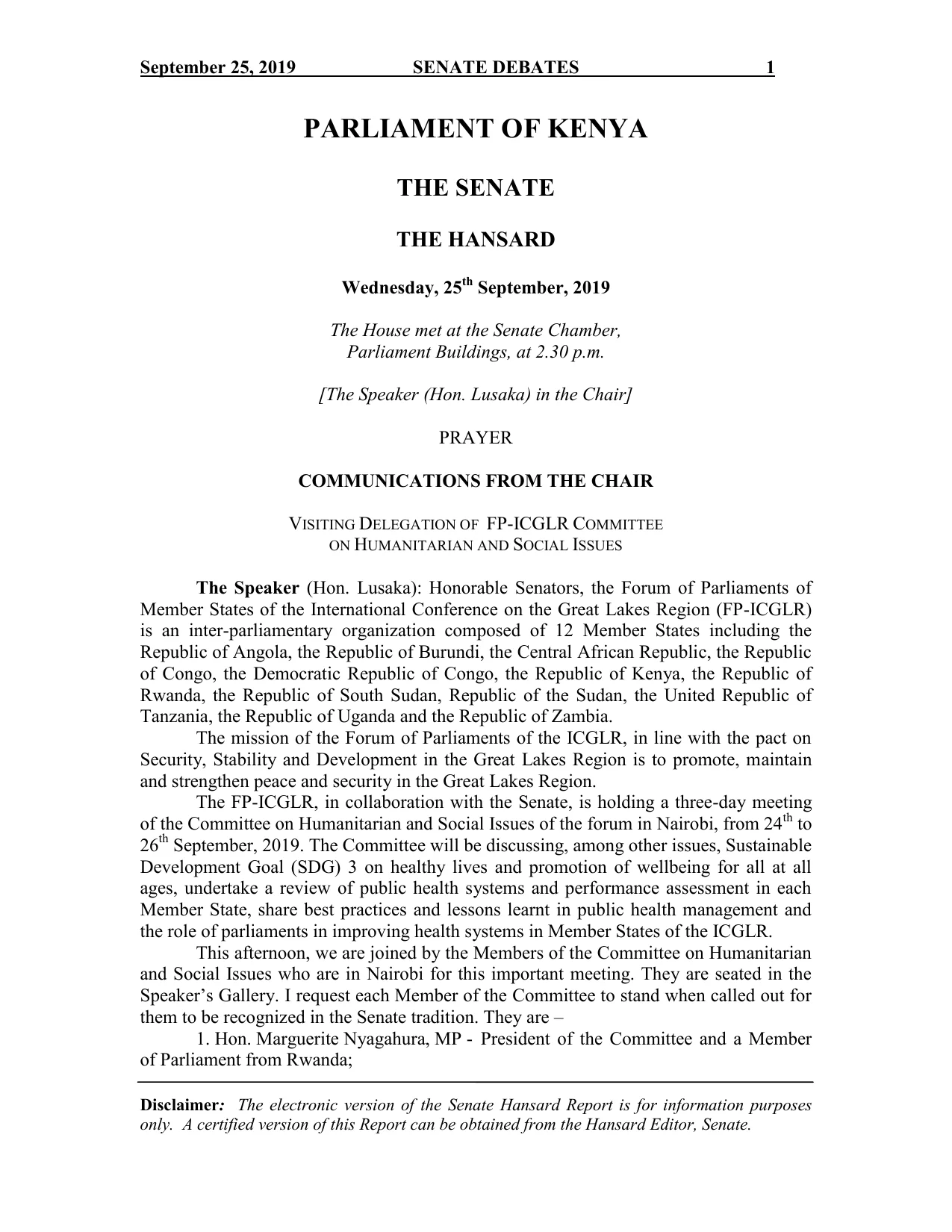
PARLIAMENT OF KENYA
Wednesday, 25th September, 2019
COMMUNICATIONS FROM THE CHAIR
VISITING DELEGATION OF FP-ICGLR COMMITTEE ON HUMANITARIAN AND SOCIAL ISSUES
Honorable Senators, the Forum of Parliaments of Member States of the International Conference on the Great Lakes Region (FP-ICGLR) is an inter-parliamentary organization composed of 12 Member States including the Republic of Angola, the Republic of Burundi, the Central African Republic, the Republic of Congo, the Democratic Republic of Congo, the Republic of Kenya, the Republic of Rwanda, the Republic of South Sudan, Republic of the Sudan, the United Republic of Tanzania, the Republic of Uganda and the Republic of Zambia.
The mission of the Forum of Parliaments of the ICGLR, in line with the pact on Security, Stability and Development in the Great Lakes Region is to promote, maintain and strengthen peace and security in the Great Lakes Region.
The FP-ICGLR, in collaboration with the Senate, is holding a three-day meeting of the Committee on Humanitarian and Social Issues of the forum in Nairobi, from 24th to 26th September, 2019. The Committee will be discussing, among other issues, Sustainable Development Goal (SDG) 3 on healthy lives and promotion of wellbeing for all at all ages, undertake a review of public health systems and performance assessment in each Member State, share best practices and lessons learnt in public health management and the role of parliaments in improving health systems in Member States of the ICGLR.
This afternoon, we are joined by the Members of the Committee on Humanitarian and Social Issues who are in Nairobi for this important meeting. They are seated in the Speaker’s Gallery. I request each Member of the Committee to stand when called out for them to be recognized in the Senate tradition. They are –
VISITING DELEGATION FROM MIGORI COUNTY ASSEMBLY
Honorable Senators, I also wish to acknowledge the presence, in the Speaker’s Gallery this afternoon, of a delegation of Members and officers from the Migori County Assembly.
Just hold on. I was allowing the Members to come in.
The delegation is in the Senate to undertake a benchmarking visit on the operations of committees and specifically with the Sessional Committee on Delegated Legislation. I request each Member of the delegation to stand for them to be acknowledged in the Senate Tradition.
They are:-
Thank you, Mr. Speaker, Sir. Allow me to join you in welcoming the distinguished colleagues from ICGLR. The ICGLR has been a very critical player in conflict resolution in the Great Lakes Region. Yours truly here was deeply involved in the setting up of the Secretariat of the ICGLR and in inviting Tanzania then to nominate the first Secretary-General, Ambassador Mulamula.
When there was a terrible flare up in the Congo in 2011 and 2012, it was the ICGLR that brought retired President Obasanjo and President Mkapa; I joined them in trying to bring normalcy and peace in the Congo. Therefore, when I see ICGLR here, I feel very gratified that they are still living to the billing that they were set up for in social justice, peace and security, democratization and many other issues that bring peace and stability to a region that has had more than its fair share of upheavals in the recent times.
Mr. Speaker Sir, I join you in inviting and welcoming our guests in the Gallery and encourage them to be active and proactive in trying to do what they were set up to do. Over 10 years down the line, the Congo is still very restless. Parts of Burundi are still restless. Kabinda is not resolved yet as well as other hot points. I encourage them to fraternize with experienced colleagues here who can help in furthering what they are doing.
Equally important is to welcome the Migori colleagues, in particular my party MCA, Mr Rioba, who I saw in the Gallery and to remind the House that the lion party is everywhere in this country.
Thank you, Mr. Speaker, Sir. Let me join you in welcoming the two parties in the Speaker’s Gallery. I happen to be the Chair of the Committee on Delegated Legislation, and I spent time with my colleagues from Migori County this morning. I would like them to feel welcome and feel at home. We believe in the passage that says “as iron sharpens iron, so man sharpens another.” Thus, we have shaped each
other and continue to do that; there is a long way to go. I hope that they can make use of the opportunities within the Senate to grow their work in Migori.
I sit in the Executive Committee of the Forum of Parliaments of the ICGLR and those who you have introduced are my colleagues. They belong to a bureau, and I want to congratulate them. I have had an occasion to be with them in one of the meetings and Kenya is a great pillar in that organization as it has been said by my senior colleague there, Sen. Wetangula.
I feel like the Speaker knows ICGLR better and we want to wish them well in their deliberations in the country.
Thank you, Mr. Speaker, Sir.
Thank you, Mr. Speaker, Sir, for giving me an opportunity to welcome our colleagues from the ICGLR and also my constituents; honourable MCAs from Migori County to this august House.
The presence of our international equals is a testimony that the culture of democracy is being deepened in Africa. Scholars who have written about liberal democracy indicate that if you want to know that democracy is with us; see what your neighbours are doing. Therefore, their visit is a testimony that in the continent, we are democratizing, practising and are doing well.
To my colleagues from Migori County, welcome to the Senate. The Senate is a lovely place. I am happy to report to the Senate that Migori is a very diverse county. It is diverse in culture, gender and in many aspects. That is attested to by the galaxy of representation we have. This is a good place to learn and I hope that they will be able to visit us more frequently so that they learn from us and we also learn from them because it is not possible to purport to legislate on their behalf without interacting with them. It is also not possible for them to legislate on behalf of our people without interacting with us. Therefore, they are welcome to this institution and hopefully they will make the best out of it and we will also make the best out of their presence.
Thank you, Mr. Speaker, Sir.
Thank you, Mr. Speaker Sir, for giving me this opportunity to add my voice to welcome our distinguished guests from the Forum of Parliaments, ICGLR.
As Sen. Poghisio has said, these are also my colleagues because I sit in the Committee for Women, Children and Vulnerable Persons. Through your good office, I was given the opportunity to sit through the Human and Social Issues Committee where we engaged very deeply.
Fellow Senators, I can tell you that we had very deep engagements in the last two days that we have sat through. With the Sustainable Development Goal (SDG) 03 which is on health, we had a site visit at the Kenyatta National Hospital, and I can tell you that they did not disappoint us. We were very impressed with what the hospital has done in terms of development and capacity building by reaching out to the other level of hospitals, Level 3 and 4. They are really working hard to build capacity for them.
I want to welcome our distinguished Members of Parliament from the region. I also want to mention to you that I got an opportunity to make a presentation on mental health and what the Senate did and discussed and the improvements we made on The Mental Health (Amendment) Bill (Senate Bills No.32 of 2018) . I can tell you one of the
resolutions that we made was to take mental health regional because it is an issue of concern to Africa.
Members, you are most welcome to Kenya and to the Senate of Kenya. To the Members of the Migori County Assembly, welcome to the Senate. This is the place where we make laws just like you do. We hope that you will have a good experience. Lawmaking is also very critical from where you sit. We, therefore, hope that you can demonstrate leadership from the front when you go back to the county. You are most welcome.
Thank you, Mr. Speaker, Sir.
Thank you, Mr. Speaker Sir. I rise to support and add my voice to join you in welcoming the MCAs from Migori County Assembly and reaffirm that devolution hinges on them. Therefore, I want to encourage them to continue to ensure that devolution continues to strengthen and to serve our people. I welcome them and say that the Senate and the local assembly is one and the same thing. Therefore, we rely on them for primary oversight and look forward to working with them closely.
Going to the FP-ICGLR, one of the reasons why I asked to say something is because some of the Members are my personal friends. Our Senator from Rwanda is also a Member of the Commonwealth Parliamentary Association, and I have met and worked with her very closely.
Looking at the people who are sitting at the Speaker’s Gallery today, I am very happy that the Forum of Parliament has such great people who are going to take Africa and the African agenda to the next level; not just through the ICGLR, but also in other fora. Therefore, I welcome them to Nairobi, and Kenya. It is home for them as well. There is nowhere in Africa that is really where other Africans are foreigners. This is not South Africa. You are here and you belong here. Welcome home.
Thank you, Mr. Speaker, Sir.
Hon. Senators, I have another Communication to make.
PROCESSING OF THE MEDIATED VERSION OF THE DIVISION OF REVENUE (NO. 2) BILL (NATIONAL ASSEMBLY BILLS NO. 59 OF 2019)
Hon. Senators, as you may recall, at a sitting of the Senate held on 17th September, 2019, I reported to the Senate a Message from the National Assembly on the decision of the National Assembly on the Mediated Version of the Division of Revenue (No.2) Bill (National Assembly Bills No. 59 of 2019) . After reading the Message, a number of Senators rose on points of order seeking clarification on the process leading to the assent of the said Bill. The Senators included Sen. James Orengo, Sen. (Eng.) Mohamed Mahamud, Sen. Moses Kajwang’, Sen. Moses Wetangula, Sen. (Eng.) Hargura Godana, Sen. Cleophas Malalah, Sen. Farhiya Haji, Sen. Mutula Kilonzo Jnr., Sen. Ledama Olekina, Sen. Reubenson Kibiru, Sen. Aaron Cheruiyot, Sen. (Prof.) Samson Ongeri, Sen. George Khaniri, Sen. (Dr.) Abdullahi Ali, Sen. Naomi Shiyonga, Sen. Isaac Mwaura, Sen. Abshiro Halake and Sen. Ochillo Ayacko.
Hon. Senators, thereafter, I gave an undertaking that I would give a comprehensive report on the activities that took place prior to the assent of the Bill. From the points of order raised, the following issues arose-
PAPERS LAID
REPORT ON THE COUNTY GOVERNMENTS CASH DISBURSEMENT SCHEDULE FOR FY 2019/2020
Mr. Speaker, Sir, I beg to lay the following Paper on the Table of the Senate today, Wednesday, 25th September, 2019:
Report of the Standing Committee on Finance and Budget of the County Governments Cash Disbursement Schedule for the Financial Year 2019/2020.
REPORTS ON THE FINANCIAL STATEMENTS OF VARIOUS COUNTY FUNDS/BOARDS
Mr. Speaker, Sir, I beg to lay the following Papers on the Table of the Senate today, Wednesday, 25th September, 2019-
Let us go to the next Order.
NOTICE OF MOTION
ADOPTION OF REPORT ON THE COUNTY GOVERNMENTS CASH DISBURSEMENT SCHEDULE FOR FY 2019/2020
Mr. Speaker, Sir, I beg to give notice of the following Motion-
THAT, pursuant to Section 17 of the Public Finance Management Act and Standing Order No.183 of the Senate, this House adopts the Report of the Standing Committee on Finance and Budget on the County Governments Cash Disbursement Schedule for the Financial Year 2019/2020, laid on the Table of the House on Wednesday, 25th September,
Let us move on to the next Order.
STATEMENTS
DEATH OF MS. ANNETTE KABARIKA DUE TO ALLEGED MEDICAL NEGLIGENCE
Thank you, Mr. Speaker, Sir, for the opportunity. I rise pursuant to the provisions of Standing Order No.47 (1) , to make a Statement on an issue of general
topical concern, namely; the death of Ms. Annette Kabarika at Vihiga County Referral Hospital on Monday, 16th September, 2019, as a result of medical negligence.
Before I proceed further, I take this opportunity to pass condolences on my own behalf, on behalf of my family and the people of Vihiga County who I represent in this House, to the family of Ms. Annette Kabarika. Ms. Annette was a young lively 22 years old lady from Gimaragwa Village, Hamisi Sub-County, Vihiga County.
I have watched painfully the video of the young lady writhing in pain on the floor of a private hospital, pleading to be taken to a Government hospital where she believed she would have gotten better service. I have also watched the mother on a national television channel describing how she spent 30 agonizing hours with her daughter in Vihiga County Referral Hospital, waiting for medics to attend to her until she passed on. The treatment the lady got from the two hospitals highlight how inhuman our healthcare providers have become.
Article 43(1)(a) of the Constitution clearly stipulates that: “Every person has the right–
Mr. Speaker, Sir, I support the sentiments of the distinguished Senator for Vihiga.
Mr. Speaker, Sir, the case of Annette and her demise is an indictment to the health institutions of this country. This is one case that has been highlighted because she had a
vigilant mother, who spoke out on her plight. How many others, like Annette, are dying in those far flung areas where there is neither media nor courage to speak out?
Mr. Speaker, Sir, the sickest patients in this country, are the health institutions. People go to health institutions walking and come out in caskets. This happens simply because of mismanagement at the levels of primary healthcare; corruption and inability to send enough resources to health facilities from the national Government.
Mr. Speaker, Sir, nurses and Medicare personnel all over the world, even in war situations, are protected because they are protectors of lives. In other cases where somebody goes to a health facility, like Annette, and is confined to an array of negligent discourses until they lose their lives, it is something this House must condemn.
Mr. Speaker, Sir, I can see the Vice Chairperson of the Committee on Health here. This is such a matter that the Committee on Health of this House should summon the CECM of Health of Vihiga County and all his senior officers to appear before the Committee and explain, in very clear terms, why such negligence can be meted out on Kenyans.
Mr. Speaker, Sir, Kenyans voted for the Constitution of Kenya 2010 to bring services closer through devolution. It is unfortunate that this has happened, and I urge Gov. Otichillo – who distinguished himself when he served as a Member of Parliament for two terms as a hardworking honest man – to speak to this. He should investigate this case and bring the culprits to book.
Mr. Speaker, Sir, as I conclude, I want to bring to your attention that when I say that the Committee should investigate, I could see my distinguished friend, the Vice Chairperson of the Committee gesturing with his hands like this; whatever that means.
Thank you, Mr. Speaker, Sir. First of all, let me join Sen. Khaniri to condole the family of Annette because of this very unfortunate incident. I agree with Sen. Wetangula that Annette is not just the one in Vihiga; there are many Annettes across the country because of medical negligence.
Mr. Speaker, Sir, emergency medical care is something that found its way even up to our Constitution. It is mandatory that when people are taken to any hospital – not just private, but even public hospitals – before you can discuss and think about payment, by the time you are asking how much should be paid for that patient, the patient must have been attended to. That is why there is a door written “emergency and accidents” in hospitals. It is because that is where emergencies are handled. That is why the Constitution says that health is a right that you cannot deny anyone.
You should stabilize the patient first and then we can discuss further treatment; if it requires medicine, workers or more money. This is an issue that we must get to the bottom of it.
Mr. Speaker, Sir, it is also important that we have here today, our Members of County Assemblies (MCAs) from Migori County. It is unfortunate that cases like the one for Ms. Annette are not being arrested at the local level because the county assemblies have become departments of the county executive.
As we speak at the moment, the County Assembly of Vihiga should have already done something so that when their Senator is reporting this issue to this House, it is at the secondary or appeal level where the county assembly will say; we have done everything possible.
If a county assembly cannot be bold enough to summon the County Executive Committee (CEC) Member of Health or the superintendent in charge of that hospital; or to call for suspension of those individuals, then what is the point of us saying that we have an oversight institution at the local level?
The responsibility per se lies with the Governor and his County Executive; he must do his job. In the failure of the Governor, his CECs, staff and medical providers to do their job; such issues must be arrested at the local level. Before the Senate Committee on Health goes to Vihiga, we want to see that the health committee of the County Assembly of Vihiga is reported from the local level that they are providing local solutions. Otherwise what is the point of saying that we have oversight at the local level?
Secondly, if it is true that CECs are disrespectful to county assemblies or perhaps county assemblies are unable to do their job, Sen. Khaniri should bring another request to your office for capacity building for oversight purposes at that local level. This thing should be sorted out. I am happy that Governor Sonko is trying to sort the issue that we will discuss later.
Counties must operate like governments. I see a lot of blame being shifted back to the national level on issues that are purely devolved. Things like agriculture and health, instead of these functions being handled at the local level, already the blame is being put on the national level.
Citizens are losing faith in their local governments because the Constitutions says that the local governments are devolved but solutions are not being provided. I believe that that should be done and Sen. Khaniri should be on this issue until someone is arrested and found culpable. This House should also look into the issue of enforcement of emergency health care in all the counties across the country.
Perhaps it is time, like Sen. Mutula Kilonzo Jnr said yesterday, that members of the public took up class action against these kinds of hospitals whether they are private or public. We hope that our courts will be bold enough to take action.
Thank you, Mr. Speaker, Sir.
The rest, please, try to keep it short. Proceed, Sen. Orengo, Leader of Minority. The Senate Leader of Minority (Sen. Orengo) : Thank you, Mr. Speaker, Sir. I also join Sen. Khaniri, the distinguished Senator for Vihiga, in condoling with the family.
Article 26 of the Constitution protects the right to life and it also states that no one should be deprived of his or her life intentionally. Those are the words of the Constitution.
In a case where somebody goes to a medical institution hoping to get healthcare and attention and loses his life because he was not given proper medical attention; that in effect is denying him the right to life. The medical profession is a noble profession because it is their duty to preserve life. There is a growing practice in many private medical institutions that they admit patients but after doing so, if money is not paid at any point where treatment is being delivered, they stop giving that person treatment. Instead of releasing the patient to go to another medical institution, the patient is held in the hospital on account of medical bills that have not been paid.
We should have something firmly in the law, and I invite Sen. Khaniri to look at this, in terms of the articles of the Constitution which have been cited. We should have a provision in the Health Act to the effect that once patients have been admitted into hospitals or medical institutions, the hospitals should carry out their primary duty which is to ensure that the patients receive treatment because it is part of their calling and demands of that profession.
Making money or profit is an additional objective which is outside their primary objective of protecting the life and health of individuals. Therefore, this incident which has happened in Vihiga, calls for attention and putting laws in place that would ensure that medical institutions particularly the private medical institutions, do not make the pursuit of profit as the major objective of the medical profession.
Mr. Speaker, Sir, medical institutions now have become like some of the churches whereby the objective of starting a church is no longer to try to take people to heaven; rather the objective is to make money on earth. Sometimes I think I went to the wrong profession. I should have started a church and today I would probably be called a Cardinal or a Pope; I would be living in a very palatial home. All that I would need to do is to pray for Sen. Murkomen or perform a miracle that when he plays football, he shall not experience any injuries or harm.
In equal measure, once somebody decides to run a private medical institution, he should be obligated to, first and foremost, look into the welfare of those who are admitted into those medical institutions. That also applies to public hospitals particularly the county ones now that we have many county hospitals of various levels and dispensaries. I think the Committee on Health should now begin to be more intensive in carrying out oversight over how counties are running these medical institutions, hospitals and dispensaries alike.
As Sen. Khaniri has pointed out, Vihiga has to show us where those hundreds of million shillings are going in terms of taking care of citizens who live in that county. Therefore, I commiserate with Sen. Khaniri and hope that the Committee on Health will take up this matter promptly and come back with the answers to the Senate.
Thank you, Mr. Speaker, Sir.
Article 26 of the Constitution protects the right to life and it also states that no one should be deprived of his or her life intentionally. Those are the words of the Constitution.
In a case where somebody goes to a medical institution hoping to get healthcare and attention and loses his life because he was not given proper medical attention; that in effect is denying him the right to life. The medical profession is a noble profession because it is their duty to preserve life. There is a growing practice in many private medical institutions that they admit patients but after doing so, if money is not paid at any point where treatment is being delivered, they stop giving that person treatment. Instead of releasing the patient to go to another medical institution, the patient is held in the hospital on account of medical bills that have not been paid.
We should have something firmly in the law, and I invite Sen. Khaniri to look at this, in terms of the articles of the Constitution which have been cited. We should have a provision in the Health Act to the effect that once patients have been admitted into hospitals or medical institutions, the hospitals should carry out their primary duty which is to ensure that the patients receive treatment because it is part of their calling and demands of that profession.
Making money or profit is an additional objective which is outside their primary objective of protecting the life and health of individuals. Therefore, this incident which has happened in Vihiga, calls for attention and putting laws in place that would ensure that medical institutions particularly the private medical institutions, do not make the pursuit of profit as the major objective of the medical profession.
Mr. Speaker, Sir, medical institutions now have become like some of the churches whereby the objective of starting a church is no longer to try to take people to heaven; rather the objective is to make money on earth. Sometimes I think I went to the wrong profession. I should have started a church and today I would probably be called a Cardinal or a Pope; I would be living in a very palatial home. All that I would need to do is to pray for Sen. Murkomen or perform a miracle that when he plays football, he shall not experience any injuries or harm.
In equal measure, once somebody decides to run a private medical institution, he should be obligated to, first and foremost, look into the welfare of those who are admitted into those medical institutions. That also applies to public hospitals particularly the county ones now that we have many county hospitals of various levels and dispensaries. I think the Committee on Health should now begin to be more intensive in carrying out oversight over how counties are running these medical institutions, hospitals and dispensaries alike.
As Sen. Khaniri has pointed out, Vihiga has to show us where those hundreds of million shillings are going in terms of taking care of citizens who live in that county. Therefore, I commiserate with Sen. Khaniri and hope that the Committee on Health will take up this matter promptly and come back with the answers to the Senate.
Thank you, Mr. Speaker, Sir.
a Motion which was brought to this House by one of the Members where we agreed that the role of setting standards should be taken back to the national Government because the standards have dropped down at the county level.
The Committee on Health should summon the County Government of Vihiga to make sure they interrogate and find out what happened to this young girl.
Secondly, the situation at our county levels is pathetic. Over the weekend, I was going round the hospitals in the county and I came across an appalling situation at a place called Ol Denyuro. This is where mothers who are about to deliver and are experiencing labour pains are put on a motorbike and taken to the hospital. This is a county hospital that is receiving support for the Universal Health Care (UHC) programme. This is really terrible, and I hope the Committee on Health Committee will do something about it. The hospitals are so dirty! The standards are not conformed to and nobody cares what is happening in most of those hospitals.
I hope at some stage, we should be able to look for that particular Motion and see how we can refer back the function of standards to the national Government. Unless we do that, then we cannot save the lives of our people. The reason for devolution is to take services closer to the people but unfortunately, Kenyans are not getting that service at that level.
I hope the Senate Committee on Health will get to the bottom of this matter and ensure that justice is done to the family that has lost its dear one as a result of negligence in Vihiga.
I thank you.
a Motion which was brought to this House by one of the Members where we agreed that the role of setting standards should be taken back to the national Government because the standards have dropped down at the county level.
The Committee on Health should summon the County Government of Vihiga to make sure they interrogate and find out what happened to this young girl.
Secondly, the situation at our county levels is pathetic. Over the weekend, I was going round the hospitals in the county and I came across an appalling situation at a place called Ol Denyuro. This is where mothers who are about to deliver and are experiencing labour pains are put on a motorbike and taken to the hospital. This is a county hospital that is receiving support for the Universal Health Care (UHC) programme. This is really terrible, and I hope the Committee on Health Committee will do something about it. The hospitals are so dirty! The standards are not conformed to and nobody cares what is happening in most of those hospitals.
I hope at some stage, we should be able to look for that particular Motion and see how we can refer back the function of standards to the national Government. Unless we do that, then we cannot save the lives of our people. The reason for devolution is to take services closer to the people but unfortunately, Kenyans are not getting that service at that level.
I hope the Senate Committee on Health will get to the bottom of this matter and ensure that justice is done to the family that has lost its dear one as a result of negligence in Vihiga.
I thank you.
I can see there is a lot of interest and we have a quite a heavy programme. I seek for your indulgence that we go to the next Statement which is also of equal interest.
Proceed, Sen. Omanga.
On a point of order, Mr. Speaker, Sir.
What is your point of order, Sen. Khaniri?
On a point of order, Mr. Speaker, Sir.
On a point of order, Mr. Speaker, Sir.
What is your point of order, Sen. Mutula Kilonzo Jnr.?
circumstances leading to this death might lead to an inquiry. Sen. Khaniri is best advised to ensure that a good postmortem is done before the burial.
Thank you, Mr. Speaker, Sir. Pursuant to Standing Order 48 (1) , I rise to seek a Statement from the Senate Committee on Education, regarding the fatalities caused by---
Mr. Speaker, Sir, there is disruption from the Senate Majority Leader. I am not able to---
FATALITIES CAUSED BY COLLAPSE OF CLASSROOM AT PRECIOUS TOP TALENT SCHOOL, NAIROBI CITY COUNTY
Thank you, Mr. Speaker, Sir. Pursuant to Standing Order 48 (1) , I rise to seek a Statement from the Senate Committee on Education, regarding the fatalities caused by---
Mr. Speaker, Sir, there is disruption from the Senate Majority Leader. I am not able to---
Senate Majority Leader, Sen. Omanga wants total attention.
Thank you, Mr. Speaker, Sir. Pursuant to Standing Order 48 (1) , I rise to seek a Statement from the Senate Committee on Education regarding the fatalities caused by the collapse of a classroom at Precious Top Talent School in Dagorretti South, Nairobi City County, which led to the death of seven pupils and over 60 injuries.
In the Statement, the Committee should-
Secondly, I join her in sending condolences to the families that have lost their young ‘angels’. It was a very unfortunate situation. As we mourn those who have passed away, we ask ourselves: How many other classrooms are in a situation where we could lose more children tomorrow, next month or in the near future?
Before this incident took place, there was something in the press about a school in Ol Kalou where there were cracks all over and parents were already expressing concern.
I am a Member of the Committee that will be looking at this matter. I assure the Senator that we will investigate it seriously because losing children out of carelessness is worse than out of sickness. We must look at deterrent measures to stop these kinds of developments taking place in our schools. As we saw in the media, that building did not have a firm foundation. We listened to the engineers who visited the site and everything was sounding pathetic.
Mr. Speaker, Sir, we ask ourselves: At what time are inspections done in our schools? We have heard that there is a Bill that is coming to this House from the National Assembly - the Build Environment Bill. However, build environment is less than what we are looking for. We are looking for regular inspection of classrooms from the building stage to completion. We hope as we look for answers for what the Senator has asked, we will be able to unearth whether the building was approved. Had engineers inspected it, or it was built without their input?
There are many questions that need to be answered not just for this case, but for other schools, including the one in Ol Kalou because it is in deplorable condition. Some of us know of a number of classrooms in our own counties which have already developed cracks.
Mr. Speaker, Sir, I support this Statement. Once more, I join Sen. Omanga in sending my deepest condolences and those from the people of Uasin Gishu to the parents who lost their children in this tragedy.
Hon. Senators, those I will give an opportunity, please, take two minutes.
Thank you, Mr. Speaker, Sir, for giving me the opportunity. I thank Sen. Omanga for bringing this Statement to the House.
Mr. Speaker, Sir, this is another sad story. From the outset, I take this opportunity, on my own behalf and on behalf of the people of Vihiga County, to send my condolences to the families that were affected by that terrible tragedy. Here is a case
Hon. Senators, those I will give an opportunity, please, take two minutes.
Mr. Speaker, Sir, I too send my condolences to the families and friends who lost their beloved ones. This is totally unacceptable. It is exactly as what happened in Vihiga, which I also say pole to Sen. Khaniri and his people. It is despicable and unacceptable that this could happen in this day and age.
One would ask themselves what happened to the Hippocratic Oath when a person who is suffering goes to hospital and they are denied treatment. That is diabolical.
I am happy that this Statement will be directed to a committee that will bring a report. Those culpable should face the full force of the law.
I am also unhappy about what happened in some school in Nairobi. It is important that we take an audit of all schools to make sure that something like that does not occur again. I hope that the committee in charge of this will take the job extremely seriously, as they usually do, to get to the bottom of the matter.
I thank you.
Mr. Speaker, Sir, this is another sad story. From the outset, I take this opportunity, on my own behalf and on behalf of the people of Vihiga County, to send my condolences to the families that were affected by that terrible tragedy. Here is a case
Mr. Speaker, Sir, allow me to join my fellow Senators in condoling with the affected families for the loss that we have suffered as a nation and they have suffered individually as Kenyans. The accident is a wakeup call to us that our early warning system is failing. It is an indication that we do not have disaster mitigation and management programmes.
Thank you, Mr. Speaker, Sir, for giving me this opportunity to add my voice to this important Statement. As I condole with the families, I congratulate Sen. Omanga for bringing this Statement to the House. I also send my condolences to the affected family in Vihiga County. I wanted to say something on that but I did not manage. Our condolences and prayers are with them. It is our prayer that no Kenyan will lose life in a careless way.
When that incident happened, many of us were touched, especially those who have school going children or grandchildren. It is unfortunate that we lost seven children. It must be devastating to the parents. They woke up very early in the morning, prepared their children and sent them to school. Unfortunately, by mid-morning, those children were no more. It is hard for parents, the school management and even the other children to cope with what happened.
The Ministry of Education needs to take inspection of every school seriously. This House has debated on matters that concern the Ministry of Education and education of our children several times. Sometimes when I see how things are done, I feel that the Ministry of Education does not pay enough attention. The Ministry should inspect and do a proper audit of all the schools, so that we know whether we have conducive facilities for children.
It is unfortunate that Kenyans have become money lovers. It is the greed that is pushing us---
You should manage your time. I gave you two minutes because of the interest on this matter.
Let us have Sen. Ochillo-Ayacko.
Mr. Speaker, Sir, allow me to join my fellow Senators in condoling with the affected families for the loss that we have suffered as a nation and they have suffered individually as Kenyans. The accident is a wakeup call to us that our early warning system is failing. It is an indication that we do not have disaster mitigation and management programmes.
As we look for a solution, we must find out what happened to the Inspection Department of the Ministry of Education. The disaster is an indication that all over the counties, constituencies and wards, we should expect that kind of failure if we do not activate our early warning systems. The responsible inspection unit should also be held to account for not being vigilant and watchful and allowing that kind of potential danger to continue unabated.
I thank you.
Mr. Speaker, Sir, I would like to join my colleagues in condoling with the families who lost their children in the unfortunate incident. Public institutions like schools, even if they are privately run, must be inspected by the relevant Government Department in the Ministry of Education. I believe that is a school where pupils have been sitting for the Kenya Primary School Examination (KCPE) .
When they approved the school for pupils to sit for examination there, they must have also checked the kind of infrastructure and the condition under which the children learn. Even if the Ministry of Education does not have engineers, the Ministry of Transport and Infrastructure Development has engineers who are supposed to do that. As an engineer, I am surprised how we can have such a structure in Nairobi.
If it is iron-sheet timber structure, it cannot be a storey building. The right thing would have been to change it to a proper reinforced concrete structure. From the way the school is structured, if upper classes were there, then the examination was going to be done in the school. It means officers of the Ministry of Education did not take their work seriously. Today, the Cabinet Secretary (CS) went round and closed down a school with that kind of structure in Kibera. That means that there are many of them around.
I urge the Committee to take up the matter with the Ministry of Education seriously to make sure that all school structures are audited. They should do what they are supposed to do.
Mr. Speaker, Sir, as a former Minister for Education, this is a pathetic situation. There was a time when we had chief inspectors of schools who not only inspected the curriculum but also the teachers and the quality of buildings around including toilets. Using a chicken wire mesh to compound a storey building is like condemning our children to massacre and death.
It was extremely painful to watch parents in agony and pain of losing such young and tender-aged children who had gone there in pursuit of knowledge. They did not go there to seek death but knowledge. In the process, because of the carelessness, corruption and the appetite for money that has pervaded this nation, they could not care what happens as long as they have money in the pockets.
The end result is a total loss to the community, the families, and the nation of Kenya. That is depriving this nation’s children who would have been the Speaker of the Senate, President of the Republic of Kenya or prominent doctors or teachers among other professions.
Therefore, whatever measures are taken, we should go in a much more deliberate and conscious manner, being able to bring to book those who have been able to cause this damage and death in these children. At the same time, we should put in a caveat on any
Asante sana, Bw. Spika, kwa kunipa fursa hii. Nataka kujumuika na wenzangu kutuma risala zangu na za watu wa Laikipia za rambirambi kwa jamaa ambao walipoteza watoto wao pale shuleni. Hili ni jambo la kuvunja moyo sana kwa kuwa katika Wizara yetu ya Elimu, kuna kile kitengo cha ukaguzi ambacho kinapaswa kuwa kimepitia pale kukagua shule vile ilivyo. Lakini inaonekaka hakuna chochote walichokuwa wamefanya. Hii ni kwa sababu darasa lilibomoka, watoto wengine wakapata majeruhi na wengine wakapoteza maisha yao.
Bw. Spika, jambo linalovunja moyo sana ni kwamba hakuna hatua yoyote iliyo chukuliwa dhidi ya yule mwekezaji. Yeye anaonekana ni mtu mlafi na nilipomuona, alikuwa anatabasamu ni kama hakuna jambo lolote baya lililotendeka. Kwa hivyo, jambo la kwanza ambalo Serikali inapaswa kufanya ni kumchukulia mtu kama yule hatua kali ili iwe funzo kwa wawekezaji wingine wowote ambao kazi yao ni kutaka kuekeza na kutumia nguvu zao za hela ili kuwapotosha Wakenya na kuwaweka katika hali hatari ya maisha yao.
Thank you, Mr. Speaker, Sir. I wish to add my voice to that of my colleagues in condoling the families of these young children.
Mr. Speaker, Sir, as we speak, there is something that continues to trouble me; the fact that the proprietor of this institution continues to walk free on the streets of this city despite the obvious fact that the kind of structures that the children were learning in were not fit for such habitation. You do not need to be an engineer or a specialist to see that they were poorly constructed. Therefore, by this time, he should already have been charged, at least, with the murder of those young children. He should be charged together with the people that gave him the approvals and the Ministry of Education officials who were supposed to check on the quality controls. What has happened to that particular issue?
Finally, we know that there are city inspectorate departments present in almost every part of this city. This is such that even when you are putting up a structure as small as a hanging line for clothes, they will show up immediately and ask for approvals from you. How was this gentleman able to put up this kind of structure? It would make more sense if, as a House, we stopped naming the people who allow these kinds of illegalities to take place by the departments or the institutions they work for.
Let us be told that the person in charge of the City Inspectorate Department in that particular region is a gentleman called Mr. “X”, “Y” or “Z”. Let us be told that the person in charge of quality control and education for that sub-county, and who seems to have been paid to look the other way and avoid keeping the checks and balances on that institution is Mr. “X”, “Y” or “Z”. That way, the history and records of this House will reflect the kind of people that are causing us all the troubles in this country. Otherwise, if we just continue referring to them by the institutions they work for---
Proceed, Sen. Kinyua.
[The Deputy Speaker (Sen. (Prof.) Kindiki) in the Chair]
Bw. Spika, ukiangalia, utaona kwamba hali hii imeletwa na wale wanaohusika kwa kuwa ni wafisadi. Badala ya kufanya kazi waliyopewa kwa uangalifu, wanatumia hela kuwamaliza Wakenya ambao ni hohe hahe.
Asante sana.
Thank you, Mr. Deputy Speaker, Sir, for giving me this opportunity. I wish to join my colleagues in passing my condolences to the families of the children who passed on in an unfortunate circumstance, which has now become a game of ping pong.
Mr. Deputy Speaker, Sir, you do appreciate that professionalism is lacking in most areas of our cadres in the society. Without throwing blame to the engineers, other professionals have issues. However, to pin the matter down to the issue here, the engineers and architects of Nairobi City Council who approved such drawings, should face murder charges similar to the Solai Dam issue.
Secondly, they should not be granted bail. We know that bail is a constitutional right, but the court should take cognisance of certain considerations before it issues express bails.
Mr. Deputy Speaker, Sir, you are a professor of law and you do appreciate that this is a tort of negligence and it is actionable. The irony of the law of insurance in relation to compensation of minors is that it is too small because of the notion of the law that the future of minors is not certain. That is the position of common law.
[The Deputy Speaker (Sen. (Prof.) Kindiki) in the Chair]
Thank you, Mr. Deputy Speaker, Sir. I stand to support this discussion as well. I will just say one thing; and we do not have to repeat ourselves. The problem with Kenya is greed and corruption. Such people should just be taken to Uhuru Park, as we have said several times, and be killed. This is because if we do not do it the Chinese way, corruption will never stop in this country. With this greed, we will kill all our children and ourselves as well. People just want to look for money in whichever way, by creating whatever sort of funny businesses they can. How can a school with small children be allowed to be built like that? How can hospitals be allowed to operate when they kill their patients?
Mr. Deputy Speaker, Sir, this country is in a big problem, and the system has to change. The Government of the day has to do whatever is necessary to make sure that action is taken on these specific issues. Otherwise, all Kenyans are going to rot in hell.
Thank you.
Thank you, Sen. (Dr.) Kabaka. This is a matter that touches the entire country. We lost seven children and that is not a small number and it would not have been small even if we lost one child because one child is big enough a number. For that reason, I direct the Committee on Education to be seized of this matter.
I will not give the Committee the traditional two weeks but I will give them one week. They should look for the people who are involved in all aspects including those involved in physical planning, and those who give approvals in the county government. They should give a report to this House within seven days.
For the sake of the public and the seriousness that this matter deserves, the comments made by the distinguished Senator for Machakos, which includes, looking for possible liability including criminal negligence, should be addressed by the Committee on Education as well. The Committee can seek for support from the Committee on Legal Affairs and Human Rights or the Directorate of Legal Services. We cannot lose children like that and keep quiet about it.
As it happened in the Solai matter, I am of the view that the rule in Rylands and Fletcher applies squarely and completely. If someone holds something and that thing hurts something that is living or non-living that is within their control, they have to be liable in terms of civil liability of tort and criminal liability.
Members, we will have one last Statement from Sen. (Dr.) Ali, but I first of all want to recognise and appreciate our visitors.
Now that you are talking about common law, I will give you an additional one minute.
Mr. Deputy Speaker, Sir, while computing claims of this nature for the deceased person, the so called multiplier and accelerator effect is very insignificant. We should change the law in relation to that without necessarily following the common law position. This Senate has powers to do that.
Thank you, Sen. (Dr.) Kabaka. This is a matter that touches the entire country. We lost seven children and that is not a small number and it would not have been small even if we lost one child because one child is big enough a number. For that reason, I direct the Committee on Education to be seized of this matter.
I will not give the Committee the traditional two weeks but I will give them one week. They should look for the people who are involved in all aspects including those involved in physical planning, and those who give approvals in the county government. They should give a report to this House within seven days.
For the sake of the public and the seriousness that this matter deserves, the comments made by the distinguished Senator for Machakos, which includes, looking for possible liability including criminal negligence, should be addressed by the Committee on Education as well. The Committee can seek for support from the Committee on Legal Affairs and Human Rights or the Directorate of Legal Services. We cannot lose children like that and keep quiet about it.
As it happened in the Solai matter, I am of the view that the rule in Rylands and Fletcher applies squarely and completely. If someone holds something and that thing hurts something that is living or non-living that is within their control, they have to be liable in terms of civil liability of tort and criminal liability.
Members, we will have one last Statement from Sen. (Dr.) Ali, but I first of all want to recognise and appreciate our visitors.
COMMUNICATION FROM THE CHAIR
VISITING DELEGATION FROM ST. TERESA ITHANGA SECONDARY SCHOOL, MURANG’A COUNTY
I would like to welcome the visiting students and teachers from St. Teresa Ithanga Secondary School, Murang’a County.
They are welcome to Parliament of the Republic of Kenya, especially the Senate of the Republic of Kenya.
Lastly, we will have Sen. (Dr.) Ali and I will not allow any observations on the Statement because we have a critical agenda ahead of us. Kindly, bear with me because you have given me the privilege of managing time on behalf of all of us.
Could we hear from Sen. (Dr.) Ali?
RECRUITMENT OF SENIOR PERSONNEL AT THE GEOTHERMAL DEVELOPMENT COMPANY
Mr. Deputy Speaker, Sir, if that is the case, can it be done tomorrow?
Thank you, Sen. (Dr.) Ali for being gracious.
I will allow the Senator for Taita Taveta to request for a Statement and that will be the last item under that particular Order.
LAND ADJUDICATION AND ALLOCATION IN MABOMANI AREA AND UPPER SOFIA IN VOI SUB-COUNTY, TAITA TAVETA COUNTY
Thank you, Sen. Mwangi. Next Order.
Thank you, distinguished Senator for Taita Taveta. The Chairperson of the Committee on Land, Environment and Natural Resources is here.
Sen. Mwangi, the distinguished Senator for Nyandarua, the issues raised in that request are weighty and they relate to the rights of citizens to property and compensation. Can you liaise with the Senator for Taita Taveta to address that issue?
Next Order.
Thank you, Sen. Mwangi. Next Order.
THE PUBLIC FINANCE MANAGEMENT (AMENDMENT) BILL (NATIONAL ASSEMBLY BILLS NO. 63 OF 2019)
Next Order.
APPROVAL OF THE COUNTY GOVERNMENTS CASH DISBURSEMENT SCHEDULE FOR FY 2019/2020
Could we hear from the Chairperson of the Committee on Finance and Budget? If he is not there, we will hear from Sen. Mutula Kilonzo Jnr.
Order, Members. The distinguished
Thank you, Mr. Deputy Speaker, Sir, for the assistance. Before I proceed, I want to speak to the case of the children and for the benefit of the Committee on Education, the principle of the Stella Awinja case still applies in terms of liability for buildings and they will benefit with that finding.
Mr. Deputy Speaker, Sir, I urge my colleagues to get this Cash Disbursement Schedule because we will be making reference to it so that you can check the sort of disbursement your counties are getting this financial year.
Secondly, I am happy to inform the Senate today that the National Assembly agreed with our proposal which ended up being Section 11 (1) (2) which has led to transfer of a total of Kshs55.071 billion to counties for the period July, August and September within seven days of the approval of this Cash Disbursement Schedule. This is an unusual place which we have made contrary to what is the usual practice of sending money on monthly basis.
Order Members!
Mr. Deputy Speaker, Sir, we have proposed that we get a policy framework on conditional grants within the shortest time possible. This will help this Senate in the future determine how conditional grants will be given to counties. I read a report by the World Bank and for some strange reasons they are the same people who are giving these grants which suggest that, in future, counties will have a problem because they are getting conditional grants for matters that are devolved.
Therefore, there is a possibility of claw back by grants which are not being monitored at county level or at the Senate level. The people at the National Treasury will at some point during our lives, be controlling about Kshs150 billion from conditional grants. That simply means that somebody sitting in the National Treasury behind a desk and a swivel chair will be managing our counties outside the legislative framework. It is a very dangerous precedent which we must get into as quickly as possible because we cannot be conveyor belts for passing grants and for them signing agreements which we do not know.
On the latter loan, we do not know for purposes of the people of Kenya the conditions attached to these grants. Are they loans? Are we going to pay? What is it that we are going to do with them? It is important that, that framework is available as soon as possible. Therefore, without belabouring the point, we want to reiterate our position as the Senate and we must say it clearly on behalf of the Chair that we are doing this very reluctantly. However, for purposes of creating a good framework we want that the Public Finance Management Bill that has been read for the first time today to be the panacea for resolving any impasse that is going to result out of the Division of Revenue Bill.
There is no guarantee that we are going agree. We want a framework so that the mediators that we will send to the mediation committee in the next financial year or any other financial year are not negotiating with guns on the table and listening to insults from a person in the name of Hon. Duale and others who think that they are dishing money to us. That cannot happen. That should not happen.
Lastly, to suggest that counties should receive 15 per cent of recently audited accounts is an insult to the intelligence of Kenyans and to the people who drafted this Constitution. They must be told that 15 per cent is a minimum. It is not a ceiling; it is a floor. That floor cannot form the basis. That amendment that has been forwarded by the National Assembly is so dangerous that if we allow it to pass the way it is---
I would like Senators to look at the Schedule No. 2 and 3. The two schedules that are attached to this document which is available at the Table Office will show you a Schedule of conditional grants by the National Government and conditional grants from donors.
Mr. Deputy Speaker, Sir, for your benefit, the conditional grants by the national Government for purposes of that Motion that was passed here by Sen. Muriuki Karue at the time, is for the construction of the county headquarters. It has come to our attention that in this Schedule, your county is receiving only Kshs1 million while the others are receiving Kshs121 million.
We have proposed and recommended on passing of this Schedule, that the Ministry concerned - we have cited here in the Report - will give within 30 days the status of the implementation. The reason for this is that we expect that within five years, these headquarters should have been constructed so that we move to other counties that do not have headquarters. More importantly, we want to see the input of county governments in terms of the headquarters that they have created. There are many others who are queuing in line waiting for this.
Thirdly, there is nearly Kshs70 billion on conditional grants from donors. This will concern you, Senators. If you look at our report, fortunately, the Members of the Finance Committee have highlighted in each of those grants, which counties are receiving them. We are concerned that the National Treasury is getting into agreements with partners on behalf of counties for various conditional grants without tabling any document or indicating what criteria they have used for such grants.
I would be interested in knowing, for example, when you pick 11 counties that have water towers, why would you leave out the Mau Forest? That is just a case in point, since it is one of our largest water towers. Now that we are having issues in Mau, that sort of funding would help in restoring Mau Forest and many other things.
On conditional grants on health and infrastructure, there is one particular conditional grant which if you look at the Schedule KDSP/2 part J, is blank. We have just voted a block figure. That amount of Kshs4.3 billion is going to counties upon fulfilling very ambiguous conditions that we do not know. That is the reason why our County Public Accounts and Investments Committee (CPAIC) was very concerned about the report by Makueni County being an unqualified report because that is part of the condition that you must bring a clean report, that you must submit budgets in advance, et cetera.
In the circumstances, our counties passed budgets on 30th of June, without the county revenue allocation because they were in a hurry to satisfy some of those very ambiguous conditions created by the World Bank without the input and the advice of the Senate that you cannot appropriate money which you do not have.
This is for the benefit of counties that are fighting over budgets; Kitui being one of them. We have recommended here that on the passing of this Cash Disbursement Schedule, now that the County Allocation of Revenue Act (CARA) is law, counties can now proceed to have a budget and appropriations. Any other budget that was created outside this framework that is the CARA and the Cash Disbursement Schedule is to that extent unlawful, unconstitutional and null and void.
Mr. Deputy Speaker, Sir, we have proposed that we get a policy framework on conditional grants within the shortest time possible. This will help this Senate in the future determine how conditional grants will be given to counties. I read a report by the World Bank and for some strange reasons they are the same people who are giving these grants which suggest that, in future, counties will have a problem because they are getting conditional grants for matters that are devolved.
Therefore, there is a possibility of claw back by grants which are not being monitored at county level or at the Senate level. The people at the National Treasury will at some point during our lives, be controlling about Kshs150 billion from conditional grants. That simply means that somebody sitting in the National Treasury behind a desk and a swivel chair will be managing our counties outside the legislative framework. It is a very dangerous precedent which we must get into as quickly as possible because we cannot be conveyor belts for passing grants and for them signing agreements which we do not know.
On the latter loan, we do not know for purposes of the people of Kenya the conditions attached to these grants. Are they loans? Are we going to pay? What is it that we are going to do with them? It is important that, that framework is available as soon as possible. Therefore, without belabouring the point, we want to reiterate our position as the Senate and we must say it clearly on behalf of the Chair that we are doing this very reluctantly. However, for purposes of creating a good framework we want that the Public Finance Management Bill that has been read for the first time today to be the panacea for resolving any impasse that is going to result out of the Division of Revenue Bill.
There is no guarantee that we are going agree. We want a framework so that the mediators that we will send to the mediation committee in the next financial year or any other financial year are not negotiating with guns on the table and listening to insults from a person in the name of Hon. Duale and others who think that they are dishing money to us. That cannot happen. That should not happen.
Lastly, to suggest that counties should receive 15 per cent of recently audited accounts is an insult to the intelligence of Kenyans and to the people who drafted this Constitution. They must be told that 15 per cent is a minimum. It is not a ceiling; it is a floor. That floor cannot form the basis. That amendment that has been forwarded by the National Assembly is so dangerous that if we allow it to pass the way it is---
Order Sen. Mutula Kilonzo Jnr. Be careful not to anticipate debate. That matter is not before us at the moment. You can say the same things without reference to debate in future.
Mr. Deputy Speaker, Sir, an amendment that suggests that counties can receive directly through the Appropriation Act, 15 per cent of the recently audited revenue or alternatively 15 per cent of the last budget is a way to kill counties. Therefore, we must resist some of these methods that are going to become some impediment to devolution.
On behalf of the Chair, I want to thank all the Senators for their resilience in Kitui, their resilience through this process, the people who have fought in the mediation team and the people who have persuaded Senators to agree to these very unenviable circumstances where we were literally coerced to take money after appropriation.
We hope this is the last time that the national Government - the Executive of Kenya – will do our work of allocation of resources from the House on the hill. It is unacceptable. If we accept that process, I am sorry to say that devolution will suffer the same fate that it suffered in 1966.
I beg to move and ask my good friend commissioner, Sen. Cheruiyot to second.
Well done Sen. Mutula Kilonzo Jnr. There is Standing Order is No.94, on anticipation of debate. However, we have heard you well and clear.
Very well. Sen. Cheruiyot.
Order! I do not know whether the Senator of Tharaka Nithi could say something, but unfortunately, he cannot. Proceed.
Disbursement Schedule, the information in the public domain is that whether or not we pass it, it does not matter because it is deducted at source. It is really unfortunate. That is an illegality being perpetuating at the National Treasury. I ask our colleagues who have been nominated to work in the ad hoc Committee on leased medical equipment to expeditiously conclude that process. This is because this is a very grave issue.
The issue that Sen. Mutula Kilonzo Jnr. raised on the conditional grants that are in Schedules 2 and 3, we are disbursing Kshs316.5 billion to our counties. Out of this amount, Kshs70 billion is almost 25 per cent which this House has no say on. If we do not have a say on conditional grants, we have already legislated ourselves out of 25 per cent of our work. We do not know what will happen next year. It might be Kshs100 billion or Kshs150. If we are not careful, we could only be allocating 20 or 30 per cent while the rest of the resources follow certain channels that are not clear to this House.
Mr. Deputy Speaker, Sir, on the list of their disbursement, they will say for this conditional grants, 21 counties are benefiting and they will list them for you. However, there is no Senator in this House who can tell you what are the exact conditions that a county has to meet to qualify for a grant. That is extremely dangerous. It was neither the intention of our Constitution nor the spirit of what this Senate stands for. This Senate must continue to pride itself as being the one House in this bi-cameral Parliament that believes in developing every part of Kenya equally.
Mr. Deputy Speaker, Sir, in the course of our deliberations today, we thought keenly about it. Once the national Government has collected revenue, it is left with the Cabinet Secretary of the National Treasury to handle it. Unfortunately, he is appointed by one of the beneficiaries of the two levels of Government. He works and reports to the national Government. Therefore, the county governments are disadvantaged. If it gets to a point where he has to use his professional digression to determine who he can fund first - he has the Ministry of Education requesting for funds and, on the other hand, county governments, I am sure he will first fund the Ministry. As they say, he who pays the piper plays the tune. We need to ask ourselves what the constitutional architecture of the two levels of government had in mind in terms of dividing resources and how it is disbursed. This House passing Kshs316.5 billion is okay, but the person who finally presses the key ‘X’ amount of money to go Siaya and ‘Y’ go to Elgeyo-Marakwet, he must be a gentleman that respects the Constitution. He must not be somebody who can be easily manipulated by either of the two levels of government.
Finally, it is on the issue of the Ministry of Transport, Infrastructure, Housing and Urban Development of submitting to the Senate reports on the status of implementation of the conditional grants on supplements for construction of county headquarters as provided for in the Third Schedule. This was a resolution of this House. After the Motion that was moved by the then Senator of Nyandarua Sen. (Eng.) Muriuki Karue, we learnt that there were counties without headquarter facilities. So, it was our intention that within four to five years, this exercise of building those headquarters should be concluded. I was teasing Sen. Mutula Kilonzo Jnr. earlier, about Tharaka Nithi County that has been allocated Kshs1 million. To me, it could be that they concluded constructing their headquarters and this Kshs1 million is only for paintworks or padlocks.
Mr. Deputy Speaker, Sir, I am properly guided. I will follow the path that has been charted by Sen. Mutula Kilonzo Jnr. The reason I raised that issue is because as the Senate, sometimes we do not do our work properly. When we do exceptional things, we leave them hanging and people do not appreciate some of the work that we do.
I look forward to a time where those five county headquarters will be complete and the Senate will have a presence in their opening. Let people know that we do not legislate just for the fun of it. We give directions and when they are properly implemented, Kenya continues to prosper.
With those many remarks, I second.
In the spirit of collective responsibility, as a Committee we will be keen to understand---
Mr. Deputy Speaker, Sir, when you say “condolences”, it is like they are dead. However, thank you because I get what you are saying. Actually, I lost some of them completely.
Mr. Deputy Speaker, Sir, I support this Motion. First of all, just to note that this House plays a very important role in both division and allocation of resources. We have a journey that is not complete yet about the sequencing of the Division of Revenue and the Appropriation Bill.
Following our remarks yesterday about the Supreme Court of the United Kingdom (UK) , I believe we do not have the power to direct our Judiciary to make the decision they have to make. However, justice delayed is justice denied. I read a comment in the social media by some of my law students and I think it was a brilliant idea. They stated that if it was the Judiciary of Kenya that was told to discuss about the question of prorogation of Parliament, they would have possibly said that the prorogation was wrong but since it had been done, it could not be reversed.
That has happened before. This is exactly the situation that we faced in the Division of Revenue Bill. We ended up waiting for over two months before making a decision to proceed because in any case, we may not get the decision to invalidate the Appropriation Bill. However, a bolder Judiciary like the Supreme Court of the UK should even be courageous to go ahead and invalidate any law that was passed against the Constitution.
We are facing a situation where after making a pragmatic decision in so far as passing the Division of Revenue Bill is concerned, we ended up also passing the County Allocation of Revenue Bill. The Office of the Speaker issued a Communication earlier in so far as the mediated version of the Division of Revenue Bill is concerned but we could not agree on even simple questions during mediation.
We sat somewhere in an office with the Speaker, the Senate Minority Leader, Senate Minority Whip and the Chairperson of the Committee on Finance and Budget just to go through the HANSARD. It is because in a report, automatically the HANSARD should have the same. The HANSARD of the National Assembly reported different from that of the Senate. These kinds of disparity must be dealt with.
Mr. Deputy Speaker, Sir, when you say “condolences”, it is like they are dead. However, thank you because I get what you are saying. Actually, I lost some of them completely.
Mr. Deputy Speaker, Sir, I support this Motion. First of all, just to note that this House plays a very important role in both division and allocation of resources. We have a journey that is not complete yet about the sequencing of the Division of Revenue and the Appropriation Bill.
Following our remarks yesterday about the Supreme Court of the United Kingdom (UK) , I believe we do not have the power to direct our Judiciary to make the decision they have to make. However, justice delayed is justice denied. I read a comment in the social media by some of my law students and I think it was a brilliant idea. They stated that if it was the Judiciary of Kenya that was told to discuss about the question of prorogation of Parliament, they would have possibly said that the prorogation was wrong but since it had been done, it could not be reversed.
That has happened before. This is exactly the situation that we faced in the Division of Revenue Bill. We ended up waiting for over two months before making a decision to proceed because in any case, we may not get the decision to invalidate the Appropriation Bill. However, a bolder Judiciary like the Supreme Court of the UK should even be courageous to go ahead and invalidate any law that was passed against the Constitution.
We are facing a situation where after making a pragmatic decision in so far as passing the Division of Revenue Bill is concerned, we ended up also passing the County Allocation of Revenue Bill. The Office of the Speaker issued a Communication earlier in so far as the mediated version of the Division of Revenue Bill is concerned but we could not agree on even simple questions during mediation.
We sat somewhere in an office with the Speaker, the Senate Minority Leader, Senate Minority Whip and the Chairperson of the Committee on Finance and Budget just to go through the HANSARD. It is because in a report, automatically the HANSARD should have the same. The HANSARD of the National Assembly reported different from that of the Senate. These kinds of disparity must be dealt with.
Order, Senate Minority Leader!
Mr. Deputy Speaker, Sir, going forward, I strongly believe that Kenyans have now accepted that the jurisdiction of the Senate should be enhanced. That way, we will not have to comb through laws to find out whether a matter concerns counties or not, so that all laws come to the Senate.
Be that as it may, we have the Division of Revenue Bill and the County Allocation of Revenue Bill and now this disbursement schedule is the last stage before our counties can enjoy the resources. We believe that when we converge here tomorrow, we will take that opportunity to vote and pass this Bill so that our counties get money.
Mr. Deputy Speaker, Sir, my county will get over Kshs4.5 billion. It will have Kshs3.8 billion as sharable revenue. There is also the conditional grant from the national Government which is almost Kshs200 billion and about Kshs350 billion from the Kenya Devolution Support Programme (KDSP) .
I totally agree that by the next financial year, the Committee on Finance and Budget which has been doing exceptionally well--- Being one of the leaders in this House, if there will be ranking of performance of committees, it will be fair for the Committee on Finance and Budget to be ranked among the top performing committees in the House. They have consistently provided leadership.
During the previous term, they provided leadership on issues such as the disbursement schedule because it never used to be there. It is because of the leadership of the Committee that we had the disbursement schedule because we realised that there was no instrument for us to track the amount that should go to a certain county and at what point. It is the Committee that led us to deal with the division of the money between county executives and county assemblies. There are also many other provisions of the law that we have amended.
Okay.
Mr. Deputy Speaker, Sir, the national Government conditional grant is slightly less than Kshs10 billion. Why should the national Government give conditional grants to polytechnics when that is directly a county function?
I can understand the roads one, because the Roads Levy is levied separate from other taxes. Therefore, it is beneficial to our counties; that over and above the division of revenue processes, we should be able to get this money.
Therefore, it is indeed important that we first streamline conditional grants so that they become truly conditional grants. This is because county village polytechnics have already been constructed. If the conditional grants were going to deal with village polytechnics, then show us what the national Government policy that these conditional grants are following? Is it the national Government position then, that many counties are unable to build village polytechnics? Consequently, are they giving a conditional grant over a determined period of time, say five years, to increase the number of village polytechnics from one in every county to about ten? Will they, thereafter, allow those counties to run those facilities and then give them money, like any other institutions, through the county allocation of revenue as an equitable share?
Thirdly, the donor funds, which is about Kshs50 billion, that none of us here can tell what the objective criteria of sending Kshs300 million to Elgeyo Marakwet and maybe Kshs1 billion to the next county – maybe West Pokot – I have not checked the exact figures of West Pokot County. If we are not careful, because Kshs50 billion is not a small amount of money, it will happen that--- Most of these monies are negotiated through line Ministries. Some individuals will then take advantage of the connections they have in line Ministries; go and negotiate donor money for their counties, constituencies, wards or their places, and then come back to this House to rubberstamp it.
I am sorry, Mr. Deputy Speaker, Sir. I was talking about the national Government first.
Okay.
We cannot oversight that money because we do not know how it was negotiated for or from which donor, and so on.
Therefore, Mr. Deputy Speaker, Sir, why can the Committee on Finance and Budget intentionally not decide that as early as possible, even in the month of October, that you have a meeting with all donors together with the Steering Committee of the Kenya Donor Support Program. You should then have a conversation on this issue of conditional grants, so that even if it remains a conditional grant, let counties participate in the negotiation of those conditional grants so that the criteria for accessing them becomes objective. That way, we will be able to say here confidently that we are sending Kshs4.5 billion to Elgeyo Marakwet County, and we have mechanism of oversighting that money.
Mr. Deputy Speaker, Sir, what happens is that if you see most of the urban areas in our counties, donor funds from the World Bank (WB), for example, build roads. The county governments then allocate money through the roads department to the same project. It is, therefore, impossible to determine how much was enough for donor funding, and how much was for that. That is how pilferage, stealing of money and corruption takes place. Therefore, that is an area that we must tighten, as the Senate.
Lastly, Mr. Deputy Speaker, Sir, we must continue fighting this monster called corruption. Let me speak as the Leader of Majority; and it is a conversation that we have had with the Leader of Minority and the Senate Business Committee (SBC). I want to encourage our brothers and sisters in the County Public Accounts and Investment Committee (CPAIC), that the expectation of this House is so high. Even though they are active every day – and I can say this from the leadership perspective – many of the Members of this House still feel that their performance is below par.
Mr. Deputy Speaker, Sir, there are complaints that sometimes we are having cozy relationships with governors when they arrive in these committees. We are accused that we keep praising them, thanking them for being our former classmates, and telling them that we look forward to coming to have tea in their villages. There is nothing wrong with that---
I hope that there are no hugs---
Majority Leader, you have been challenged.
Mr. Deputy Speaker, Sir, if I go in that direction – and you can see the excitement of the Members – a Motion will be brought to discuss the Committee, which is why I do not want to go in that direction.
On a point of order, Mr. Deputy Speaker, Sir. I am a Member of CPAIC. Is Sen. Murkomen in order to cast aspersions at a Committee which is working very hard? If he has any evidence, has he to table it before this House.
Majority Leader, you have been challenged.
Mr. Deputy Speaker, Sir, if I go in that direction – and you can see the excitement of the Members – a Motion will be brought to discuss the Committee, which is why I do not want to go in that direction.
Sen. Mutula Kilonzo Jr. can you make way for Sen. Moi to take that seat? Consult in a dignified manner.
Proceed.
Thank you, Mr. Deputy Speaker, Sir. The point I am making is that we have been admonishing the Committee on Health for below par performance, and they have taken this challenge over and over again. I would like to challenge the CPAIC that the expectation of this House is beyond what you think you are doing very well. People are asking themselves which reports of which county have been tabled here, that indicts how many governors on grounds of corruption, which are so glaring.
Mr. Deputy Speaker, Sir, two of us cannot stand at the same time. If he can sit somewhere there---
Sen. Mutula Kilonzo Jr. can you make way for Sen. Moi to take that seat? Consult in a dignified manner.
Proceed.
Thank you, Mr. Deputy Speaker, Sir. The point I am making is that we have been admonishing the Committee on Health for below par performance, and they have taken this challenge over and over again. I would like to challenge the CPAIC that the expectation of this House is beyond what you think you are doing very well. People are asking themselves which reports of which county have been tabled here, that indicts how many governors on grounds of corruption, which are so glaring.
Order, Members! Proceed, Leader of the Majority.
One Senator came to me, in my capacity as Majority Leader. She had attended one of these Committee meetings because she was a Member of the Delegation of a County. When she reached there, the elected Senator of that County started by saying, “For the avoidance of doubt, I support my Governor 110 per cent.” That was then followed by another Senator saying, “You know, Governor, we were classmates.” There was then laughter, joy and tea. That was reported speech, thus it may not be true.
Therefore, Mr. Deputy Speaker, Sir, it is important to encourage our Committees that this House and its Members live in our counties and we know the things that are happening there. We can tell even that projects that even members here--- For example, in my county, the Auditor-General has pointed out that there is a sub-county headquarters building that has been pending. It has changed contractors and the former contractor has
been paid, the second and third contractors were paid and yet it has not started. These are things that are outright. If we ultimately come here and then the report of Elgeyo Marakwet says it is now clear--- You know that I was a Member of that Committee, courtesy of your leadership.
For the first one year when I sat in that Committee, one of the things that used to baffle me is that the Chair stands, asks the question, and then asks the Auditor-General whether that issue has been cleared. The Auditor-General then says that it has been cleared, and then we say proceed. Nobody is even challenging to ask the Auditor-General whether they have seen the building, whether it is complete; and what he means by saying it has been cleared. This is because many of the initial audited reports are correct. However, the intervening period between the auditing and the ultimate clean report is where the devil lies. More than three counties in this Republic got unqualified audited reports, including Machakos, Nyandarua and Makueni. There is no county that should get unqualified reports, even if I was a governor of a county. It is impossible!
We are actually lying to the people of Kenya that we have unqualified reports. This is because the people who are running counties are not angels. If the governor does not make a mistake, then a CEC, a Chief Officer, a mini parastatal in the county or a town municipal board will make mistakes. You cannot tell me that we have counties in this Republic of Kenya where there is cleanliness from “A” to “Z”. The only truth in that unqualified report is that these reports, in paper, are doctored and made to be clean. Do you want to tell me that, therefore, the CPAIC cannot summon those counties because the report is unqualified? I refuse to accept that!
I like the fact that the Committee is now sitting in counties. We need to go a step further and listen to the alternative reports that are coming from the citizens of this Republic. In one of the unqualified county reports, it was indicated that Kshs50 million went to an Early Childhood Development (ECD) project. When a proper research was done on that report, they found out that there was no ECD or structure on the ground.
We might be challenged to go further. I am saying this because this is a Committee that changes every year, it might change next year. I am not casting aspersions on the current membership of the Committee. Even as Senators, we must be able to sit down and ask ourselves how best we are going to work to ensure that accountability will be achieved in this country. This will ensure that we do not find ourselves in a situation where we have to depend on the DCI and the Ethics Anti- Corruption Commission (EACC) and yet this Senate is saying we are oversighting and we have absolutely no single indictment on anybody including those that have been found to have stolen directly a lot of money in the Republic of Kenya.
With those many remarks, I beg to support.
Thank you, leader of Minority. It is not easy to be complimented by a senior counsel.
The Senate Minority Leader (Sen. Orengo) : In conclusion---
Mr. Deputy Speaker, Sir, I will be very brief on this matter, particularly where the real work has been compromised and now we are just approving.
said that some of these pronouncements cannot be made now; he shall await the outcome of the matter before the court.
It must be said without fear of contradiction that the question of Clause 1 of the Division of Revenue Bill was not a matter for mediation at all. Even if the record comes out that the mediation Committee probably spoke to it and agreed to it, it was outside their jurisdiction; it was ultra vires. It is not what the Speakers of both Houses committed for mediation. I hope that whereas sometimes we have tried to pin our hopes on what is called the law of principle of necessity that it is possible to justify our conduct, it should not justify us breaking the law.
As Lord Denning once said: “If you apply the law of necessity, it can lead to absurdity.” This is because poverty may be so extreme that a man who has not gone without food for a year or two months or a day can use that principle to break into a house, go into a restaurant and eat for a free. This would actually be an act of theft. Disobedience of the law in whatever shape or form only brings anarchy and disorder. That should not be encouraged.
As we pass this Motion, I hope we will revisit. I know the Deputy Speaker has the best words to address the court. Last time I listened to you and said I should just be a cheer leader.
I can go to the market and say, “Mwezi huu Kshs10 billion imeingia. Let the governor show where it went.
This is an empowering process as simple as it looks. I saw in a particular county which I shall not name where somebody was just carrying the audit reports, the HANSARD reports and going to funerals---
Mr. Deputy Speaker, Sir---
Order, Sen. (Dr.) Kabaka!
Proceed, Leader of the Minority.
Sometimes even the rules and criteria leading one to be a senior counsel should also be examined.
I can go to the market and say, “Mwezi huu Kshs10 billion imeingia. Let the governor show where it went.
This is an empowering process as simple as it looks. I saw in a particular county which I shall not name where somebody was just carrying the audit reports, the HANSARD reports and going to funerals---
post-mortem on reports without being current. We are current. We presented before this honourable House the fiduciary reports covering all those years. When we look though the books and everything else, we have been able to cover and know what the danger points are, areas of corruption and misuse or abuse of office. Accordingly, we have been able to in the context.
Finally, on that point, it is only today that we have been able to clear at least 10 counties in today’s sitting from those years I have mentioned up to the current 2017/2018. They will be table before this House. Over the weekend, we intend to also do another 10 or 20. By the end of this coming week, we might be doing all the 47. Therefore, we will be doing 235 reports current from the year they were there up to this year. If there is any accolade it should go to CPAIC because we have been able to go through all those accounts and to update.
We were very tired of this language that the division of revenue was being based on the last audited accounts. The last audited accounts that the national Government is using to effect the division of revenue is based on Financial Year 2013/2014 books of account. When one looks at those audited accounts, they are under Kshs1 trillion. Today the national budget is Kshs3.2 trillion.
For us to be able to position ourselves to bargain on the basis, should this policy continue, we will be based on the current audited books of accounts. We thought that the Senate should take the lead so that we are able to be current. They will have no excuse, except that the National Assembly has not been able to be current. So, we should congratulate the CPAIC for reaching that level
The other point which has been touched on is the question of unqualified accounts. I think we are referring to Makueni and Nyandarua counties which were the only two unqualified books of accounts. We opened the Pandora’s Box in Makueni. They were to appear in Kitui, but did not. Mr. Deputy Speaker, Sir, today, the County Government of Machakos was served with the summons - I think their Senator is in the know - that we shall be there on Monday to interrogate the books of that County.
For anybody to stand here and say that the CPAIC has done nothing, I think is a misadventure in that story. I can only call it so. They should wait and not pre-empt the report because it will be here on the Floor of this House.
Mr. Deputy Speaker, Sir, I support this Schedule of Disbursement. One of problems we are finding in the CPAIC is that when we audit, examine and interrogate those books is the late Exchequer releases from the National Treasury to the county governments. We are now seeing that one of the mischiefs that are causing the pending bills is because the funds that ought to be disbursed before 30th of June of the ensuing financial year are now being disbursed in the following financial year. Consequently, this does not fall within the budgets that the county governments had developed that are done very well.
For your information, one of the audit reports that we went through is the report on Tharaka-Nithi County which is voluminous, and I know it will come to this House. We can take solace that we have looked at audit reports from Financial Years 2013/2014 to 2017/2018. We also looked at the audit report of Siaya County, where the Senate Minority Leader comes from.
Order, Sen. (Dr.) Kabaka!
Thank you, Senate Minority Leader for those great remarks. For those Senators who are feeling light weight, be advised accordingly.
I will now give the Floor to the distinguished Senator of Kisii County, Sen. (Prof.) Ongeri.
Thank you, Mr. Deputy Speaker, Sir, for the opportunity. There are very unfortunate remarks that have been made on this Floor of the House.
Order, Members!
I take the earliest opportunity to disabuse this kind of misunderstanding of the role and activities of CPAIC. One, it is the CPAIC that has been able to bring to book the majority of the governors who initially could not even appear before it. Secondly, the accounts for financial years 2013/2014, 2014/2015, 2015/2016, 2016/2017 and 2017/2018, respectively had not been done in the last Session of the Senate by the CPAIC. We have on the table 235 reports on the executive alone, leave alone the county assemblies again another 235 reports. If you add on the various county funds, we will be dealing with more than 500 reports emanating from the financial years 2013/2014 to 2017/2018. Mr. Deputy Speaker, Sir, we have been able to come to Financial Year 2017/2018 covering all those years behind because we strongly believe that there is no point doing a
Thank you, Sen. (Prof.) Ongeri. It is always a pleasure to listen to you. You have actually made a very good case about what your Committee is doing.
However, having listened to the Majority and Minority Leaders, the issue is not really that the Committee is not working. I understand and now communicate from the Chair. My understanding is that the House and the public have waited for too long, and the Committee is taking too much time in the kitchen.
Two, you are under the public spotlight, and lawyers will tell you that justice has to be seen to be done. Because your work is oversight and you are doing it on behalf of the House, it is actually adversarial. This is because you have an accused person, who is accused of plundering money meant for roads, hospitals and drugs. Therefore, the way you conduct yourselves as you do those hearings is very important. It should not be seen as if it is a diplomatic conference, where you have a nice time with governors and the other people whom you call to appear before your Committee.
I think it is more or less of a methodology issue than casting aspersions or thinking that perhaps any particular Member of the Committee is doing wrong. We should, therefore, take it in stride and as a source of encouragement. In fact, it shows that the Senate still has faith in you, and wants you to produce results. The public wants casualties; they want to see people who have plundered money meant for the poor citizens looking miserable, defeated and weak.
We will soon look at that of Elgeyo-Marakwet County. I wish the Senate Majority Leader was here because he is scheduled to appear before us. We will ask him whether the meeting should be here or in his own county headquarters. The ball is in his court. So, he should not lament here.
We do not want them to parade here and talk big. I heard some governors – whom I do not want to name – in the past one week lecturing the country and the Senate on why they cannot do this or the other. They have a lot of bravado. This House, through you, must instill the fear of God and the fear of the Law in these people. They must crawl before you and the public as they try to exonerate themselves.
Very well; that was communication from the Chair. I think I have been on one side too much. I now give the Floor to Sen. (Rev.) Waqo before I come back to the Minority side.
Well done, Sen. (Prof.) Ongeri. I am just congratulating you on your speech. It is no wonder that you are called ‘ambassador,’ among other titles.
Thank you, Mr. Deputy Speaker, Sir, for giving me this opportunity to give my mind on the approval of the county government Cash Disbursement Schedule for the Financial Year 2019/2020. It is good that we are discussing this very important matter at this particular time. We know that our counties have suffered for some time and are eagerly waiting for this.
Mr. Deputy Speaker, Sir, we need to remind ourselves once again that through devolution, many of our people, the citizens, have really benefitted. Yes, corruption is high on the ground; many things are going wrong; maybe a lot of money cannot be accounted for, and a few individuals who are close to the executive are really benefiting and getting richer. We have what the people at the county level call “overnight millionaires.” However, even with all that, devolution has helped our people on the ground. Even in areas that we used to say were marginalized, you can now see great buildings coming up; people developing themselves, and the towns being developed. You can see some growth taking place. That is all through devolution, which we should see how it can continue and benefit our people even more and more.
Mr. Deputy Speaker, Sir, it is unfortunate that the division of revenue was based on the 2013/2014 audited report. Many years down the line, we are still basing that on the past five, six or even more years, which is unfortunate because it will not guide us well. However, because we are in that situation now, there is nothing much we can do. Although for the future, we should avoid that.
It is my humble request to the Committee on Finance and Budget to work extra hard. Prof. Ongeri has put it clearly and said that they are determined to work almost 24 hours and make a difference. It is our prayer that this Committee will work extra hard, so that Kenyans who depend on this can have a clear mind on what is happening in their counties, and see how best we can improve the services on the ground.
Mr. Deputy Speaker, Sir, when the counties do not get their monies on time, a lot of things are affected. The work on the ground is affected and salary payment is affected. This means that the performance of staff goes down, especially when you consider the health department, which depends on people’s effort and sacrifice besides the salaries they get. When the staff do not get their salaries on time, they are demoralized. We should, therefore, work very hard, so that the counties get their shares as early as possible. This will also ensure that even the National Treasury releases the money to counties on time.
Mr. Deputy Speaker, Sir, we know very well that there are projects that have been going on for many years in many counties. Once they get this money, it is our prayer that even the stalled projects can be revived. There are people who have been given the job – the contractors – who are discouraged because they keep on paying loans. They have not been paid and there are so many things that are happening on the ground which are so discouraging. Sometimes, people even wonder why they have been identified as contractors or as people who are doing different things. Therefore, the stalled projects and other things that need proper attention need to be given this money.
Before I conclude, Mr. Deputy Speaker, Sir, I know that we have always talked about financial mismanagement at the county level. This is something that is affecting the entire nation. Corruption is as a result of financial mismanagement.
We have people who wait for their opportunity to come, so that they can fetch and pocket as much as they can, and create their own wealth while other Kenyans are dying in poverty. It is high time for us to see how best those who mismanage finances and other public resources can be punished harshly, so that others cannot think or imagine of doing that.
We have countries that cut off the hands of people who steal. Kenyans should not just talk of corruption or financial mismanagement. Instead, we should come up with tough measures that will make those who want to steal to think twice. We should make them scared of losing a certain part of their body.
I once watched a clip of a young man who raped a lady in Somalia and was taken to court. The court ruled that he be dealt with there and then. A man took a knife and that young man lost a better part of his body. We should introduce some tough measures in Kenya, so as to minimise the things happening in our country.
The Auditor General and his team should also work hard because their circulated audit reports are usually doubted by many people. We cannot talk of rumours, but it is always said that many things happen before the compilation of the audited report. It is good to have measures that will help us control every step taken after the release of the finances.
I believe that the Senate will continue being the watchdog, through the Committee on Finance and Budget. We should continue talking on behalf of the innocent people and be the voice of the voiceless. We should ensure that the resources that we have in our country are used well for the benefit of the poor man.
Thank you and I support the Motion.
Thank you Sen. (Rev.) Waqo.
Thank you, Mr. Deputy Speaker, Sir, for giving me this opportunity to support the Motion by my Committee on Finance and Budget. I know that I have a lot of time, but will be very brief to the issues.
The issue of the leased medical equipment keeps on recurring and that makes me wonder, as a Senator. I fail to understand why we cannot revise the illegal contract and make the heads roll.
The second issue is own source revenue deficit that Sen. (Prof.) Ongeri explained in detail. I am aware that my County, Machakos County, is going to receive approximately Kshs7.8 billion. During the municipal councils era, Mavoko, which has eight sub counties, used to collect Kshs3 billion per annum. The Auditor General’s Report indicates that the county ought to have been collecting about Kshs2.7 billion per annum. It is sad to know that the county is only collecting about Kshs650 million. That means that there is a loss of about Kshs2 billion.
The question is: where does this money go to? We can only speculate that the money is misappropriated and ends up benefitting individuals. There is lack of prudence and we should fill in the lacuna, as the Senate, by amending the finance laws, including the Public Finance Management Act and other Acts of Parliament. We should empower the Senate for it to audit the own source revenue. That gap must be filled.
The Senate Majority Leader, Sen. Murkomen, talked of delays in release of revenue by the National Treasury, but I also want to talk of the artificial delay occasioned
The ivory towers must come down!
Sen. (Dr.) Kabaka, you can have your sit. You have brought an important issue about the judgment that was rendered regarding the role of the Senate as well as the county assemblies on own source revenue. I hope that judgment has been appealed. Even if it has not been appealed, I think there should be ways in which, though our Committee on Justice, Legal Affairs and Human Rights, and I see Senior Counsel, Sen. Omogeni, distinguished Counsel, Sen. Mutula Kilonzo Jnr. and Counsel, Sen. (Dr.) Kabaka here---
On this issue, I would like to guide that a way be sought to open up this matter even if in a differently re-crafted suit. This is because I believe the court was in error to apply Article 96 (3) in quite a pedestrian and simplistic manner. It talks about the Senate allocating or determining the allocation of monies from the national level and oversighting the same funds.
However, generally - this is food for thought that I am giving to the Committee on Justice, Legal Affairs and Human rights and lawyers in this House - we owe our duty to the nation as an institution. This matter cannot just be left to lie like this. I believe that the general duty of the Senate to protect and defend devolution and counties and county
governments, includes defence and protection of counties from external threats, including stealing own source revenue. So, you can jump from Article 96(3) and 96(1) and make a strong case. That is food for thought.
What is it Sen. Mutula Kilonzo Jnr.?
We have people who wait for their opportunity to come, so that they can fetch and pocket as much as they can, and create their own wealth while other Kenyans are dying in poverty. It is high time for us to see how best those who mismanage finances and other public resources can be punished harshly, so that others cannot think or imagine of doing that.
We have countries that cut off the hands of people who steal. Kenyans should not just talk of corruption or financial mismanagement. Instead, we should come up with tough measures that will make those who want to steal to think twice. We should make them scared of losing a certain part of their body.
I once watched a clip of a young man who raped a lady in Somalia and was taken to court. The court ruled that he be dealt with there and then. A man took a knife and that young man lost a better part of his body. We should introduce some tough measures in Kenya, so as to minimise the things happening in our country.
The Auditor General and his team should also work hard because their circulated audit reports are usually doubted by many people. We cannot talk of rumours, but it is always said that many things happen before the compilation of the audited report. It is good to have measures that will help us control every step taken after the release of the finances.
I believe that the Senate will continue being the watchdog, through the Committee on Finance and Budget. We should continue talking on behalf of the innocent people and be the voice of the voiceless. We should ensure that the resources that we have in our country are used well for the benefit of the poor man.
Thank you and I support the Motion.
Thank you Sen. (Rev.) Waqo.
Thank you, Mr. Deputy Speaker, Sir, for giving me this opportunity to support the Motion by my Committee on Finance and Budget. I know that I have a lot of time, but will be very brief to the issues.
The issue of the leased medical equipment keeps on recurring and that makes me wonder, as a Senator. I fail to understand why we cannot revise the illegal contract and make the heads roll.
The second issue is own source revenue deficit that Sen. (Prof.) Ongeri explained in detail. I am aware that my County, Machakos County, is going to receive approximately Kshs7.8 billion. During the municipal councils era, Mavoko, which has eight sub counties, used to collect Kshs3 billion per annum. The Auditor General’s Report indicates that the county ought to have been collecting about Kshs2.7 billion per annum. It is sad to know that the county is only collecting about Kshs650 million. That means that there is a loss of about Kshs2 billion.
The question is: where does this money go to? We can only speculate that the money is misappropriated and ends up benefitting individuals. There is lack of prudence and we should fill in the lacuna, as the Senate, by amending the finance laws, including the Public Finance Management Act and other Acts of Parliament. We should empower the Senate for it to audit the own source revenue. That gap must be filled.
The Senate Majority Leader, Sen. Murkomen, talked of delays in release of revenue by the National Treasury, but I also want to talk of the artificial delay occasioned
Thank you, Mr. Deputy Speaker, Sir. There is a difference between Kisii County and Nyamira County.
Absolutely. Except, Senior Counsel,
Mr. Deputy Speaker, Sir, it is like Meru County and Tharaka- Nithi County.
I also rise to support the County Governments Cash Disbursement Schedule for the Financial Year 2019/2020. First, let me make a point to my colleague, the distinguished Senator for Kisii County, Sen. (Prof.) Ongeri, that when we hear some strong views on the performance of the Committee on County Public Accounts Investments (CPAIC) , it is a reflection on the feelings of our people on the ground. We are not really passing harsh judgment on the Committee. It is just a way of some peer review mechanism on our colleagues, and also to urge them to be more aggressive against governors.
The cry in our counties from everybody is that county governments and the employees in our counties are misusing money. That is the talk and we cannot run away from that fact. It is because people at the county level have seen CEC members coming to office as paupers, and then they are transformed into millionaires. In fact, some are driving vehicles which most of us cannot dream of driving. The people on the ground are not seeing blood! That is why we are raising this issue.
On a point of order, Mr. Deputy Speaker, Sir. I know you will stop me from anticipating debate, but let me also help. For the first time, the National Assembly has submitted a Public Finance Management (PFM) (Amendment) Act. That PFM amendment talks about sharable revenue. This is the opportunity of including a clause under Article 96 that will cure a judgment per incuriam by the Court of Appeal.
It is because of the rule of natural justice.
Sorry; it is Nyamira County, which is a neighbour of Kisii County.
Thank you, Mr. Deputy Speaker, Sir. There is a difference between Kisii County and Nyamira County.
This delay in disbursement of money and inadequacy of resources being send to counties resonates with the Members of County Assemblies.
I am not seeing any challenge in us obtaining an approval from more than the 25 county assemblies. I challenge us, as Senators, to be bold. If push comes to shove, let us go back to the people. Let us draft a constitutional amendment, go back to the people, get the one million signatures and go for a referendum, so that we strengthen this Senate. Otherwise, history will never forgive us. Some of these things are happening because some people want to give a skewed interpretation to our Constitution.
What is in Articles 90 and 94 about legislative authority being in the National Assembly and the Senate is in the same language as what is in the United States of America (USA) Congress and the Senate. It was copy pasted into our Constitution. If you go to the USA, the Senate has more say on issues dealing with appropriation of money than what we have here. What is happening here is because Members of the National Assembly have a fixated mind that Senators should not have any say on revenue sharing. How can we, seven years after enacting our Constitution, still be debating an interpretation of Article 218?
Madam Speaker, I have read in this Schedule that we are urging the county governments to act expeditiously---
Mr. Deputy Speaker, Sir, it is like Meru County and Tharaka- Nithi County.
I also rise to support the County Governments Cash Disbursement Schedule for the Financial Year 2019/2020. First, let me make a point to my colleague, the distinguished Senator for Kisii County, Sen. (Prof.) Ongeri, that when we hear some strong views on the performance of the Committee on County Public Accounts Investments (CPAIC) , it is a reflection on the feelings of our people on the ground. We are not really passing harsh judgment on the Committee. It is just a way of some peer review mechanism on our colleagues, and also to urge them to be more aggressive against governors.
The cry in our counties from everybody is that county governments and the employees in our counties are misusing money. That is the talk and we cannot run away from that fact. It is because people at the county level have seen CEC members coming to office as paupers, and then they are transformed into millionaires. In fact, some are driving vehicles which most of us cannot dream of driving. The people on the ground are not seeing blood! That is why we are raising this issue.
Mr. Deputy Speaker, Sir, I must say that devolution will never achieve its purpose unless we deal with this dragon called corruption. That is the truth and the fact, and we cannot run away from that. We need to have the approach of the Director of Public Prosecutions (DPP). We do not need to pick all cases of counties; dealing with others half-heartedly and then picking the next one.
Mr. Deputy Speaker, Sir, my case in point is that I sat in CPAIC that interrogated the affairs of the Nyamira County Government. One of the issues that was raised was with regard to construction in a market, where the financial drawings indicated that some timing had been done in that market. The people protested saying that had never been done. When the governor appeared, I made a case that we visit the Nyamira County Government Headquarters, have a look at that building and then make a conclusion. It is almost one year down the line. I am told that my governor is coming tomorrow. Again, he will appear there and we will hear stories. That does not inspire confidence in our people.
There are serious issues. Another case was the issue of a borehole, where the auditor raised an issue saying that there was budget allocation and money was paid to drill a borehole. However, there is no borehole or water. The best way to make people have confidence in the Senate is for us to do a visit to counties. Let us visit counties and put governors to task. We can question the governors against what the auditor has said and the positon on the ground. From there, we can summon the DPP here and ask why he has not taken those people to court, because they have been paid money for services not rendered. That is what we are looking for.
Let me tell this House that people in counties want to see blood being drawn. They want to see the governors who have stolen their money in jail. That is the spirit. Unless we do that, we will never achieve what the justice system is meant to achieve, that is, deterrence. Unless we see some governors locked up behind bars, they will continue stealing money that is meant to improve the livelihoods of poor people. We are talking about poor and vulnerable people. The money being stolen is meant for health services and improvement of agriculture, so that we can improve the livelihoods of our people. This is not something that we, as leaders, can take lightly.
Mr. Deputy Speaker, Sir, I want to make a strong appeal to Members who serve in the CPAIC that let us also be men and women of integrity. At times when a governor is scheduled to appear before the CPAIC, we read online that people are saying that they have been told that a certain Senator is meeting the governor before the CPAIC meeting takes place. This should not happen. We see these things, and it is really giving a very bad name to this House. Let us have rules of operation. If you serve in the CPAIC, for God’s sake; if a governor calls you to meet him or her at the Intercontinental Hotel, do not go there.
Mr. Deputy Speaker, Sir, I am sorry. I make a correction. I read that county governments should expeditiously prepare and adopt the Annual Budget and Appropriation Bill to ensure service delivery. We can see the confusion that has been caused by this between the National Assembly and the Senate.
There are some counties that have already passed their budgets and Appropriation Bill, in total defiance of Article 224 of the Constitution. How can we be a country that does not want to respect and adhere to constitutionalism? How can it be? This is something that we, as a House, should fight day and night to ensure that we bring to an end this confusion on how we should interpret and apply our Constitution.
Finally, we should not joke around with the lives of our Kenyan people. In my County of Nyamira, from shared revenue, we are sending Kshs4.8 billion and Kshs600 million from the conditional grants. Our governors must be reminded that some of these monies are debts that Kenyans will pay. If we take just simple statistics, we will be told that each Kenyan owes the Chinese Kshs11,000. When we give this money to county governments, it is not meant to go and grease their pockets. This is not pocket money for governors. This money is supposed to improve the lives of our people.
An example is that in my County of Nyamira, we are giving the county government Kshs350 million from International Development Association (IDA) to assist them in the National Rural Inclusive Project. What should be the use of that money? They should use it to increase agricultural productivity and food security. However, one will be surprised that at times, Madam Speaker--- I am sorry, Mr. Deputy Speaker, Sir.
This delay in disbursement of money and inadequacy of resources being send to counties resonates with the Members of County Assemblies.
I am not seeing any challenge in us obtaining an approval from more than the 25 county assemblies. I challenge us, as Senators, to be bold. If push comes to shove, let us go back to the people. Let us draft a constitutional amendment, go back to the people, get the one million signatures and go for a referendum, so that we strengthen this Senate. Otherwise, history will never forgive us. Some of these things are happening because some people want to give a skewed interpretation to our Constitution.
What is in Articles 90 and 94 about legislative authority being in the National Assembly and the Senate is in the same language as what is in the United States of America (USA) Congress and the Senate. It was copy pasted into our Constitution. If you go to the USA, the Senate has more say on issues dealing with appropriation of money than what we have here. What is happening here is because Members of the National Assembly have a fixated mind that Senators should not have any say on revenue sharing. How can we, seven years after enacting our Constitution, still be debating an interpretation of Article 218?
Madam Speaker, I have read in this Schedule that we are urging the county governments to act expeditiously---
Have I said “Madam Speaker” again. This money is supposed to improve ---
Order! You are aggravating the situation.
Mr. Deputy Speaker, Sir, I am sorry. I make a correction. I read that county governments should expeditiously prepare and adopt the Annual Budget and Appropriation Bill to ensure service delivery. We can see the confusion that has been caused by this between the National Assembly and the Senate.
There are some counties that have already passed their budgets and Appropriation Bill, in total defiance of Article 224 of the Constitution. How can we be a country that does not want to respect and adhere to constitutionalism? How can it be? This is something that we, as a House, should fight day and night to ensure that we bring to an end this confusion on how we should interpret and apply our Constitution.
Finally, we should not joke around with the lives of our Kenyan people. In my County of Nyamira, from shared revenue, we are sending Kshs4.8 billion and Kshs600 million from the conditional grants. Our governors must be reminded that some of these monies are debts that Kenyans will pay. If we take just simple statistics, we will be told that each Kenyan owes the Chinese Kshs11,000. When we give this money to county governments, it is not meant to go and grease their pockets. This is not pocket money for governors. This money is supposed to improve the lives of our people.
Sen. (Dr.) Zani is right. Sen. Omogeni, the repetition is notoriously curious. Is anything the matter?
He should approach the Chair.
The repetition is so notorious that it begs the question whether all is well.
Have I said “Madam Speaker” again. This money is supposed to improve ---
On a point of order, Mr. Deputy Speaker, Sir.
What is it, Sen. (Dr.) Zani?
Mr. Deputy Speaker, Sir, is Sen. Omogeni in order by insisting on calling you “madam?” This is especially having come from Kitui and knowing that there is a rock there where if one goes round seven times, they can change their gender. Is there something he knows that we might not know?
Order! You want him to approach the Chair and--- You have not concluded your sentence. The Chair should ask the Senator of Nyamira to approach the Chair and---?
Mr. Deputy Speaker, Sir, confirm---
On a point of order, Mr. Deputy Speaker, Sir.
Order! You have fallen into the trap. You and the Senator of Nyamira are out of order!
I withdraw “Madam Speaker” and replace it with “Mr. Deputy Speaker, Sir.” I will not repeat it.
I hope you are winding up your remarks.
Yes, I am now winding up. The point I was making is that the money we get from our donors is supposed to improve many things in our counties.
In terms of agriculture, we need to see more support for farmers groups, cooperative societies and extensions officers. Counties should assist farmers to get markets using technology, so that we have improved livelihoods.
I am sorry to say that counties are notorious in diverting money to other things which were not meant to be funded by conditional grants they get from the national Government. That is unfortunate. That is what we see in audited accounts of most counties.
In conclusion, I hope that the money meant to improve health, so that we increase the number of children who are fully immunized, will be utilised well by the counties. I also hope it will decrease mortality rates in our counties and increase the number of women between 18 and 49 years who use modern family planning methods. Unless counties use the money for intended purposes, all these good projections and intentions will never be achieved.
I support, Mr. Deputy Speaker, Sir.
Order! You want him to approach the Chair and--- You have not concluded your sentence. The Chair should ask the Senator of Nyamira to approach the Chair and---?
Mr. Deputy Speaker, Sir, confirm---
Are the animals equal in that farm?
I beg your pardon, Mr. Deputy Speaker Sir.
In that animal farm in Kajiado, are the animals equal?
Yes, I am now winding up. The point I was making is that the money we get from our donors is supposed to improve many things in our counties.
In terms of agriculture, we need to see more support for farmers groups, cooperative societies and extensions officers. Counties should assist farmers to get markets using technology, so that we have improved livelihoods.
I am sorry to say that counties are notorious in diverting money to other things which were not meant to be funded by conditional grants they get from the national Government. That is unfortunate. That is what we see in audited accounts of most counties.
In conclusion, I hope that the money meant to improve health, so that we increase the number of children who are fully immunized, will be utilised well by the counties. I also hope it will decrease mortality rates in our counties and increase the number of women between 18 and 49 years who use modern family planning methods. Unless counties use the money for intended purposes, all these good projections and intentions will never be achieved.
I support, Mr. Deputy Speaker, Sir.
Sen. Pareno, before you take the Floor, please approach the Chair together with the Senate Minority Whip. It is not for the purposes that were suggested earlier by the Senator for Makueni in respect of Sen. Omogeni.
Sen. Pareno will now have the Floor.
we will not feel as if there could be some favoritism, because if you do not give us the criteria, then what are you using to give these conditional grants?
Mr. Deputy Speaker, Sir, of course, the Committee also observed the rate at which the counties were using the money for construction of county headquarters. This was a big topic in this Senate. The county headquarters have been constructed year in, year out. A lot of money has been spent on them to the extent that the Controller of Budget and Auditor-General had to query it and even come up with a ceiling. They had to tell them to stop it, because they gave them a ceiling under which they are supposed to operate to construct the county headquarters. At one point, we had indicated that we needed to audit and see how far they had gone. They probably were through with the projects, and we were still allocating funds. Alternatively, if you are allocating more than is required, then this is an aspect that needs to be discussed. This is because we need to operate within the four ceilings that were given by the Controller of Budget.
Finally, Mr. Deputy Speaker, Sir, on the preparation and adoption of annual Budget and Appropriation Bills by the counties, we have heard severally that the counties sometimes use the carrot and stick method. They say that they will not pass these budgets until this or that happens, yet the people who are suffering are the citizens we represent. It is time we saw these budgets and appropriation bills being realized in good time, so that we do not delay further. This is because they are talking of counties suffering, but they are the same ones who will say that they will not pass the budgets until the governors do this and that. We hope to see cooperation in terms of how the county assemblies and the county executive will move, now that the money is finally going to be disbursed.
Mr. Deputy Speaker, Sir, I submit.
We are already late in terms of implementing the budgets of the counties because we have taken so much time. The counties are being wasted and many projects have stalled because of either lack of money or the money is sent late, such that they are unable to finish what they are supposed to do in time.
The last I heard, when we had the Report of the Controller of Budget on how the counties had been able to realize their budget, is that they do not even have records. This applies to many other counties; I am not just speaking of Kajiado. They do not even have proper personnel to implement these budgets. In fact, the example that was given about Kajiado, is that when they looked at the files, they could not tell what qualifications their people had. These are the people that are supposed to be implementing whatever projects that are being undertaken, and they are probably not even qualified. If they are qualified, they have not disclosed it. We, therefore, have a lot of homework to do. We implore upon our counties to ensure that we have proper implementation by the right people.
Mr. Deputy Speaker Sir, I will still give an example of what I observed in the report on Kajiado; that they actually did not disclose their own-source revenue. They did not even disclose some of the assets they have. Specifically for Kajiado, they did not disclose that they had an animal farm, where I know they sell bulls very expensively. I see them grazing there and they did not disclose in their---
Are the animals equal in that farm?
are being issued based on budgets, on what basis are people operating huge bank accounts? On what basis are Governors withdrawing Kshs17 million to Kshs20 million in cash? On what basis are counties like Makueni keeping 18 commercial bank accounts? That is a concern that we must address.
It is disappointing that in the vetting of the new Controller of Budget, we will not have a role. It pains me dearly that we will not be able to tackle this issue. However, I hope that tomorrow we can get our colleagues here and send this report straight to the National Treasury and our county assemblies; send the money within seven days and let us see some action.
We must continue preaching to that Committee that we have bestowed our faith in them. As I said in Kitui, when I am hung on the left, Sen. (Prof.) Ongeri would be on the right. This is because we have even entrusted them with our core mandate as elected Senators, for them to give us something. That is the pain we feel when we do not get something concrete.
This House has such good people that when we go to our counties the temptation to go into a market and start saying that the governor is a thief or someone has stolen is too high, but we have restrained ourselves so much. This is because we have entrusted that responsibility, as onerous as it is, to nine Members of the CPAIC. May you, CPAIC, not let us down because it will be very sad if that happens; that at the end of this Session, we will carry to our counties empty shells, empty talk and rhetoric from the Floor of the Senate, and nothing tangible other than passing good budgets.
With those few remarks, I beg to reply and request that under Standing Order 61(3), you defer the putting of the Question until tomorrow.
Thank you, Mr. Deputy Speaker, Sir.
It is so ordered. The Division will be done tomorrow, as this is an urgent matter of national importance.
Thank you, Sen. Mutula Kilonzo Jnr. It is always a pleasure to listen to you. I keep on saying that you are one of the Senators who have mastered the A, B, C of legal writing and speaking; accurate, brief and clear. Well done!
I now direct that under Standing Order 40, we go straight to Order No.19. Mover, the Order has not been called out. As you prepare to move, the distinguished, Sen. (Dr.) Agnes Zani and your Seconder, beware of the clock.
The animals are kind of equal, because what I know is that they have very good breeds which they sell. Many of us have bought them. However, in that report, they had not disclosed this source of revenue. I would, therefore, like to see more accountability, not just for the disbursed funds, but also for own-source revenue.
Mr. Deputy Speaker, Sir, the Committee made very good observations. We observed that the County Allocation of Revenue Act (CARA) provides that the National Treasury shall transfer the money within seven days. This is one such aspect that we should check to ensure that it is done. If it is not done within the next seven days, we should be back on the Floor of this House to speak about it, lest it becomes just a song for us to pass this Schedule.
The second thing that was observed by this Committee, which is very important and needs to be picked up, is that there is need to develop a policy framework on conditional grants. This means that we do not have a framework on which these conditional grants are operating. They are conditional on what terms and in which agreement. What details are there in these agreements? How do you have the criteria? Sometimes we wonder how we choose which counties benefit. What is the criteria? Is it not important to disclose this for transparency and accountability’s sake? This is one such observation that needs to be followed up. I am sure that we will be able to realize these budgets properly if we have disclosure of these agreements and their criteria. That way,
we will not feel as if there could be some favoritism, because if you do not give us the criteria, then what are you using to give these conditional grants?
Mr. Deputy Speaker, Sir, of course, the Committee also observed the rate at which the counties were using the money for construction of county headquarters. This was a big topic in this Senate. The county headquarters have been constructed year in, year out. A lot of money has been spent on them to the extent that the Controller of Budget and Auditor-General had to query it and even come up with a ceiling. They had to tell them to stop it, because they gave them a ceiling under which they are supposed to operate to construct the county headquarters. At one point, we had indicated that we needed to audit and see how far they had gone. They probably were through with the projects, and we were still allocating funds. Alternatively, if you are allocating more than is required, then this is an aspect that needs to be discussed. This is because we need to operate within the four ceilings that were given by the Controller of Budget.
Finally, Mr. Deputy Speaker, Sir, on the preparation and adoption of annual Budget and Appropriation Bills by the counties, we have heard severally that the counties sometimes use the carrot and stick method. They say that they will not pass these budgets until this or that happens, yet the people who are suffering are the citizens we represent. It is time we saw these budgets and appropriation bills being realized in good time, so that we do not delay further. This is because they are talking of counties suffering, but they are the same ones who will say that they will not pass the budgets until the governors do this and that. We hope to see cooperation in terms of how the county assemblies and the county executive will move, now that the money is finally going to be disbursed.
Mr. Deputy Speaker, Sir, I submit.
Clause 28 is about records and what those records should entail, so that these children can always be followed and monitored at whatever point they may be.
Clause 29 highlights specifics services that will be given. It states as follows:- “The manager of a home registered under this Act shall ensure that the following services are provided in the home –
Proceed, Sen. (Rev.) Waqo.
are being issued based on budgets, on what basis are people operating huge bank accounts? On what basis are Governors withdrawing Kshs17 million to Kshs20 million in cash? On what basis are counties like Makueni keeping 18 commercial bank accounts? That is a concern that we must address.
It is disappointing that in the vetting of the new Controller of Budget, we will not have a role. It pains me dearly that we will not be able to tackle this issue. However, I hope that tomorrow we can get our colleagues here and send this report straight to the National Treasury and our county assemblies; send the money within seven days and let us see some action.
We must continue preaching to that Committee that we have bestowed our faith in them. As I said in Kitui, when I am hung on the left, Sen. (Prof.) Ongeri would be on the right. This is because we have even entrusted them with our core mandate as elected Senators, for them to give us something. That is the pain we feel when we do not get something concrete.
This House has such good people that when we go to our counties the temptation to go into a market and start saying that the governor is a thief or someone has stolen is too high, but we have restrained ourselves so much. This is because we have entrusted that responsibility, as onerous as it is, to nine Members of the CPAIC. May you, CPAIC, not let us down because it will be very sad if that happens; that at the end of this Session, we will carry to our counties empty shells, empty talk and rhetoric from the Floor of the Senate, and nothing tangible other than passing good budgets.
With those few remarks, I beg to reply and request that under Standing Order 61(3), you defer the putting of the Question until tomorrow.
Thank you, Mr. Deputy Speaker, Sir.
She has provided a framework that I believe will be comforting to the needy children in our society.
Mr. Deputy Speaker, Sir, I would have said much, but because of time, allow me stop there.
Thank you and I beg to second.
THE ESTABLISHMENT OF CHILDREN’S HOMES BILL (SENATE BILLS NO. 12 OF 2019)
Mr. Deputy Speaker, Sir, thank you for that lovely title you have given me.
I beg to move that the Establishment of Children’s Home Bill 2019 be now read a Second Time. As we know, children are very precious in any society, and sometimes, it is not easy for everybody to take care of them. It is a fact that we have neglected them at various levels, especially at the national level. Attempts have been made to take care of our children. For example, we have children’s homes. Some of them are privately run while others are owned by the Government. However, the whole idea of taking care of neglected children has not been cascaded to the counties. This is what this Bill hopes to do.
It establishes in a very detailed format how these children homes should be run. It even outlines process to be followed in setting up these homes. It talks of licensing these homes, educational standards, health standards, level of homes themselves and their environment.
It will be very easy for me to quickly move this Bill because the details are in the Bill itself. The most important component of the Bill is to ensure that neglected children have a place to go to, and this has to be facilitated at county level. At the county level, this Bill is legislated for County Executive Committee (CEC) Members to come up with specific procedures within their various ministries, to ensure that these children are well taken care of.
It also allows for specific legislation to be done at the county level, so that these children can have a place to call home. You are aware that over time we have had children’s home, and sometimes heard most scary stories about what has happened there. It is important for us to legislate in order to ensure orphaned children, sick and those who have been disowned by their families are taken care of in these homes. Yesterday, we were talking about children with neurological and other disorders. Sometimes children really do suffer, yet we know they are the hope of tomorrow.
This Bill is premised on Article 53 of the Constitution on the rights of the child. It answers to each of these rights; name, nationality, free education, nutrition, shelter, protection and parental care. They should not be denied food and everything else they desire in life.
Considering that Kenya is an unequal society, we, as legislators, need to come up with laws to take care of neglected children in our society. This Bill also tackles the national aspect because it is already contained, but stresses on the county aspect.
I want to pick on two clauses that I think capture the whole nexus of this Bill. This is what the licensee, the person who is running the home should be able to do. He or she should be able, for example, to employ a qualified person to run the home. He or she should employ qualified personnel using a particular criteria, ensure that each employees completes appropriate induction, et cetera. This will make sure that the caregivers do a good job.
Clause 27 (2) talks about the manager. The manager of children homes shall admit a child and ensure that, that child is not neglected. He or she should also ensure that the child is given the care and protection that is so desired. At the end of the day, they need to be able to have this child taken care of and protected within that particular home.
Clause 28 is about records and what those records should entail, so that these children can always be followed and monitored at whatever point they may be.
Clause 29 highlights specifics services that will be given. It states as follows:- “The manager of a home registered under this Act shall ensure that the following services are provided in the home –
Order, Sen. Pareno. I think we have a few seconds left, but for the convenience of the House, those few seconds can help us do the adjournment; it is actually time.
Hon. Senators, it is now 6.30 p.m., time to adjourn the House. The Senate, therefore, stands adjourned until tomorrow, Thursday 26th September, 2019, at 2.30 p.m.
The Senate rose at 6.30 p.m.
Thank you, Mr. Deputy Speaker, Sir, for allowing me to do this. I second this Bill that seeks to provide a framework for the registration and licensing of children’s homes. As the Mover has already said, this is a very important Bill. I congratulate Sen. (Dr.) Zani for coming up with this Bill that seeks to take care of the needy children in our society.
The number of orphans in our country is growing. Unless we provide safe children’s homes that can take care of them and give them all the opportunity they need, we may not be able to take care of them. I have managed to go through the Bill and it captures all areas very well.
Part I provides the framework and registration. Part II is about care and protection of neglected children. It proposes that children have a right to basic education, shelter, health and everything. Part III is about establishment of children’s homes and conditions in which they should be. Part IV deals with the care of the children within children’s homes.
This Bill will provide guidelines because in Kenya many people take the opportunity to exploit those children. Some of them are even mistreated in the children’s homes. Once this Bill is effected, it will enable us to protect our children in the homes.
She has provided a framework that I believe will be comforting to the needy children in our society.
Mr. Deputy Speaker, Sir, I would have said much, but because of time, allow me stop there.
Thank you and I beg to second.
Well done, Sen. (Rev.) Waqo. Some of the best speeches are short.
Hon. Senators, we still have a few minutes. I will open up the matter for debate but, first, I will propose the question.
Sen. Mutula Kilonzo Jnr.
Thank you, Mr. Deputy Speaker, Sir. I rise to support. First, in my forays as a rhetorician for the last 20 years, I have had the benefit of visiting so many children’s homes. Similarly, in my forays in attempting to deal with cases of defilement of children, it has occurred to me that we do not have rescue centers or homes for the children who are defiled.
The country has concentrated so much on punishing pedophiles, but we have not made an effort to have a place where these children can be put in and rescued. As I was mentioning to Sen. (Dr.) Zani last week, the Cabinet suspended international adoptions for three months. This was done because of what appears to be child trafficking and the unregulated manner in which they are doing adoptions.
Mr. Deputy Speaker, Sir, had this law been in place, the Cabinet would have found a method of regulating international adoptions and adoptions generally. However, because we do not have that framework, the people who are doing child trafficking have come into the country and interfered, because we do not have processes. Because they have dealt with an international arbitration of a child, that child must be kept in a home and there must be reports. In the absence of such a framework, I am afraid that even if they lift the bond after 90 days---
I am affected, Sen. Omogeni. I am afraid that even after 90 days of lifting that ban, we are still going to end up with the same problem that the Government is trying to run away from. Sen. (Dr.) Zani, the solution is that this Bill should be done quickly. That way, one of the things that we should do to the task force that the Cabinet has approved to come up with structures of how international arbitration is done, is to give them this Bill, because it is the answer. A place where you can keep a child, a child can be tracked, you can know their origin et cetera---
I have learned that in counties like Makueni, for example, parents take their children to the children’s home and pick them during the holidays, which is very sad. I, therefore, called my staff and asked: “Can I go to Mtito Andei to do a Corporate Social
Responsibility (CSR) activity?” They said: “No, the children were picked by their parents.” Therefore, parents find a nice place to keep their children, so that they can get food, provisions et cetera. Once again, that is a structure that is abused, because a children’s home should be for a child who has no parent or guardian. When you are making an appeal for that child to get aid, medical care and education, there should be a proper structure. That is the problem.
Mr. Deputy Speaker, Sir, we have a children’s home called New Life Home, along Lenana Road, which was for a specific cause; children who are infected and affected by HIV/AIDS. There should be causes. There is a children’s home in Langata for the mentally challenged children.
As I wind up, Sen. (Dr.) Zani, I hope that while we take care of the children who need care – those children who do not have parents, young boys and girls who are dumped on streets, latrines and are taken care of by a person – the caregivers of these children, more often than not, are forgotten. I would love to take this Senate to that children’s home for the mentally challenged children in Langata. The patience of those women to feed and dress a person who cannot communicate with you – including those children who are affected by cerebral palsy – is impressive. Sen. (Dr.) Zani, please have a special place for the caregivers of these very vulnerable children. That is a one way of appreciating people who are rarely recognized.
With those few remarks, Mr. Deputy Speaker, Sir, I beg to support this Bill. Thank you.
ADJOURNMENT
Order, Sen. Pareno. I think we have a few seconds left, but for the convenience of the House, those few seconds can help us do the adjournment; it is actually time.
Hon. Senators, it is now 6.30 p.m., time to adjourn the House. The Senate, therefore, stands adjourned until tomorrow, Thursday 26th September, 2019, at 2.30 p.m.
The Senate rose at 6.30 p.m.