Hansard Summary
Senator Musuruve moved the Kenyan Sign Language Bill, highlighting its importance for the deaf community, constitutional compliance, and the need for sign language inclusion in education, workplaces and legal proceedings. He identified gaps such as lack of curriculum integration, insufficient trained interpreters, and called for a statutory board and a national register to professionalise sign language interpretation. The speech was largely supportive but underscored practical challenges to implementation. Senators discussed a report from the 64th Commonwealth Parliamentary Conference, highlighting climate change, deforestation and water scarcity as urgent national concerns. The debate was largely supportive, praising the report’s recommendations while also critiquing gaps in respect, youth unemployment, sexual harassment and disability inclusion within parliamentary practice. Speakers called for clear policies and stronger oversight to address these issues. Senators debated the status of Migingo Island and broader border disputes with neighboring countries, emphasizing Kenya’s territorial integrity and the impact on local fisheries. Several members called for a plenary session and a joint survey to clarify the legal and diplomatic positions, while expressing frustration over perceived concessions and administrative lapses. Procedural interruptions highlighted the urgency but also the challenges in reaching consensus.Sentimental Analysis
MixedTHE PARLIAMENT OF KENYA
THE SENATE
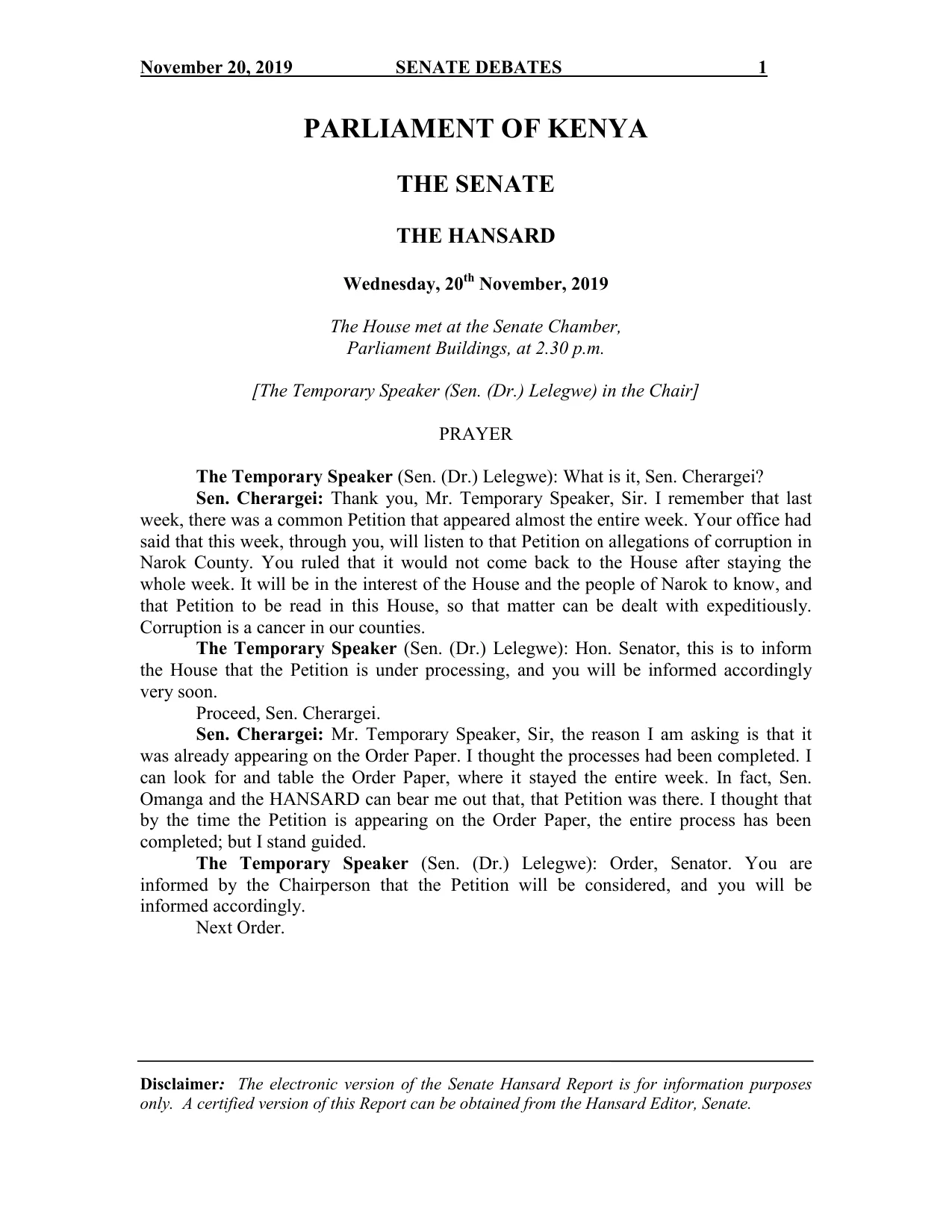
THE HANSARD
PARLIAMENT OF KENYA
Wednesday, 20th November, 2019
What is it, Sen. Cherargei?
Thank you, Mr. Temporary Speaker, Sir. I remember that last week, there was a common Petition that appeared almost the entire week. Your office had said that this week, through you, will listen to that Petition on allegations of corruption in Narok County. You ruled that it would not come back to the House after staying the whole week. It will be in the interest of the House and the people of Narok to know, and that Petition to be read in this House, so that matter can be dealt with expeditiously. Corruption is a cancer in our counties.
Hon. Senator, this is to inform the House that the Petition is under processing, and you will be informed accordingly very soon.
Proceed, Sen. Cherargei.
Mr. Temporary Speaker, Sir, the reason I am asking is that it was already appearing on the Order Paper. I thought the processes had been completed. I can look for and table the Order Paper, where it stayed the entire week. In fact, Sen. Omanga and the HANSARD can bear me out that, that Petition was there. I thought that by the time the Petition is appearing on the Order Paper, the entire process has been completed; but I stand guided.
Order, Senator. You are
NOTICE OF MOTION
CREATION OF PARASPORTS ASSOCIATIONS IN THE 47 COUNTIES
Thank you, Mr. Temporary Speaker, Sir, I am sorry for the delay. I beg to give notice of the following Motion:-
THAT, AWARE THAT sport has the unique ability to transcend linguistic, cultural and social barriers, making it an excellent platform for inclusion and adaptation of different groups; FURTHER AWARE THAT the universal popularity of sports and its physical, social and economic development benefits makes it an ideal tool for fostering the inclusion and well-being of persons with disabilities; COGNIZANT of the fact that persons with disabilities often face societal barriers and disability evokes negative perceptions and discrimination in many societies and, as a result of the stigma associated with disability, persons with disabilities are generally excluded from education, employment and community life, which deprives them of opportunities essential to their social development, health and well-being; ACKNOWLEDGING that sports can help reduce the stigma and discrimination associated with disability by transforming community attitudes towards persons with disabilities by highlighting their skills and reducing the tendency to see the disability instead of the person; FURTHER ACKNOWLEDGING that sports has become a career to many young people with talents, hence a source of income; CONCERNED that there are many young talented youths with disabilities in the counties whose talent in sports has not been tapped, and that these young people are wallowing in poverty, which they have the potential to eliminate through sports and talent; NOW THEREFORE, the Senate calls upon the Ministry of Sports, Culture and Heritage in partnership with the Council of Governors to ensure that county governments:
Create a Para Sports Association in each of the 47 counties, affiliated to the National Paralympic Committee, and responsible for the development and promotion of para- sports within the counties; and
Submit an annual report to the Senate on the activities of the Para sports associations, including the amounts of money spent on disability sports, and the number of Paralympic games, teams and players sponsored by the
county during the year.
Next Order, Statements pursuant to Standing Order 48 (1) .
FUNDING OF MAJOR PROJECTS BY THE NATIONAL GOVERNMENT
Thank you, Mr. Temporary Speaker. I rise pursuant to Standing Order 48 (1) to seek a Statement from the Standing Committee on Finance and Budget on the funding of major projects by the national Government. In the Statement, the committee should -
On a point of order, Mr. Temporary Speaker, Sir.
What is it, Sen. Linturi?
Thank you, Mr. Temporary Speaker, Sir. This is with regard to the Statement being sought by my good friend, Sen. Mwaruma. He is trying to gather information on the projects that will be funded by the amount of money that will be raised out of the expansion of the debt ceiling from Kshs6 trillion to Kshs9 trillion. Is it in order for Sen. Mwaruma to feign ignorance, when he voted for the opening of the budget ceiling? Did he vote without knowing why he was giving such an approval?
Mr. Temporary Speaker, Sir, leaving that point of order aside, I think the Senator is in good order to ask that question. All Kenyans should know what we
are paying for, and where these projects are. Most of the projects are in a few counties. You see will that there are 5, 10 or even 20 projects in some counties, while there are none in others. We want to know where this money goes. We did not have those opportunities before, and some of us where promised that projects would be done in---
On a point of order, Mr. Temporary Speaker, Sir.
Order, Sen. (Dr.) Ali!
Thank you, Mr. Temporary Speaker, Sir. I am baffled by with the contribution of Sen. (Dr.) Ali, and I sit in the Committee on Finance and Budget. The other members are Sen. Mutula Kilonzo Jnr., Sen. Wetangula, Sen. (Eng.) Mahamud, our Chairman and Sen. Farhiya.
The last time we had a meeting, we had called the Committee of Finance and Budget to sit at the Kenya International Convention Centre (KICC) , and I remember that he was there. We were given the schedule of those projects, their value, the areas of distribution and so on, and so forth. He was also among those who voted ignorantly. He is not better than my best friend, Sen. Mwaruma of Taita-Taveta County.
Order, Senators! Proceed, Sen. (Dr.) Ali.
Mr. Temporary Speaker, Sir, you should not allow ignorant Senators to talk about the ignorance of others. Unfortunately, my friend is not better than the others. We do not come here to rise on points of orders which do not have any meaning.
I am right and in order to ask the Committee on Finance and Budget to tell us where these projects are being undertaken, in support of Sen. Mwaruma. Some projects are ongoing, and we were told that others will be started soon. We want to know which ones are yet to commence, and which ones are ongoing. Which ones will be funded by this money? Yes, we are here for politics, but we also want facts. We want facts from the Ministry and not only the political aspects of it.
Thank you, Mr. temporary Speaker, Sir. We met the Cabinet Sectary (CS) in charge of the national Treasury and Planning, and he gave us the list of these projects. Shockingly, the list of development across the counties are only in three or four counties, yet we have 47 counties. Is the CS in charge of the National Treasury and Planning aware that there are 47 counties? That is something he should be aware of, when he is sharing the national cake.
The issue of the Building Bridges Initiative (BBI) is because of equity and fairness in distribution of projects. For example, in Nandi County, there is a project called Keben Dam, which was earmarked to be build. However, when the CS in charge of the
National Treasury came, he gave resources to do dams in only three counties. Are we borrowing Kshs9 trillion for only three counties? I want to request the Committee that this matter will be referred to the entire Senate. This is not an issue of only a Committee. Every county must be given two national Government projects. In the spirit of the BBI, these projects must be shared equally across the counties.
Secondly, the CS must tell us why we are borrowing up to Kshs9 trillion; and each county should be allocated projects equally. For example, in Elgeyo-Marakwet County, we had the Arror and Kimwarer dams which were earmarked to be build. One was cancelled, while the other one was downscaled, yet other project are ongoing in other counties.
I am happy that I am one of the people who voted against the raising of the debt ceiling. There is confusion and some of us do not even know what they voted for. I wish we would have, first of all, been told why we are borrowing up to Kshs9 trillion. Sen. Mwaruma, those are some of the conversations that you want us to have. We do not oppose the raising of the debt ceiling because of simply borrowing, but we wanted to know how money was to be utilized across the country.
The people of Taita Taveta County are not part of this national cake. Everybody wants to eat the cake, including myself. Could we have the cake shared equally in the country?
On a point of order, Mr. Temporary Speaker, Sir.
Sen. Mwaruma, you need to raise your intervention the right way. However, you may proceed.
Mr. Temporary Speaker, Sir, even as I raised this Statement, it is very clear that we need two priority projects per county. What was provided was a schedule of hundreds of projects. This is something that is inherent in our country, where we write many projects because of the thirst for borrowing and over borrowing. I have just asked for two projects per county; one that is ongoing and the other which is about to begin. I am very clear on this.
Mr. Temporary Speaker, Sir, I rise to support the Statement by Sen. Mwaruma. We cannot cry over spilt milk; we already passed that stage. It is fair for us to know which projects are being earmarked to be funded by the money that we are borrowing. I was under the impression that the money being borrowed will be used to retire the commercial loans. This House represents Kenyans, therefore, I fully support the Statement by Sen. Mwaruma, so that we know how we are progressing.
Mr. Temporary Speaker, Sir, I also support the Statement by Sen. Mwaruma. A number of hon. Senators have jumped onto the idea of ignorance. I do not think it really makes sense to call another Senator “ignorant,” because ignorance is not an excuse for what is going on. Kenyans need to know the kind of projects that are being carried out throughout the country. That is a fact. Every Senator needs to know the projects that are being carried in his or her county. I represent Turkana County, so I need to know the projects that are being carried out there.
Mr. Temporary Speaker, Sir, we are borrowing a lot of money. The Kshs9 trillion should be distributed among the 47 counties. It makes sense that if I and my children are
paying taxes, I and the people of Turkana will have to use that money. However, it is not acceptable for these projects to be concentrated in particular counties, yet the rest of us are paying. This is what Sen. (Dr.) Ali is saying. We need to know the projects that are being carried out in the North, and all counties in the country.
Thank you, Mr. Temporary Speaker, Sir.
Mr. Temporary Speaker, Sir, this issue of distribution of the national wealth has brought a lot of disparity in this nation. This is especially so in terms of what is going on at the Commission on Revenue Allocation (CRA) , and sharing of the national cake. The formula which has been introduced has brought problems. These are concomitant to what Sen. Mwaruma is trying to assert. Either way, if you look at it from the top, bottom or sideways, it is still the same question of sharing of the national cake.
Since independence to date, it is true that certain areas in this country have benefited more than others, particularly the SAHEL areas. The North Eastern and Lower Eastern have not been allocated adequate projects. The formula is very cooked up. The 21 counties as opposed to---
On a point of order, Mr. Temporary Speaker, Sir. I am I in order to inform the not too ignorant Senator that the SAHEL is way up there in the continent? It is three quarters of Africa. Our counties cannot be counted as part of the SAHEL.
Proceed, Sen. (Dr.) Kabaka.
Mr. Temporary Speaker, Sir, I stand corrected. I meant the Arid and Semi Arid Lands (ASALs) . We had a conference in Malindi on the same. However, that encompasses areas from where I come from, Kitui, Machakos, Makueni, Garissa, Marsabit and so on, and so forth. That is the area that I am referring to.
In 1969, the late Tom Mboya drafted Sessional Paper No.10, which gave priority to areas with the best weather to be developed. This was done not knowing that God has His own ways of doing it in His own creation. Those are the areas which were marginalized, the areas that people are now rushing to. It is foolhardy for the Government to continue marginalizing these areas, which are the future of the country. These areas have a lot of minerals and a huge potential. Recently, we visited Loiyangalani with my friend, the Senator from Marsabit, and we saw a major wind power project. That is the future.
Mr. Temporary Speaker, Sir, without much ado, this Government needs to rethink the issue of sharing of wealth in this nation. Therefore, it is important for them to ensure fairness in opportunities and projects in this country. Even as we talk about performance in the national examinations, we are not seeing the children from those areas doing well, because there has been a lot of skewed development and discrimination.
I support Sen. Mwaruma.
Thank you, Mr. Temporary Speaker, Sir, for this opportunity. To some extent, I commiserate with the position we are in, and the Statement by Sen. Mwaruma. However, from the Constitution, it appears as if we must make a resolution to get this information under Article 211. Therefore, as we approve the
Statement, it appears to me that Sen. Mwaruma should have proposed a Motion, which should have led to a resolution of the Senate to get the information he is seeking for.
Generally, the projects being undertaken for this financial year and the ones the Government was borrowing for this financial year are included in the report that was tabled here before we voted. We had that opportunity to ask those questions then, which were not asked.
Thank you.
POINT OF ORDER
FAILURE BY SEN. MADZAYO TO COMPLY WITH THE OFFICIAL DRESS CODE
Mr. Temporary Speaker, Sir, I rise pursuant to the Speaker’s Rules, Third Edition, published in July, 2018, and specifically Part I (5) , which relates to the conduct of Senators within Parliament. Part I (5) , for avoidance of doubt states:-
“Senators are required not to enter the Chamber, Lounge or Dining Room without being properly dressed. This means that a male Senator shall be dressed in a coat, collar, tie, long trousers, socks and shoes, or service uniform, religious attire or such other decent dressing as may be approved by the Speaker from time to time. An equivalent standard shall apply in respect of women Senators, who may also wear Kitenge or such other African attire.” Mr. Temporary Speaker, Sir, I would like you to look at how Sen. Madzayo is dressed, and find that he is not compliant with the requirement of Rule No.5 of this House. For that matter, he should be excused from the Chamber to go and dress properly.
Hon. Senators, it is true, but I will give this chance to Sen. Madzayo to confirm.
Asante, Bw. Spika wa Muda. Sheria zetu za mikataba ya Bunge la Seneti zinasema kwamba Mbunge anafaa kuvaa koti ambayo itakua imefika kwenye shingo na imeweza kumfunika kisawasawa. Hakuna mahali popote ambapo panasema kwamba mimi nimevaa hali sintofahamu ya kuingia ndani ya Bunge.
Nataka kumwambia ndugu yangu, ambaye pia ni shemeji yangu, Sen. Linturi, kwamba vile nimevaa ni kadri na sheria za Bunge.
Asante.
Sen. Madzayo, I will read you the provisions of the conduct of Senators within the precincts of Parliament. Rule No. 5 states as follows:-
“Senators are required not to enter the Chamber, Lounge or Dining Room without being properly dressed. This means that a male Senator shall be dressed in a coat, collar, tie, long trousers, socks and shoes, or service uniform, religious
attire or such other decent dressing as may be approved by the Speaker from time to time. An equivalent standard shall apply in respect of women Senators, who may also wear Kitenge or such other African attire.” Sen. Madzayo, you are out of order. So, get properly dressed. Sen. Madzayo, the Chair ruled you out of order, so you are given this chance to say whether you are on religious attire.
Thank you, Mr. Temporary Speaker, Sir. I will also follow suit with the Minority Leader. I have also come severally to this Chamber dressed in Kaunda suits with no collar. When you have no collar, you cannot wear a tie. This is a decent African dressing. He cannot wear a tie because the coat has no collar. He cannot wear a shirt because the Kaunda Suit coat has no collar. This is how we have been dressing.
Mr. Temporary Speaker, Sir, we urge you to reconsider that ruling and allow Sen. Madzayo to continue.
Mr. Temporary Speaker, Sir, it is not my wish to challenge what Sen Orengo and Sen. (Dr.) Ali have said. I have no problem with the positions they hold,
considering our history and the development of the attire that has been worn by Members of Parliament in the past.
This Parliament can make rules, and the Speaker can make rules that will guide our conduct, as a House. As long as rules have been made and adopted, then the obtaining position should be that, those are the rules that should be followed at that particular time.
The rules I referred you to, and I was very clear, are the Speaker’s Rules as published in July, 2018, when the referred Senators had left the Senate. This means that the date of application of the rules that govern how we dress is from July, 2018, to now. We have no problem, we can even change the rules to even not put on anything.
Mr. Temporary Speaker, Sir, will I be in order, taking into account the views---
Order, Sen. Madzayo. Proceed, Sen. (Eng.) Hargura.
Mr. Temporary Speaker, Sir, taking into account the views given out by my colleagues and also the practices which we have seen, because I am aware of the rulings made by former Speaker Ekwee Ethuro in the last Senate, will I be in order to request that you reconsider your ruling, because we have to be consistent with past traditions?
Sen. Madzayo, we have given you a chance to explain the attire you are wearing. Explain to the House before we proceed.
Mr. Temporary Speaker, Sir, quite a number of other Senators have contributed to this debate, but it is important that I respond. In the previous Parliament, the Speaker ruled that this is proper and decent dressing. The Senate has never been dissolved since 2013, when we were elected, up to date; it is still the same Senate. We have hon. Otiende Amollo in the National Assembly, who never wears a tie. He always dresses this way. The Speaker there ruled that it is decent dressing.
Sen. Madzayo, I gave you an opportunity to explain what you are wearing. It is not about what I said, as the Chair.
That is why I am telling you that Speakers who were there before you had no problem with it. It is decent.
Order, Senator!
You should not depart from that.
Order, Senator! You need to explain what you are wearing.
A very decent dress.
Hon. Senators, the Senator has explained that he is putting on decent African attire. Let us proceed. Let us listen to Sen. Olekina.
Mr. Temporary Speaker, Sir, I need your protection.
Order, Hon. Senators.
STATEMENTS
FACTS ABOUT THE 2019 POPULATION CENSUS
Mr. Temporary Speaker, Sir, I rise pursuant to Standing Order 48 (1) to seek a Statement from the Standing Committee on Finance and Budget concerning the recently concluded 2019 Kenya Population and Housing Census by the Kenya National Bureau of Statistics (KNBS) . In the Statement, the Committee should -
Sen. Cherargei, the Floor is yours.
Mr. Temporary Speaker, Sir, I rise pursuant to Standing Order 48 (1) ---
Sen. Cherargei, I thought the request was to comment on the Statement by Sen. Olekina.
I have a Statement to seek.
We are not there yet. Let us have Sen. (Dr.) Ali.
Mr. Temporary Speaker, Sir, while I support the Statement by the Senator for Narok County, some of us have a lot of complaints about the 2019 Population Census. The CS is also concerned about that.
Some dignitaries in this country said that it will disenfranchise some parts of this country, because the figures provided are questionable and they should be reduced. That
is exactly what happened. They started threatening people based on census figures which are not right. Some of us are not happy with those reports. Therefore, we will go to court to complain about that.
They came up with a prelisting or mapping before the census was conducted, which is unfortunate. If we want to go that way, it will be sad for this country. We have counties in this country where people are marginalised and are poor, but they are still being pushed to the corner. I do not know what they want to do to some of us.
Mr. Temporary Speaker, Sir, we are part and parcel of this country. The census report by the KNBS is not right, and it should not be encouraged. We oppose it in totality.
Mr. Temporary Speaker, Sir, I would also like to say something about the Statement by Sen. Olekina. As much as he has asked for the figures from the Government, I agree with Sen. (Dr.) Ali that the recently concluded population census was a sham. There was nothing to tell me about the population of Turkana County. It was badly done! It is like Turkana do not get children, because the numbers are going backwards. The number of people we had 10 years ago when we had census was more than what we have currently.
In a place like Turkana North Constituency, we have 65,000 people less than we had 10 years ago, which is difficult to believe. The mess starts with whoever makes decisions in this country, based here in Nairobi. Some boys who do not know anything about Turkana, the places and the language, were sent to go and map the areas. They mapped out Lodwar Town and then came back to Nairobi. During the time of census, they went to small sections of the county that they had mapped out and counted people there.
Many of our people live on the mountains, because that is where you find grass for the cattle. There are seven major mountains in Turkana County, but those people were not counted. It is also possible that not everyone was counted in Lodwar Town. How can you trust such figures for the Government to meet people’s demands? In the first place, the information will be based on faulty data.
Mr. Temporary Speaker, Sir, as much as I agree with Sen. Olekina, I just want to point out that the census figures that were given this time around are absolutely not correct. We cannot, therefore, base any correct information on them.
Thank you. The Senate Minority Leader (Sen. Orengo) : Mr. Temporary Speaker, Sir, the questions being raised about the census are legitimate. The reason why the population census is important is because planning and allocation of resources depend on populations in regions, counties and sub-counties and so on, and so forth. Therefore, it is not without reason that a census takes place regularly. If people have no confidence in the population census, then it is an exercise in futility.
I do not know whether Nigeria has carried out a census recently. For many years, it was impossible to carry out a census in Nigeria because nobody would accept the figures for good reasons.
This is because most of the figures were being fraudulently altered. When it came to the contest of who are more, between the Yoruba and the Hausa, it was a big political
question. Therefore, there are some regions where, honestly, some questions should be answered by the responsible State agency.
Having said that, Mr. Temporary Speaker, Sir, the request of this Statement is on matters which do not necessarily do with the global figures, as it were, for regions or counties. I think it is talking about rural-urban population and also the number of domestic animals. These are our important figures to have for planners and even leaders.
I support this Statement, and I hope that when the Committee comes with it, we will have these statistics which will guide us in many ways in planning and development.
question. Therefore, there are some regions where, honestly, some questions should be answered by the responsible State agency.
Having said that, Mr. Temporary Speaker, Sir, the request of this Statement is on matters which do not necessarily do with the global figures, as it were, for regions or counties. I think it is talking about rural-urban population and also the number of domestic animals. These are our important figures to have for planners and even leaders.
I support this Statement, and I hope that when the Committee comes with it, we will have these statistics which will guide us in many ways in planning and development.
Proceed, Sen. Farhiya.
Thank you, Mr. Temporary Speaker, Sir. For most pastoralists counties, figures were based on pre-census figures. The pre-census figures were based on villages’ settlement. Not all those people who are looking after camels and cows--- I am sure whether you know that pastoralists move from one place to another. If the census was based on settlements, then there are so many Kenyans out there who were not counted.
Census is data that is used for planning. Therefore, to be honest, interfering with data for planning is the highest level of corruption that we can get in this country. There are some counties which are getting minus and others 50 per cent, and then on the normal demographics that comes in terms of statistics, on the number of children per household, it is said this county has an average of six and the other two. The one with an average of two then comes up with an increase of 49 per cent. How is that possible scientifically? It is impossible.
Mr. Temporary Speaker, Sir, there is even a United Nations (UN) way of counting pastoralists, and I am sorry to say that the KNBS never used it. This is also linked to the formula that is coming, that is based on population. In this formula, 66 per cent of the formula is based on population. To make it worse, certain regions have been threatening that we will see them this time around, and it happened. Therefore, what kind of scientific data are we taking out there? If we are spoiling even the data for our own planning---
To be fair, the Director General for KNBS should be behind bars for being a criminal, for lack of a better word. If you are corrupt on even your own planning, what else can you do? He is not right for that job, and he should be told so.
Mr. Temporary Speaker, Sir, I agree with the Statement from Sen. Olekina, that this census should be repeated because it is fraudulent and faulty. It cannot be used for planning purposes.
Proceed, Sen. Mutula Kilonzo Jnr.
Just to add on to what Sen. Orengo is saying, we unfortunately have a culture of dishonesty in this country. That is the same dishonesty that led to the population census for parts of Kenya going into litigation, five years into the last census. I suspect it is the same thing that is going to happen even now.
Mr. Temporary Speaker, Sir, in future – that is why it is good that some of my colleagues in the Committee on Finance and Budget are sitting here – we should adopt that framework that is being used in Pakistan and India, on how they deal with population. In the case of India, they have suspended the use of population for a period up to 2026, and they have opened only a small window. This is because the propensity of cheating is so high, that this will never be an accurate figure for purposes of ensuring that one plus one is two in Kenya.
One plus one, for purposes of population of Kenya, is almost four, because everybody wants to cheat and have resources for purposes of their population. This is opposed to a framework where this country understands that if you live in the topmost part of this country and the most southern part of this country, you are entitled to development equally. If that was to happen, it would solve these problems, where you want to add your household or the people who have given birth in such a proportion, that you do not know whether people are sleeping day and night and have produced children four times more than they should; and others whose population has stagnated.
For purposes of this Senate, there is need for a better way and a resolution of how we should guide this. Earlier on, Sen. Orengo or Sen. Olekina proposed that we should have formed a Committee in advance to deal with the Committee that was dealing with the census. Of course, let us forget about the question of the Huduma Namba. We sat in this room, chased away the media and it was a closed meeting. Therefore, we never quite handled this properly. That is the reason why you are going to hear statements.
More importantly, Mr. Temporary Speaker, Sir, the President has issued an order that the current population census should be effected immediately. This House must make a resolution. I would propose that a Motion be moved here that a resolution for that document that was used by the census team to be tabled officially, and not just a Statement. A resolution of this Senate should come forth.
Just to add on to what Sen. Orengo is saying, we unfortunately have a culture of dishonesty in this country. That is the same dishonesty that led to the population census for parts of Kenya going into litigation, five years into the last census. I suspect it is the same thing that is going to happen even now.
Mr. Temporary Speaker, Sir, in future – that is why it is good that some of my colleagues in the Committee on Finance and Budget are sitting here – we should adopt that framework that is being used in Pakistan and India, on how they deal with population. In the case of India, they have suspended the use of population for a period up to 2026, and they have opened only a small window. This is because the propensity of cheating is so high, that this will never be an accurate figure for purposes of ensuring that one plus one is two in Kenya.
One plus one, for purposes of population of Kenya, is almost four, because everybody wants to cheat and have resources for purposes of their population. This is opposed to a framework where this country understands that if you live in the topmost part of this country and the most southern part of this country, you are entitled to development equally. If that was to happen, it would solve these problems, where you want to add your household or the people who have given birth in such a proportion, that you do not know whether people are sleeping day and night and have produced children four times more than they should; and others whose population has stagnated.
For purposes of this Senate, there is need for a better way and a resolution of how we should guide this. Earlier on, Sen. Orengo or Sen. Olekina proposed that we should have formed a Committee in advance to deal with the Committee that was dealing with the census. Of course, let us forget about the question of the Huduma Namba. We sat in this room, chased away the media and it was a closed meeting. Therefore, we never quite handled this properly. That is the reason why you are going to hear statements.
More importantly, Mr. Temporary Speaker, Sir, the President has issued an order that the current population census should be effected immediately. This House must make a resolution. I would propose that a Motion be moved here that a resolution for that document that was used by the census team to be tabled officially, and not just a Statement. A resolution of this Senate should come forth.
average home has five, six, or eight to ten children, yet they are saying that the average holding is 3.6. This is a man, a wife, a child and 0.6 of child, which may be a pregnant woman.
Mr. Temporary Speaker, Sir, we cannot accept the census results, knowing that all the planning, sharing of resources and everything else is pegged on the population. I encourage the Speaker to order that the Senate Majority and Minority Leaders lead the House in calling for a Committee of the Whole, to call the CS responsible for the population census, which falls under the Ministry of Treasury and National Planning, to explain all these anomalies. It is not out of nothing that every direction in the country is complaining.
average home has five, six, or eight to ten children, yet they are saying that the average holding is 3.6. This is a man, a wife, a child and 0.6 of child, which may be a pregnant woman.
Mr. Temporary Speaker, Sir, we cannot accept the census results, knowing that all the planning, sharing of resources and everything else is pegged on the population. I encourage the Speaker to order that the Senate Majority and Minority Leaders lead the House in calling for a Committee of the Whole, to call the CS responsible for the population census, which falls under the Ministry of Treasury and National Planning, to explain all these anomalies. It is not out of nothing that every direction in the country is complaining.
Thank you, Mr. Temporary Speaker, Sir. Let me also join my colleagues in appreciating the Statement on the population census. I do support it. I do not want to repeat what has been said. I concur that this is probably the most contested census result of all time.
One of the things about our population which we must begin to guard against, is the fact that people desire for results of census. This is because we have told them that if they do not have enough people in their region, there are certain services that they cannot get. For example, they will not get a constituency or a ward.
In the future, we should use the census properly to develop areas that are hitherto left behind, and make those places more attractive to populations. It should not be to make people live in situations where we cannot even count them. In most of our areas in the northern Kenya, if we sent people to count today, there are areas where they cannot access. We are never given the correct figures of the population census in those areas. Even in everyday census service, we cannot reach them.
Mr. Temporary Speaker, Sir, let us not use population, first of all, to intimidate others or to disburse resources towards certain people. Let us agree that we will work on accuracy of the census. I will not just give you the example of West Pokot, which shows that in this census, we have not grown in ten years. I like what Sen. Wetangula says about Western Kenya, because it is true. If you travel through Western Kenya, you can see that more women are pregnant than any other place in this country, and they are carrying small babies on their backs. The population sizes are bigger than what was captured here.
Therefore, let us not use census results to desire theft of the results, but to increase the resources towards areas where people live to make it attractive.
Thank you, Mr. Temporary Speaker, Sir. I stand to request for a Statement under Standing Order 48 (1) , on the Status and fate of Migingo Island.
STATUS AND FATE OF MIGINGO ISLAND
I seek a Statement from the standing Committee on National Security, Defence and Foreign Relations concerning the recent pronouncement by the Kenya Government, in particular the CS responsible for Foreign Affairs, that Migingo Island, in Lake Victoria and in Kenyan territory, will be administered jointly by the Governments of Kenya and Uganda.
In the Statement the Committee should -
Mr. Temporary Speaker, Sir, I rise to support this Statement. The word that came into my mind at the time Sen. Orengo was speaking was pussy-footing. When it comes to Uganda, we are prepared to give them a piece of land in Naivasha in an arrangement that was done by the national Government. However, when it comes to Migingo Island, the only thing we can do is pussy-footing.
Mr. Temporary Speaker, Sir, I inquired from the desk about Article 5 of the Constitution, which we do not speak about a lot, but we should. It states:-
“Kenya consists of the territory and territorial waters comprising Kenya on the effective date and any additional territory and territorial waters as defined by an Act of Parliament. The effective date is 27th August, 2010. We appear not to have an Act of Parliament. Sen. Wetangula and his distinguished ‘nephew,’ Sen. Sakaja, are quick on these things and they can quickly draft this and include Migingo Island as part of our territorial waters so that we stop pussy-footing around this issue.
The Ugandan authorities have no problem chasing away our Kenyan fishermen. However, when it comes to us, it paints a sad picture of why we fought for Independence, only for us to cede a rock. Whether it was a dot in the map of Kenya or not, it is a Kenyan rock, and our ‘bedroom.’
Mr. Temporary Speaker, Sir, I begin by thanking my elder brother, the Senator for Bungoma County, for raising this important matter. For those of us who studied political science, it is simple. Political science 101 states that the first responsibility of any Government is, one, to protect the lives of its people and their property. Two, is to protect its territory.
Mr. Temporary Speaker, Sir, the statement that came from the Foreign Affairs and International Trade CS is unfortunate---. Any Government that cannot protect its territory has no business calling itself a Government.
Mr. Temporary Speaker, Sir, this is an unfortunate Statement. It is an unfortunate state of things. Jomo Kenyatta, Tom Mboya, Dedan Kimathi and Paul Ngei must be turning in their graves. This country got Independence and we got our territory. However, matters of our territorial integrity are taken lightly. This matter came to our Committee, and when we tried to deal with it at that point, I remember such a casual demeanor of the CSs and PS who came before us.
Mr. Temporary Speaker, Sir, we have begun to lose and become the laughing stock of the region. Look at what is happening. We are about to become the first sea locked country in Africa because of our maritime dispute with Somalia. This issue was taken so lightly, but now we are going to hear a case that we know we will lose in the Court of Arbitration. Kenya will lose its waters in the Indian Ocean to Somalia because of oil and gas interests.
Mr. Temporary Speaker, Sir, with regard to the Ilemi Triangle in the north, the Senator for Turkana knows what I am talking about. South Sudan has claimed it. If you look at the map of South Sudan, it has the Kenyan territory as part of its territory. What kind of Government allows people to play with us right, left and center? Migingo Island is in Kenya.
Mr. Temporary Speaker, Sir, I support calls that this is the time we need our Commander-in-Chief, His Excellency President Uhuru Kenyatta, to show himself strong. We must not allow that it is during his watch, as President and Commander-in-Chief, that Kenya lost its territory, for example, Migingo, Ilemi Triangle and the arbitration in the maritime dispute with Somalia. They are saying that the map is supposed to be drawn diagonally, yet Tanzania is saying that theirs must go as it has been based on our agreement.
This is an important issue, especially for a Senate that is concerned with our country and counties. What is happening to the people up in Turkana, as they go towards our Kenyan border? In fact, if anything, we need to build a big school and put facilities so that the people of Turkana can get services there, as part of our territory. How do you share administration of your own territory?
Mr. Temporary Speaker, Sir, just the other day I decided to go to Uganda by road, because I wanted to see what is happening in the border. The officers saw me and they were very excited, because I was driving myself. They took me to a point where they said, “Sasa Mheshimiwa, tukifika hapa, hatuwezi pita”. This is because that is how borders are. At no man’s land, they say asante, they salute and go back. The Ugandans will pick you from there, and you move with them. These ones are inside Kenya with guns. If a police officer is with a gun inside your country, it is war; it means you are fighting. Therefore, this matter needs to be taken seriously.
I am glad that the feeling in the House is that this is an issue not just for one Committee, but for the Committee of the Whole House. We must stand strong. President Uhuru Kenyatta should show himself strong, as the Commander-in-Chief. This is not for the CSs, it is for the President himself to come out clearly.
Mr. Temporary Speaker, Sir, as Kenyans, we are ready to defend our country. I am not declaring anything, but we are ready to defend our country. All able-bodied men will defend our country. It cannot be that we are now pussy-footing.
When some Presidents came to Kenya, all Presidents went to State House to see the President. However, our President went to the hotel to see the President of Somalia, because we are now massaging him so that we can agree. We will not agree. A Government that cannot control 1.7 square kilometers in their country is trying to take our waters. We need to come out strongly and defend our country. Kenya needs strength in its Commander-in-Chief and leaders.
We are friendly with Uganda and South Sudan which, in fact, copied our flag. It was the biggest sign of endorsement of brotherhood. However, how does our small brother take our flag and our land? We cannot allow that.
Mr. Temporary Speaker, Sir, please direct that the Committee of the Whole be done before we go for recess in December. It must be done in the next two weeks.
Mr. Temporary Speaker, Sir, I support calls that this is the time we need our Commander-in-Chief, His Excellency President Uhuru Kenyatta, to show himself strong. We must not allow that it is during his watch, as President and Commander-in-Chief, that Kenya lost its territory, for example, Migingo, Ilemi Triangle and the arbitration in the maritime dispute with Somalia. They are saying that the map is supposed to be drawn diagonally, yet Tanzania is saying that theirs must go as it has been based on our agreement.
This is an important issue, especially for a Senate that is concerned with our country and counties. What is happening to the people up in Turkana, as they go towards our Kenyan border? In fact, if anything, we need to build a big school and put facilities so that the people of Turkana can get services there, as part of our territory. How do you share administration of your own territory?
Mr. Temporary Speaker, Sir, just the other day I decided to go to Uganda by road, because I wanted to see what is happening in the border. The officers saw me and they were very excited, because I was driving myself. They took me to a point where they said, “Sasa Mheshimiwa, tukifika hapa, hatuwezi pita”. This is because that is how borders are. At no man’s land, they say asante, they salute and go back. The Ugandans will pick you from there, and you move with them. These ones are inside Kenya with guns. If a police officer is with a gun inside your country, it is war; it means you are fighting. Therefore, this matter needs to be taken seriously.
I am glad that the feeling in the House is that this is an issue not just for one Committee, but for the Committee of the Whole House. We must stand strong. President Uhuru Kenyatta should show himself strong, as the Commander-in-Chief. This is not for the CSs, it is for the President himself to come out clearly.
Mr. Temporary Speaker, Sir, as Kenyans, we are ready to defend our country. I am not declaring anything, but we are ready to defend our country. All able-bodied men will defend our country. It cannot be that we are now pussy-footing.
When some Presidents came to Kenya, all Presidents went to State House to see the President. However, our President went to the hotel to see the President of Somalia, because we are now massaging him so that we can agree. We will not agree. A Government that cannot control 1.7 square kilometers in their country is trying to take our waters. We need to come out strongly and defend our country. Kenya needs strength in its Commander-in-Chief and leaders.
We are friendly with Uganda and South Sudan which, in fact, copied our flag. It was the biggest sign of endorsement of brotherhood. However, how does our small brother take our flag and our land? We cannot allow that.
Mr. Temporary Speaker, Sir, please direct that the Committee of the Whole be done before we go for recess in December. It must be done in the next two weeks.
Constitution was promulgated in 2010, it would clearly have all the nautical values and latitudes that were necessary to locate where our territories lie and within which boundaries. The exercise was done with the full knowledge of the historical background that included the colonial and post-colonial era.
It is important to note that the Migingo Island occupies 2,000 square meters. It is the third largest island in the world in terms of population. It has a population density of more than 65,500 people per square kilometre. It occupies a very important commercial centre for our people. If it was just a rock, we might have thought otherwise. However, human beings occupy that island. Those are Kenyans who eke out a living through exploitation of marine products such as fish, which are in plenty in that region. Migingo is the hibernating centre for all the fish species.
Mr. Temporary Speaker, Sir, it is painful to note that when you are in Homa Bay, you can visualize the Migingo Island. However, somebody has to sail from Entebbe to Migingo, which is more than 200 kilometres away. In 1952 while I was schooling in Uganda, I took a steamship from Kisumu to Port Bell, and then took a train from Port Bell to Kampala. It took us a whole night and half of the afternoon to get to Port Bell from Kisumu.
Constitution was promulgated in 2010, it would clearly have all the nautical values and latitudes that were necessary to locate where our territories lie and within which boundaries. The exercise was done with the full knowledge of the historical background that included the colonial and post-colonial era.
It is important to note that the Migingo Island occupies 2,000 square meters. It is the third largest island in the world in terms of population. It has a population density of more than 65,500 people per square kilometre. It occupies a very important commercial centre for our people. If it was just a rock, we might have thought otherwise. However, human beings occupy that island. Those are Kenyans who eke out a living through exploitation of marine products such as fish, which are in plenty in that region. Migingo is the hibernating centre for all the fish species.
Mr. Temporary Speaker, Sir, it is painful to note that when you are in Homa Bay, you can visualize the Migingo Island. However, somebody has to sail from Entebbe to Migingo, which is more than 200 kilometres away. In 1952 while I was schooling in Uganda, I took a steamship from Kisumu to Port Bell, and then took a train from Port Bell to Kampala. It took us a whole night and half of the afternoon to get to Port Bell from Kisumu.
What is your point of order, Sen. Sakaja?
On a point of order, Mr. Temporary Speaker, Sir. Did I hear Sen. (Prof.) Ongeri mention 1952 or 1972? I am not sure what I heard. I would like him to clarify the year.
With those few remarks, I beg to support this Statement and call for Plenary, so that we can enlarge on what we know about Migingo Island. We are not just about to surrender.
Mr. Temporary Speaker, Sir, I thank you.
With those few remarks, I beg to support this Statement and call for Plenary, so that we can enlarge on what we know about Migingo Island. We are not just about to surrender.
Mr. Temporary Speaker, Sir, I thank you.
There is a high interest in this Statement. I will give only two minutes to each Member who wishes to contribute to this Statement.
On a point of order, Mr. Temporary Speaker, Sir. We have at least three Senators here who participated in the joint survey under Question No.2. If you agree with our proposal to have Plenary, would I be in order to suggest that the joint survey that is mentioned in Question No.2 by Sen. Wetangula should also be tabled, so that we can understand and question the Cabinet Secretary Ministry of Foreign Affairs and International Trade on why there was a departure and whether a Cabinet decision made by a previous Cabinet is binding on the Cabinet of President Uhuru Kenyatta?
I thank you.
Asante sana Bw. Spika wa Muda kwa kunipa fursa hii kuchangia taarifa iliyosomwa na Seneta wa Bungoma, Sen. Wetangula. Taarifa hii imeletwa hapa kwa wakati mwafaka kabisa. Serikali imeendeleza utepetevu katika kutetea hadhi ya inchi ya Kenya. Itakumbukwa kwamba tuna mzozo wa mipaka na Somalia na kesi hiyo iko katika korti ya kimataifa inayohusiana na mambo ya bahari. Vile vile, kule Vanga katika Kaunti ya Kwale, wavuvi wengi hushikwa na wanamgambo wa Tanzania wakati wanavua katika Bahari ya Hindi.
Kwa hivyo Bw. Spika wa Muda, bahari ama nchi yetu si jambo la kuchezewa ovyo ovyo kwa sababu kuna Wakenya wengi ambao walimwaga damu na kutoa mali yao ili kupigania uhuru wa nchi hii. Kutoa ardhi kiholela kama ilivyofanywa huko Migingo si sawa.
Bw. Spika wa Muda, utapata kwamba Wakenya wengi Migingo, haswa wavuvi, wamekuwa wakilalamika kuwa wanapokonywa mali, bidhaa na vifaa vyao vya uvuvi. Ikiwa tutaipatia Uganda nusu ya mamlaka, ina maana kwamba wale Wakenya wataendelea kuteseka ilhali wanaamini ya kuwa ni wananchi wa Kenya. Serikali ya Kenya ina jukumu la kuwalinda na kuwatetea kuhusiana na mali yao.
Hili sio jambo la kudharauliwa. Ni jambo ambalo linahitaji Kamati husika kuaanda kwa upesi tukutane na Waziri ili swala hili litatuliwe haraka.
Order, Senator. Proceed Sen. Poghisio.
by some kind of innuendo? One day it is in Uganda and the next Kenya. How is that even possible?
In 1930 Kacheliba Constituency was ceded to Uganda for administration only. That was very wrong, but it was decided then that it would be administered by Uganda. What happened is that, today, we do not even have our administrative beckons. Some of the beckons have been destroyed. Why? It is because when the other country is administering, they can do whatever they want. We should be very careful. First of all, the good things about having the Cabinet Secretary here is to ask how this works.
Finally, this is sovereignty ceded. It is not possible on the watch of the Senate. As the Senate, we have the first duty to protect our counties, which forms part of our national interest.
Thank you, Mr. Temporary Speaker, Sir. I rise to support this Statement by Sen. Wetangula.
Kenya borders four countries of East Africa. Kenya has lost land to these four countries. I am not sure why we are so scared that we cannot defend our own. If you live in Turkana County, you will understand what I am saying. We border Uganda and the people in Turkana know how far they go into Uganda. This is the part of Uganda where the Turkana have lived and know is part of Kenya. However, the Government of Kenya has let Uganda move its border to a place like Lokiriama.
Lokiriama is right inside Turkana, but there has been no challenge on that. Turkana also borders South Sudan. As Sen. Mutula Kilonzo Jnr said, their map includes large parts of Turkana right now. They are now building an international road that will go into South Sudan up to the West Coast of Africa. The people of South Sudan have stopped construction of that road at Ladapel, yet Kenya said the border continues to Lakoda, which is inside Kenya.
Kenya extends into South Sudan up to a place called Narus. Narus is a watering point, which was founded by the Turkana people. That is still part of Kenya, yet Kenya says that it is only Lakoda. The rest of Kenya---
Hon. Senators, we have to make progress. We are already past the Statements Hour.
I request Sen. Chebeni to move a Motion on the election of the Temporary Speaker.
Thank you, Mr. Temporary Speaker, Sir. I rise to support this Statement by Sen. Wetangula.
Kenya borders four countries of East Africa. Kenya has lost land to these four countries. I am not sure why we are so scared that we cannot defend our own. If you live in Turkana County, you will understand what I am saying. We border Uganda and the people in Turkana know how far they go into Uganda. This is the part of Uganda where the Turkana have lived and know is part of Kenya. However, the Government of Kenya has let Uganda move its border to a place like Lokiriama.
Lokiriama is right inside Turkana, but there has been no challenge on that. Turkana also borders South Sudan. As Sen. Mutula Kilonzo Jnr said, their map includes large parts of Turkana right now. They are now building an international road that will go into South Sudan up to the West Coast of Africa. The people of South Sudan have stopped construction of that road at Ladapel, yet Kenya said the border continues to Lakoda, which is inside Kenya.
Kenya extends into South Sudan up to a place called Narus. Narus is a watering point, which was founded by the Turkana people. That is still part of Kenya, yet Kenya says that it is only Lakoda. The rest of Kenya---
Hon. Senators, we have to make progress. We are already past the Statements Hour.
I request Sen. Chebeni to move a Motion on the election of the Temporary Speaker.
PROCEDURAL MOTION
ELECTION OF A SENATOR TO PRESIDE OVER SITTINGS OF THE HOUSE PURSUANT TO STANDING ORDER NO.15 AND ARTICLE 107(1) OF THE CONSTITUTION
Mr. Temporary Speaker, Sir, I beg to move the following Motion:- THAT, Pursuant to Standing Order No.15 and Article 107 (1) (c) of the Constitution, the Senate elects Sen. Sakaja, MP, to preside over the sitting of the Senate for the remainder of the day, in addition to other Members of the Speakers’ Panel present, in the absence of the Speaker and the Deputy Speaker. I beg to move and request Sen. (Dr.) Musuruve to second.
Mr. Temporary Speaker, Sir, I second the Motion that Sen. Sakaja takes over as the Speaker. Sen. Sakaja did it yesterday, and did a wonderful job.
He is my Chairman in the Committee on Labour and Social Welfare. He is an able Chair and equally doing a great job there. I have confidence in him. I know that he will do a great job and a lot of listening like he did yesterday as we debate national issues.
I second.
Thank you Mr. Temporary Speaker, Sir, and congratulations to my Chairman, Sen. Sakaja.
I rise pursuant to Standing Order No.48 (1) to seek a Statement from the Standing Committee on Education on the proposal by the Higher Education Loans Board (HELB) to publish names and photographs of loan defaulters in the national dailies.
In the Statement, the Committee should-
PROPOSAL BY HELB TO PUBLISH NAMES AND PHOTOGRAPHS OF LOAN DEFAULTERS
Thank you Mr. Temporary Speaker, Sir, and congratulations to my Chairman, Sen. Sakaja.
I rise pursuant to Standing Order No.48 (1) to seek a Statement from the Standing Committee on Education on the proposal by the Higher Education Loans Board (HELB) to publish names and photographs of loan defaulters in the national dailies.
In the Statement, the Committee should-
[The Temporary Speaker (Sen. Sakaja) in the Chair]
I will allow a few comments on that Statement. I wish I did not take the Chair before I spoke on this, but I am sure Members will represent us.
Sen. Mutula Kilonzo Jnr., kindly proceed.
According to the Act, in order for HELB to resort to either civil recovery or any other method, it is contemplated that they would check, first, after the period of one year that is provided under the law, whether that person has been employed and the circumstances under which that person has not paid. We should be seeing waivers of those payments for those people who they have determined that an attempt to get money from would be futile or cost much more than the money they have borrowed.
Mr. Temporary Speaker, Sir, there is a more punitive measure where these loanees are paying a fine of Kshs5,000 on what is due. I have read the Act twice this week and there is no provision anywhere where HELB can publish the names or photographs of defaulters. It is a way of embarrassing and ridiculing persons who, for no fault of their own, have been rendered poor and unemployed due to mismanagement of this country by the Government; because they should have been employed. That is the reason you went to court to challenge the employment or nomination of a person, who in your view and correctly so, should not have been the head of the National Employment Authority.
If that person was a loanee of HELB, then we would be saying that, that person should be given that opportunity, so that they can pay their loan. May you continue doing what you are doing. This matter should have gone to the Committee on Legal Affairs and Human Rights because it is a legal issue. It is not even a labour issue; it is your issue. We should summon these people - even before it goes there - and remind them that we gave them an Act of Parliament, which they should adhere to.
If Sen. Sakaja who is employed got a loan and has not paid, they should pursue his employer and not Sen. Sakaja. If he has not been employed, then they should find out why he has not been employed.
I gave a reasoned example. As chairman of a secondary school, we were replacing teachers. The teachers who graduated between 2010 and 2013 were earning 30 marks. The people who graduated in 2018 were earning 10 marks. It simply means that at the start of the interview, those who recently graduated were already disadvantaged. There was this young man who graduated in 2018 with straight A in Chemistry and Biology, but we could not hire him, yet this person has a loan.
Even the employment opportunities, through Teachers Service Commission (TSC) are discriminating people, who by now in the one year window that is provided under the Act, should start paying. Should we not now say that if the Government of Kenya cannot find employment for these young people within five years, you waive the loans?
On a point of information, Mr. Temporary Speaker, Sir. He has mentioned the party leader and the deputy party leader to mean that the loans were
waived for coffee and other agricultural sector products in the Rift Valley only. He has to be reminded that it happened in the entire country. It was not only in Rift Valley. I just wanted to inform my learned senior to be seized of the matter, so that it does not appear that the party leader and the deputy party leader are marginalizing other Kenyans.
Well spoken. That is a good challenge.
Well spoken. That is a good challenge.
Secondly, I wish to thank Sen. Cherargei for bringing to the Floor a very important issue that is affecting our country regarding the way HELB management wants to treat the students who completed university education or training in various training institutions.
Mr. Temporary Speaker, Sir, it is not a long time ago when we were told that defaulters should be locked up by the policemen. Now, here we are, we want to parade them in the newspapers.
Mr. Temporary Speaker, Sir, the stress that the youth in this country are being subjected to cannot be overemphasized. More importantly, those are the youth do not have any gainful employment. A few minutes ago, somebody talked about those graduates who go to look for employment. Recently in our Committee on Labour and Social Welfare we were struggling to ensure that those first graduates should not be charged when going to obtain clearance certificates from the Credit Reference Bureau (CRB) and Kenya Revenue Authority (KRA) . We have not resolved that particular issue and we now want to parade them.
Every day we read in newspapers that the debt level in this country is soaring higher and higher. Therefore, creating employment is becoming a challenge. The youth who complete university education using loans come from poor families. Just like one of
my colleagues has stated, the Government should be compelled to write off loans for people who stay at home for over five years if they happen to get employment.
As I speak, there are many graduates who have been at home for over 10 years because there is no employment in this country. We have seen several times old people being appointed to lead institutions. How about the youth?
The issue of management by HELB should be looked into by the Committee that will be tasked to deal with this particular Statement, and I think it is the Committee on Education. The Committee should stamp its feet on this particular issue because recently we dealt with the issue of taking these children to the police station.
I beg to support. The Temporary Chairperson (Sen. Sakaja): Well spoken. Let us now listen to the Senator for Mombasa County.
my colleagues has stated, the Government should be compelled to write off loans for people who stay at home for over five years if they happen to get employment.As I speak, there are many graduates who have been at home for over 10 years because there is no employment in this country. We have seen several times old people being appointed to lead institutions. How about the youth?The issue of management by HELB should be looked into by the Committee that will be tasked to deal with this particular Statement, and I think it is the Committee on Education. The Committee should stamp its feet on this particular issue because recently we dealt with the issue of taking these children to the police station.I beg to support. The Temporary Chairperson (
Thank you, Mr. Temporary Speaker, Sir, for giving me this opportunity to air my voice. I will start by thanking Sen. Cherargei for coming up with this Statement.
There is need to investigate whether the information on the Floor of this House is authentic from the HELB. I am saying so because I heard the statement being issued when I watched news last night. Immediately after that, there was a correction and they said that they will publish names of those who have cleared loans. So, there is need to investigate and find out whether the information is authentic. If it is not, then they should apologise to the HELB for coming up with such a statement. I heard it from the media and it has two contradictory effects.
Mr. Temporary Speaker, Sir, I am not standing here to---
Well spoken. Let us now listen to the Senator for Mombasa County.
Asante Bw. Spika wa Muda kwa kunipa fursa hii kuunga mkono Taarifa iliyoletwa na Sen. Cherargei. Labda angetujulisha kama ana interest yoyote kwa sababu tunajua kwamba alimaliza masomo hivi karibuni. Hata hivyo, hiyo haitaathiri umuhimu wa Taarifa hii kwa sababu wanafunzi wengi humaliza masomo katika vyuo vikuu na kupata shida ya kuajiriwa na kufungua biashara. Kwa hivyo, si rahisi wao kulipa mikopo ya HELB ambayo inaendelea kuwasonga kama watu wanaotakikana kunyongwa. Itakumbukwa kwamba Serikali ilileta mikopo ya HELB ili kusaidia wanafunzi kusoma na pia Serikali iweze kupata watu walio na tajriba na ujuzi wa fani mbali mbali nchini. Si sawa kuwa-profile na kuweka picha zao magazetini na kuwakejeli kwa sababu ya kushindwa kulipa mikopo. Bw. Spika wa Muda, itakumbukwa kwamba Serikali imetupilia mbali mikopo ya sekta za sukari, majani chai na kahawa ambazo zilikuwa na mabilioni ya pesa ambazo wakulima walikopeshwa, ili wafanye biashara lakini biashara hizo hazikua. Sioni ni kwa nini wanafunzi waliofuzu wasisaidiwe kupata kazi. Wanafaa kupewa mikopo mingine waanzishe biashara ili wajiendeleze kimaisha na kulipia mikopo waliochukua. Si vyema kuwakejeli na kuwasukuma kwenye ukuta. Matokeo ya Darasa la Nane yalitolewa juzi. Ikiwa wale ambao wamesoma hawana kazi hadi sasa ilhali Serikali inawafuata kulipa mikopo, tutawafanyia nini wale wanaotaka kusoma? Itatoa taswira mbaya. Ni kama nchi inapigana na vijana wake kwa sababau hawana kazi. Pili, wanafuatwa kulipa mikopo ambayo hawawezi kulipia. Sheria ingebadilishwa ili kuwe na moratorium kwamba wasishurutishwe kulipia mikopo mpaka baada ya miaka kumi wakati wameanza kufanya biashara ama kupata kazi na kujistawisha. Bw. Spika wa Muda , nashukuru kwa kunipa fursa hii. Ningependa pia kukupongeza kwa sababu Maseneta wa Majiji katika Bunge hili ni watatu pekee. Kuna wewe, mimi na Seneta wa Kisumu. The Temporary Chairperson (
I did not know about that. I said that the work of the Committee is to look into that matter. They should establish the veracity of the information that has been brought and report to us. The mandate of the Committee is to look into, investigate or inquire about any matter brought in the form in which it is brought to the House. So, we will wait for the Committee to tell us whether it is true, then you can say what you are saying.
You can proceed.
Thank you, Mr. Temporary Speaker, Sir, for giving me this opportunity to air my voice. I will start by thanking Sen. Cherargei for coming up with this Statement.
There is need to investigate whether the information on the Floor of this House is authentic from the HELB. I am saying so because I heard the statement being issued when I watched news last night. Immediately after that, there was a correction and they said that they will publish names of those who have cleared loans. So, there is need to investigate and find out whether the information is authentic. If it is not, then they should apologise to the HELB for coming up with such a statement. I heard it from the media and it has two contradictory effects.
Mr. Temporary Speaker, Sir, I am not standing here to---
Sen. (Dr.) Musuruve, that is what the Committee will do. The Committees have the mandate to investigate and inquire into any matter that is brought in the form that it is brought. So, let us not jump the gun and say what will come out of it. We should wait for the Committee to bring to us the truth because the Parliamentary Powers and Privileges Act makes it quite an offence for a witness to bring false information to Parliament. Therefore, we will get that from the Committee.
You may proceed.
Mr. Temporary Speaker, Sir, the issue of HELB has become controversial of late because we have been asking many questions about it. They renege whenever they see Statements.
I heard that it was in the news, but it is wrong. The HELB is creating more problems. We have talked about the issue of students being asked to get clearance from the Credit Reference Bureau (CRB) and other documents before being employed. That happens when they make applications even before they go for interviews. We all understand that the HELB gets very little from students in terms of loan repayment.
As many people have stated here, many organisations and businesses have been given exemptions, without forgetting those who plant cash crops. Last time the President gave miraa farmers Kshs1 billion, but students are an important human resource in this country. We know that once they finish studies, many students do not get jobs. That is why many of them are jobless.
Sometime back we were faced with the issue of Al Shabaab and many teachers left Wajir and other counties in the former North Eastern Province. Where are we taking the young boys and girls? Are we encouraging them to join Al Shabaab?
When you threaten our graduates that you will splash their photos in the newspapers and everywhere, you are telling them that they have graduated and refused to repay their loans. How will they feel? Where will they go? Are we encouraging our youth to become gangsters or Al Shabaab? This is a very wrong concept and whatever the Government of Kenya does, I know that the issue of loans and all the payments all over the world is a problem, especially when it comes to education.
In the United States of America (USA) these problems are there, but nobody threatens them. There are billions and trillions of dollars owed by graduates in form of loans, and they are not threatened. However, in Kenya, we are threatening our students for not repaying their loans. This is a wrong concept and it should not be allowed. I am following the footsteps of the Members who have spoken before me and urge the Government to forgive these students. They cannot afford to repay those loans.
Most Kenyans are very poor. Instead of harassing and threatening their families, they should be forgiven and the loans written off. Banks are given extra loans to pay for a longer period. As the Senator of Mombasa said, we can give them a grace period of 10 years. I asked for a similar statement last year or earlier this year and we did not get a proper answer.
I remember Sen. (Dr.) Musuruve said that when the Committee on Labour and Social Welfare asked the Higher Education Loans Board (HELB) to appear before them, they were talking tough. It is the same issue every time. The Committee on Education or whoever is responsible for this matter should push to make sure that these loans are exempted and our Students are free for the last five years, so that we allow people like Sen. Cherargei to pay. Anything above five years should be exempted.
Thank you, Mr. Temporary Speaker, Sir.
Sen. Cherargei, what is your point of order?
Mr. Temporary Speaker, Sir, I want to summarily say that the HELB should ensure that people who come from low economically endowed families benefit. Currently, they are working to ensure that students of Technical and Vocational Education and Training (TVET) institutions get loans. So, there is need to investigate and ensure that the loanees are protected as much as they get the support. I hope that the Committee on Education will deal with this matter because I would like to listen to the issues.
We also met officers of the HELB in one of our committees and the issue of clearance came out. From the way they spoke, they seem to be keen to ensuring that they do not come up with harsh measures that will affect Kenyans negatively. So, there is need to investigate the authenticity of this information.
I thank you.
Well said. Let us now have Sen. (Dr.) Ali.
I am not confirming. I am saying that I have been paying. So, it should not go into the record of the House that some interventions need to be made for me to pay the HELB loan.
Mr. Temporary Speaker, Sir, you are the pioneer of the National Employment Authority (NEA) . You did not want to go to court because that is one of the vehicles that you should use to create employment. If you come to our offices, they have become employment bureaus. We have more application letters than NEA.
I thank you.
Point well taken, and keep paying your HELB loan.
Sen. Madzayo, proceed.
On a point of order, Mr. Temporary Speaker, Sir. I want to confirm that I am paying my HELB loan. So, to insinuate that some intervention should be done so that I can pay is unfair. I want to agree with him that this issue of HELB must be handled in a way--- In fact—
kusema kwamba ataendelea kulipa mkopo huo, kuna umuhimu wa watu kama hao waambiwe ya kwamba watalipa deni mara moja ili pesa ambazo zitapatikana zitatumiwa kugharimia masomo ya wanafunzi kutoka familia maskini ambao hawajiwezi. Ni aibu kuona ya kwamba wewe uko katika Bunge la Jamhuri ya Kenya na bado unaendelea kulipa pole pole mkopo wa chuo kikuu.
Sen. Cherargei angekuwa hapa akusikize kwa sababu umesema jambo la maana.
Ninajua anaangalia runinga pale alipo na ninataka anisikize. Ikiwa wewe una uwezo afadhali ulipe mkopo huo mara moja badala ya kulipa pole pole ilhali watoto wa Kenya wako nyumbani bila kazi. Wengine wanadaiwa na wewe bado unalipa reja reja ilhali unaweza kulipa deni hilo mara moja.
Ni jambo la kusikitisha kwamba watoto wetu sasa wameanza kujiingiza katika maswala mabovu mabovu ambayo yana madhara kwa Wakenya wenzao kama Al Shabaab. Katika ufuo wa bahari, tunaona wengine wakivuta vitu ambavyo havitakikani kuvutwa.
Kwa hivyo tunasema ya kwamba ikiwa hii HELB inaweza kupewa kama loan ya Serikali vile ambavyo vifaa vinavyotumika katika hospitali vimepeanwa halafu wao wanalipa baada ya miaka saba, kwa maana watu wanaenda zaidi ya miaka saba bila kazi. Haina haja mtu kama huyo akiwa hajalipa na hajapata kazi kulazimishwa kwamba siku ile atapata kazi alipe. Itakuwa muhimu pia kuona ya kwamba ikiwa hajaweza kulipa na imepita miaka mitano basi ninapendekeza mkopo huo uwe written off ili tusiendelee kuwajazia madeni watoto wetu wanaomaliza masomo katika vyuo vikuu.
Asante, Bw. Spika wa Muda.
Thank you very much, Sen. Madzayo. Because of the urgency of this Statement, I want to direct that the Committee gives us a preliminary report this Thursday, under the Order of Statements. They can give us a more comprehensive report thereafter.
Members, for convenience of the House, we will defer Statements pursuant to Standing Order No.51 (1) (b) .
kusema kwamba ataendelea kulipa mkopo huo, kuna umuhimu wa watu kama hao waambiwe ya kwamba watalipa deni mara moja ili pesa ambazo zitapatikana zitatumiwa kugharimia masomo ya wanafunzi kutoka familia maskini ambao hawajiwezi. Ni aibu kuona ya kwamba wewe uko katika Bunge la Jamhuri ya Kenya na bado unaendelea kulipa pole pole mkopo wa chuo kikuu.
We shall also rearrange business as follows: Orders Nos. 8 to 17 shall be deferred, and we go straight to Order No.18.
Ninajua anaangalia runinga pale alipo na ninataka anisikize. Ikiwa wewe una uwezo afadhali ulipe mkopo huo mara moja badala ya kulipa pole pole ilhali watoto wa Kenya wako nyumbani bila kazi. Wengine wanadaiwa na wewe bado unalipa reja reja ilhali unaweza kulipa deni hilo mara moja.
Ni jambo la kusikitisha kwamba watoto wetu sasa wameanza kujiingiza katika maswala mabovu mabovu ambayo yana madhara kwa Wakenya wenzao kama Al Shabaab. Katika ufuo wa bahari, tunaona wengine wakivuta vitu ambavyo havitakikani kuvutwa.
Kwa hivyo tunasema ya kwamba ikiwa hii HELB inaweza kupewa kama loan ya Serikali vile ambavyo vifaa vinavyotumika katika hospitali vimepeanwa halafu wao wanalipa baada ya miaka saba, kwa maana watu wanaenda zaidi ya miaka saba bila kazi. Haina haja mtu kama huyo akiwa hajalipa na hajapata kazi kulazimishwa kwamba siku ile atapata kazi alipe. Itakuwa muhimu pia kuona ya kwamba ikiwa hajaweza kulipa na imepita miaka mitano basi ninapendekeza mkopo huo uwe written off ili tusiendelee kuwajazia madeni watoto wetu wanaomaliza masomo katika vyuo vikuu.
Asante, Bw. Spika wa Muda.
Thank you very much, Sen. Madzayo. Because of the urgency of this Statement, I want to direct that the Committee gives us a preliminary report this Thursday, under the Order of Statements. They can give us a more comprehensive report thereafter.
Members, for convenience of the House, we will defer Statements pursuant to Standing Order No.51 (1) (b) .
ACTIVITIES OF THE COMMITTEE ON NATIONAL COHESION, EQUAL OPPORTUNITY AND REGIONAL INTEGRATION ACTIVITIES OF THE COMMITTEE ON NATIONAL SECURITY, DEFENCE AND FOREIGN RELATIONS ACTIVITIES OF THE COMMITTEE ON ROADS AND TRANSPORTATION ACTIVITIES OF THE COMMITTEE ON TOURISM, TRADE AND INDUSTRIALIZATION ACTIVITIES OF THE COMMITTEE ON COUNTY PUBLIC
ACCOUNTS AND INVESTMENTS
We shall also rearrange business as follows: Orders Nos. 8 to 17 shall be deferred, and we go straight to Order No.18.
ADOPTION OF CPAIC REPORT ON INQUIRY INTO FINANCIAL OPERATIONS OF VARIOUS COUNTIES FOR FY2014/2015
THE CARE AND PROTECTION OF CHILD PARENTS BILL (SENATE BILLS NO.11 OF 2019)
THE ALTERNATIVE DISPUTE RESOLUTION BILL (SENATE BILLS NO. 19 OF 2019)
COMMITTEE OF THE WHOLE THE RETIREMENT BENEFITS (DEPUTY PRESIDENT AND DESIGNATED STATE OFFICERS) (AMENDMENT) BILL
(SENATE BILLS NO. 2 OF 2018)
COMMITTEE OF THE WHOLE THE KENYA MEDICAL SUPPLIES AUTHORITY (AMENDMENT) BILL (SENATE BILLS NO. 38 OF 2018)
COMMITTEE OF THE WHOLE THE CANCER PREVENTION AND CONTROL (AMENDMENT) BILL (SENATE BILLS NO. 9 OF 2019)
COMMITTEE OF THE WHOLE THE COUNTY HALL OF FAME BILL (SENATE BILLS NO. 39 OF 2018)
COMMITTEE OF THE WHOLE THE COUNTY TOURISM BILL (SENATE BILLS NO. 5 OF 2019)
COMMITTEE OF THE WHOLE THE STREET VENDORS (PROTECTION OF LIVELIHOOD) BILL (SENATE BILLS NO. 10 OF 2019)
COMMITTEE OF THE WHOLE THE ESTABLISHMENT OF CHILDREN’S HOMES BILL (SENATE BILLS NO. 12 OF 2019)
There is need to come up with a legislative framework that will ensure that these children are not victimised and do not feel sad about their state. We need also to define who an intersex person is. The current definition of intersex states clearly that this person is neither male nor female, or can be in between. That definition does not cater for the different hormonal and social changes that go on in their lives when they mature.
The definition that has been proposed by these organisations states as follows: “Intersex is a person who is conceived and born with biological sex characteristics that cannot be exclusively categorised with the human common binary of female or male due to their inherent and mixed anatomical, hormonal ovaries and testes or chromosomal X and Y patterns, which could be apparent prior to, at birth, in childhood, puberty or adulthood.” Mr. Temporary Speaker, Sir, this definition caters for the many changes that go on in their lives. Another thing that has come out in the amendment is that if a person who is intersex wants a change or maybe the person was called Jane and then with time the chromosome and hormonal changes now portray that he is John. Therefore, this amendment states that if this person wants to be changed from Jane to John in the registration, then it means that the person has to get a consent from a medical practitioner who will verify. When it is verified, it means that information can be true and reliable because it has come from a medical practitioner.
Even when it comes from a medical practitioner, the amended Bill proposes that the person’s sex does not change immediately. It should take almost a year from the time of submission. This time is good because it gives that person time to contemplate over the issue of changing sex; whether she really wants to become John or John wants to become Mary. It will help them heal psychologically and accept themselves in the new mode of change.
Therefore, 12 months grace period is very good for the purpose of ensuring that the particulars in the registration can change. Even when it changes, the proposition in this amendment is that we need to have three slots of someone registered as male, female or intersex. Therefore, if a person is intersex, then the X will be the intersex. In the event of any changes; that maybe the person has changed from Mary to John and then, later on, changes again to Mary, the identity card will show that this is an intersex person because of hormonal changes.
Mr. Temporary Speaker, Sir, there is need to sensitize a number of key stakeholders on this issue. This issue sounds very small and negligible, but it is big. There are many people who are intersex in this country, but they do not overtly come out to say so, because of stigmatization and embarrassment. Sometimes they do not know how the society will treat them. There is need for a massive sensitization, so that intersex persons can be given the psychological support they need.
These intersex persons need psychosocial support, so that they accept themselves the way they are. They also need treatment for gender dysphoria. Some of them are not happy about their gender. They are annoyed and pessimistic. However, there is need to give them treatment, so that they stop being pessimistic and accept themselves the way they are.
THE REGISTRATION OF PERSONS (AMENDMENT) BILL (SENATE BILLS NO.12 OF 2019)
Sen (Dr.) Musuruve you were on the Floor and have 15 minutes left.
Please, proceed
Thank you, Mr. Temporary Speaker, Sir, for giving me this opportunity to continue supporting this Bill by Sen. Mwaura on registration of persons who are intersex. I support it because of the many challenges these persons face daily.
Persons who are intersex have major problems with regards to their constitutional rights. Article 28 of the Constitution provides that every person has a right to dignity. However, these persons’ right to dignity is curtailed.
Article 26 of the Constitution says everyone has a right to life. However, the intersex children are killed at birth. When their parents realise they are not male or female, sometimes they kill them. Those who live are treated as outcasts and their freedom is curtailed. As stipulated in Article 27 of the Constitution, they do not enjoy freedom. They do not even enjoy the right to a name as stipulated in Article 53 (1) (a) of the Constitution. It says that every child has a right to a name and a nationality from the time the child is born.
These children go through tormenting moments from the time they are born. They are abused and bullied in schools, especially during their puberty age. For instance, when someone is called John, he grows up as John. However, at puberty stage, he develops hips and faces a lot of challenges. Sometimes they go through dysphoria in terms of being dissatisfied as human beings with regard to the kind of gender they have. This is because they cannot overtly be stated to be male or female. They are not the only ones who go through this; their parents are also tormented psychologically. We are talking about mental anguish on the children, siblings, parents and their significant others.
Mr. Temporary Speaker, Sir, there is need to come up with a clear amendment that will ensure that it is addressing the real issues that they suffer as human beings. With regard to attaining highest standards of health, these children sometimes do not get proper medical attention in our hospitals. This is very inhuman.
Thank you, Sen. (Dr.) Milgo. The Mover is not here to reply to the Bill. I will, therefore, defer the reply by the Mover and putting of the question to Wednesday next week.
Let us move on to the next Order.
Second Reading
Thank you, Sen. (Dr.) Musuruve for a very passionate contribution. Indeed, this is one matter that needs a lot of public sensitization. When it came to our Committee for public participation, we realised that we were very ill informed. People may confuse this for other issues like those of the transgender. However, it is a very different matter. So, it needs stronger public participation and raising awareness to the people.
Hon. Senators, I see no further interest in this Bill.
Mr. Temporary Speaker, Sir, pursuant to Standing Order No.61
Thank you, Sen. (Dr.) Milgo. The Mover is not here to reply to the Bill. I will, therefore, defer the reply by the Mover and putting of the question to Wednesday next week.
Let us move on to the next Order.
Second Reading
THE KENYAN SIGN LANGUAGE BILL (SENATE BILLS NO.15 OF 2019)
Hon. Senators, this Bill is jointly sponsored by Sen. (Dr.) Musuruve and Sen. (Prof.) Kamar. Who will move the Bill first? Would you like to move it together? You can share the time or one of you can move, while the other seconds.
Thank you, Mr. Temporary Speaker, Sir, for giving me the opportunity to move this Bill. I beg to move that The Kenyan Sign Language Bill (Senate Bills No.15 of 2019) be now read a Second Time.
This is an all inclusive Bill. It is a win for the deaf community and towards implementation of gap areas in the Sector Needs Policy that was launched by His Excellency the President when we entered Parliament. It is also a win towards implementing Article 54 (2) of the Constitution.
Let me give a quick brief on why I came up with this Bill. Kenyans need to know that I taught in a school for the deaf about 20 years ago. I was an English teacher. When I taught English at Secondary School Level, I was extremely pained because I had taught in regular secondary schools. However, when I went to teach at St. Angela’s School for the Deaf, I realised that students who were in Form Two were not able to articulate or write a proper sentence in English. They did not have that language that is dominant to help them interact with others. That forced me to go back to school and do Special Education for my first degree, with a bias in linguistics. I did my second degree with a view to filling the gap.
Mr. Temporary Speaker, Sir, when I was doing my Masters, I was passionate about giving back to the society in the form of a contribution in this area. I wrote quite a number of books that spoke to the gap areas I saw as a teacher. God is marvellous because He brought me to Parliament. I joined the Committee on Education where I found Sen. (Prof.) Kamar who seemed to be very passionate about what I was doing. We interacted on many occasions and she encouraged me to fill the gap.
Mr. Temporary Speaker, Sir, when I came up with this Bill, I spoke to you as my Chairperson in the Committee on Labour and Social Welfare concerning it. I want to thank you, on behalf of Persons with Disabilities (PWDs) . Kenyans must know that you are a true advocate of PWDs. You gave this Bill a chance to be submitted to the Committee on Labour and Social Welfare. Eventually, it was established. As a result of the dynamics of the educational component it has, the Committee allowed that it goes to the Committee on Education. I commend you for the contribution that you made. That is why this Bill has been published.
Mr. Temporary Speaker, Sir, I also know that you are very knowledgeable on issues of Sign Language and linguistics in the many interactions that I have had with you. I am sure that when you are not in the Chair, you will give a linguistic contribution to this Bill, which will be all inclusive, touching also on labour issues.
Mr. Temporary Speaker, Sir, what is there is Kenya Sign Language (KSL) , but it is not in the curriculum.
This Bill also speaks to the issues of KSL at the work place. The Bill suggests that there is need for organisations to embrace sign language, so that people are taught sign language for the purpose of inclusivity. I have seen it working in hospitals, where medics are taught sign language. So, organisations can deliberately take up this and teach their employees KSL.
However, there is a gap because in as much as we are saying that people should learn sign language, then they should have people they can interact with. Many organisations say they are teaching sign language to their staff, and then members of staff have no one to interact with. This Bill is coming in to effect Article 54 (2) of the Constitution, where it says that the Constitution allows for employment of Persons with Disabilities (PWDs) either on elective or nominated positions.
Mr. Temporary Speaker, Sir, this Bill is speaking to organisations to at least employ PWDs. The good thing about what the Constitution says is that it does give the criteria that the PWD must have this grade and all that.
You will find sign language interpreters in so many media houses; it is a commendable job. However, there is also need to employ the deaf, so that the media fraternity can interact with the users of the language.
This Bill also talks about the use of sign language in legal proceedings. It is important for a Judge to have true facts of a case in legal proceedings. The Bill suggests
that in a situation of legal proceedings, sign language should be in such a way that it depicts the exact information that is there. If a Judge acts on information that is not true, even the verdict of the Judge is compromised. There is the saying “as sober as a Judge,’ and Judges want true information.
When we talk of sign language in legal proceedings, it should be KSL, so that all the information that is being articulated gets to the Judge correctly. This will ensure that the judge makes a ruling that will not be unfair to PWDs and the deaf. Even when the deaf are communicating, there is need for them to have all the information they give communicated to the Judge. In legal proceedings, people should not just sign what they know, but exactly what the deaf person is saying.
Mr. Temporary Speaker, Sir, this Bill comes out clearly to state that there is need for a mechanism of ensuring that sign language interpreters are trained and given recognition. The Cabinet Secretary (CS) should also be aware of them. There is need to identify who the sign language interpreters are and have ways to recognise them nationally and internationally. According to the Bill, there is need to have a register of sign language interpreters. When they are needed, it should be possible to get them from the register of sign language interpreters. When I talk about sign language interpreters, I mean those that have been trained and accepted by a board.
We met Prof. Ndurumo during public participation on sign language interpretation. He told us some pertinent issues about sign language interpretation that I do not want to change even a single sentence about. He clearly said that there is need to establish a board of nine members to deal with sign language issues.
Regarding the composition of the board, it is true that members will add value when it comes to interpretation. It is provided that one of the persons will come from the Kenya Institute of Curriculum Development (KICD). We will also have persons from the Kenya National Association for the Deaf (KNAD), the Commission for University Education (CUE), Teachers Service Commission (TSC), the Kenya National Examination Council (KNEC), and two deaf professionals preferably with Masters Degree. That was a suggestion by Prof. Ndurumo and I believe it will also enrich the Bill because KSL should develop.
Mr. Temporary Speaker, Sir, as I speak, KSL has fossilized; it is not developing despite the fact that we have technology. Sometimes we see people saying in the media that the signs have changed because of technology. Sign language has not been enriched. Therefore, there is need for us to see how we can enrich this area.
This Bill also seeks to ensure that KSL is also taught in Technical and Vocational Education Training (TVET) institutions and Teachers’ Training Colleges (TTCs). It is a plus for KSL to be taught in TTCs because there is a shortage of teachers in this area. The Bill proposes that if not three, there should at least be a unit on sign language taught in all TTCs. By the time teachers finish colleges, they leave with an understanding of KSL, so that they have an idea when they go to the classrooms.
Mr. Temporary Speaker, Sir, sometimes teachers are posted to even schools for the deaf but they have do not have the slightest idea of how to communicate using KSL. They find themselves in a situation where they have to learn from the pupils. When they
Sen. (Dr.) Musuruve, you have said something repeatedly. Please, clarify. When you say that Kiswahili has been removed from the syllabus, what do you mean? Is Kiswahili no longer being taught? Please, clarify that point.
The KICD is mandated in developing the curriculum but they seem to look for what seems to be palatable to them. It is a shame and we must correct this.
When we talk about the issue of education for the deaf, we should compare the deaf to even the blind who are equally disabled. There are many blind people in universities but when you talk about the deaf, people always quote one or two. Gone are the days when people were used as rubberstamps. There is need for us to ensure that this Bill becomes law so that it corrects the mistakes that are there.
What pains me most is that when results were being announced, Prof. Magoha - I do not blame him because he is not a linguist or a deaf specialist because he was just doing what he is supposed to do - said that there were many passes in KSL. If you ask him to place those children somewhere so that they also have jobs in the future, he will be among the first ones to avoid looking at you. This is because they do not have qualifications. We must ensure that deaf learners are not wasted. We must deliberately make a move to ensure that these people are included.
I will give an example of a country I visited when we had a meeting with the Commission on the Status of Women (CSW). There was a deaf person who could communicate well in English and French.
This country should give appropriate input to its learners. For example, books that learners in lower primary school level get from the Kenya Institute of Curriculum Development (KICD) have sentences that are written, ‘me eat finish’ or ‘rain, rain, why’ as a complete sentences. I took the Committee on Education through what is happening in sign language. I also requested to take the Committee on Labour and Social Welfare through the key issues that are happening in sign language so that we can look at these issues squarely. I want Senators to be on the same footing as I am.
Mr. Temporary Speaker, Sir, I speak with a lot of passion because I am a teacher. I have interacted with learners in the classrooms and I know the gap that has not been filled. I know that the Senate is a House of reason. It does not go with what people say; it will do what needs to be done.
When people talk about issues of the deaf, the people that are put on the front have not gone to Form Four or college. They are used as rubber stamps to maintain the status quo. You will be shocked to learn that the qualifications of those who examine the Kenyan Sign Language (KSL) or Form Four in the Kenya Examination Council, teach in pre-school. It is that serious. This is because the area is not being developed. Therefore, I would like the universities to take up this issue because they do research and can correct some of these issues.
There was a time Kiswahili had an issue in the country and it was not examined. I remember it took quite a while for it to be examined. However, when it started being examined at the university level, it cascaded to other levels. So, people need to have the basic sign language skills so that they can interact with the deaf. We should not be unfair to our deaf children by giving them inappropriate input and when it comes to output, we want them to be like the rest. This is painful and should not happen.
Mr. Temporary Speaker, Sir, I take you back to when we were growing up. However, you qualify to be my son-in-law because we did not grow up at the same time.
Okay, that is noted.
Mr. Temporary Speaker, Sir, what is there is Kenya Sign Language (KSL) , but it is not in the curriculum.
This Bill also speaks to the issues of KSL at the work place. The Bill suggests that there is need for organisations to embrace sign language, so that people are taught sign language for the purpose of inclusivity. I have seen it working in hospitals, where medics are taught sign language. So, organisations can deliberately take up this and teach their employees KSL.
However, there is a gap because in as much as we are saying that people should learn sign language, then they should have people they can interact with. Many organisations say they are teaching sign language to their staff, and then members of staff have no one to interact with. This Bill is coming in to effect Article 54 (2) of the Constitution, where it says that the Constitution allows for employment of Persons with Disabilities (PWDs) either on elective or nominated positions.
Mr. Temporary Speaker, Sir, this Bill is speaking to organisations to at least employ PWDs. The good thing about what the Constitution says is that it does give the criteria that the PWD must have this grade and all that.
You will find sign language interpreters in so many media houses; it is a commendable job. However, there is also need to employ the deaf, so that the media fraternity can interact with the users of the language.
This Bill also talks about the use of sign language in legal proceedings. It is important for a Judge to have true facts of a case in legal proceedings. The Bill suggests
Mr. Temporary Speaker, Sir, allow me to continue to stand.
do so, the deaf pupils are happy to teach them during the whole lesson. They may correct teachers but also tell them how stupid they are because of not signing well. However, it is an expense.
When TTCs train teachers on KSL, it will be a plus for this nation. Apart from that, an element of KSL should be taught in TVETs. More importantly, if universities embrace KSL, they will also help in the development of this area. You will be shocked that there is no single book that is read by people who talk so much about KSL, to see how they can develop the area. You will also be shocked to find out that they just talk based on what they know. There is need for a scholarly approach to ensure that we enrich this area.
This Bill proposes that county governments should ensure that they develop KSL. It will be incumbent upon county governments to set some money aside to ensure that KSL is taught to siblings of the deaf children, parents and guardians, so that when the deaf children go back home, they can communicate with them using KSL. The Bill also proposes that county governments should not ignore this area.
What happens during national functions? Sometimes county governments hire interpreters on a need basis. During a national function, they may be hired to interpret for two hours. This is not something to joke about. County governments should have permanent interpreters so that in the event that there is a function in a particular county, interpreters are deployed to go and work. They should know that they have permanent jobs. Even when they are employed permanently, county governments need to ensure the deaf are also employed, so that they interact with them.
I do not want to lie about this. I have realised that in this country, people use the deaf as a business but they are not concerned about developing the deaf child. People are busy learning KSL to only become interpreters in order to deliver information. However, if you look at who they deliver to, you will realise that they deliver to themselves because sometimes the deaf are not even there.
Mr. Temporary Speaker, Sir, it is sad to say that there are people in this country who are happy about the status quo when the deaf are ignorant and not educated so that they misuse them. It is painful and they should not be tolerated. Prof. Ndurumo said that if he gets an opportunity to come to the Senate, he will take Senators through the real issues when it comes to education for the deaf.
I just heard someone talking on television and, I think it was Prof. Akech. He said harshly that President Uhuru Kenyatta and hon. Raila Odinga should learn KSL. What for? Why are we dragging the President in such issues when the country that is led by President Uhuru Muigai Kenyatta has institutions in place to fill this gap? We have the KICD and the President is not a curriculum developer. There is an institution that does that.
Mr. Temporary Speaker, Sir, there is need for us to deliberately address this issue. We should not politicize issues to do with education for the deaf. I would like people to envision being deaf or having a deaf child. It is painful. While others can easily go through issues that can make them noble people in this society, the deaf are just stagnating. There are people who are happy about the status quo and they do not mind.
Sen. (Dr.) Musuruve can qualify her statement on what she meant.
On a point of order, Mr. Temporary Speaker, Sir.
What is your point, Sen. Madzayo?
The deaf already have a language problem. Therefore, it is the onus of the society to ensure that it helps them to get the dominant language. This is because they will not stay in school forever. At some point, they will be in the wider society. So, there is no way we can implement Article 54(2) and employ them if they cannot write an application letter because the world will judge them harshly.
Mr. Temporary Speaker, Sir, when it comes to the blind, Braille is in exact English and so they do not lose out on anything. If you get a blind and a deaf person to write a paragraph, you will not understand a thing from the deaf learner. However, you cannot blame them because it is the input that they get and also, the area has not been developed.
As a country, the onus is on us to ensure that we develop this area and not politicize the issue of KSL. Many people do not understand KSL. Those who want the status quo to remain will always take us back and tell us the language is for the deaf users.
Mr. Temporary Speaker, Sir, I am a Tiriki. My late father was a Tiriki and my mother is a Maragoli. I cannot purport to research in Tiriki language because my father was Tiriki or look at linguistic issues in Maragoli and be an authority. I am a user of a language but not an authority. For example, if a person speaks Luo language, they should clearly know they may not be able to write a proper sentence in the language in the manner in which it is supposed to be.
There is need for us to push this Bill to the next level so that county governments can take responsibility and ensure that it is implemented. However, when there are functions in the counties, most county governments do not support this area.
We cannot say that the National Council for Persons with Disabilities (NCPWD) alone has the mandate to develop this policy. It is the area of linguists and all the stakeholders in this field.
Mr. Temporary Speaker, Sir, whenever key issues are needed to develop this area, Prof. Ndurumo is always excluded. The Kenya Institute of Curriculum Development (KICD) has never brought Prof. Ndurumo on board. Similarly, the NCPWD has never brought Prof. Ndurumo on board. The NCPWD and KICD always bring deaf people who are not well educated and claim that those are the users of the language.
When I was a lecturer at the Kenyatta University (KU), I taught some units on sign language. I taught a lady named Ms. Pakata who works at the KICD. She confessed that there is need to do something in this area. Ms. Pakata and all the other educated deaf people will tell you that KICD is wrong in not co-opting the right people. However, the deaf who have been misused will want the status quo to remain.
Mr. Temporary Speaker, Sir, the reason people sometimes want the status quo is so that they can misuse the deaf. Whether a person has a disability or not, when they are educated, they become empowered because they are liberated and can articulate issues which can be meaningful to the society. Without proper education, there is no way the deaf will be liberated.
This Bill is looking at liberating the deaf. The deaf will remember that this Senate made a contribution. They will remember that the Senate ensured that they receive better
I will excuse you.
Mr. Temporary Speaker, Sir, I do not know whether my ears heard right. Were you referred to as a brother or father-in-law? Is that the true position?
Sen. (Dr.) Musuruve can qualify her statement on what she meant.
Mr. Temporary Speaker, Sir, my words can be rewound in the HANSARD. I said: “When we were growing up”. However, I realised the age disparities between me and you. So, that is I why extended that our ages are different, may be, you are in the bracket of my sons-in-law. I am not purporting that you are a son- in-law. The Temporary Speaker (
The appointment was brought to my attention by Sen. Mwaruma when I was away attending a meeting of the United Nations Educational, Scientific and Cultural Organization (UNESCO) meeting. I would like to assure President Kenyatta that I will do my best to contribute to the disabled in this country and make them feel as Kenyan as they should be.
I thank the co-sponsor of this Bill, Sen. (Dr.) Musuruve, who has a great passion not only for the deaf but for the disabled. While working with Sen. (Dr.) Musuruve, I learnt a lot from her. I congratulate her for the strides she has made since she came to this House.
Mr. Temporary Speaker, Sir, my encounter with the deaf started when I met Prof. Ndurumo at Moi University when I was a Deputy Vice Chancellor. At the time, I was not very sure on how a deaf person could train or how they are trained. However, Prof. Ndurumo turned the perspective of Moi University on deaf people around.
Better still, I was transformed by a beautiful deaf girl who I employed as my secretary when I was the Member of Parliament for Eldoret East Constituency. That girl was beautiful at heart and physically. More importantly, she was extremely efficient. She quietly moved the office. She was one of the best secretaries I have ever met. Many people did not know she was deaf when they first met her because she knew how to receive guests and make them comfortable.
I believe that deaf people can perform extremely well. While working with my deaf secretary, I was interested in knowing how she learnt to perform her secretarial duties so well. I was surprised when she told me that she had taught herself the skills before she was given an opportunity to work in an office where she learnt more.
Mr. Temporary Speaker, Sir, you will realize that the deaf are normal in all ways except that they cannot express themselves verbally. The Bill before us highlights the issue of the language of expression. The Kenyan sign language can be used by the deaf to express themselves.
Article 54(1)(b) of the Constitution states that: ‘A person with any disability is entitled—
There are many brackets. Earlier on, a Senator said that he was in Form Two in 1952. So, it goes on and on. Let us proceed.
Mr. Temporary Speaker, Sir, I was a pupil at St. Anne’s Primary School, Jogoo Road. We had a day for speaking Kiswahili and other days for English. We spoke English for three days and two days for Kiswahili.
If a person was found speaking Kiswahili during time for English, they were given a talisman so that everybody would know that they spoke Kiswahili at the time when they were supposed to speak English. In the process, we improved in both Kiswahili and English.
So, during my time learners got grade As in Kiswahili and English. This is because we were taught the languages from an early age. By the time we sat for our exams, it was something that we were used to. However, it is different for deaf learners because they are not given opportunities to communicate in Kiswahili or English. So, they have performance issues.
Having been a teacher, we have a standard language that is used in the classroom. The kind of Kiswahili that a teacher speaks with his or her peers, for example, sheng, cannot be used in the classroom. A classroom situation helps learners to get the language to help them go beyond their villages, society and communicate internationally. So, a teacher cannot code-switch in an English or Kiswahili class. It should be the same for the deaf learners. They should be taught appropriate language that will help them.
Deaf learners have already been taught KSL because the sentences are brief. They just go for content words and not the functional words as long as they have communicated a message.
When children are growing up, they learn a certain language. For example, when a child says, ‘susu’, the parent knows that the child wants to go to the toilet. So, the child does not have to complete the entire sentence because it is clear.
When my children were growing up, I was instrumental in teaching them our language. When a child showed me a cup and it is tea time, I knew that he or she wants tea. So, I would make a complete sentence to help them get the language clearly.
The deaf already have a language problem. Therefore, it is the onus of the society to ensure that it helps them to get the dominant language. This is because they will not stay in school forever. At some point, they will be in the wider society. So, there is no way we can implement Article 54(2) and employ them if they cannot write an application letter because the world will judge them harshly.
Mr. Temporary Speaker, Sir, when it comes to the blind, Braille is in exact English and so they do not lose out on anything. If you get a blind and a deaf person to write a paragraph, you will not understand a thing from the deaf learner. However, you cannot blame them because it is the input that they get and also, the area has not been developed.
As a country, the onus is on us to ensure that we develop this area and not politicize the issue of KSL. Many people do not understand KSL. Those who want the status quo to remain will always take us back and tell us the language is for the deaf users.
Mr. Temporary Speaker, Sir, I am a Tiriki. My late father was a Tiriki and my mother is a Maragoli. I cannot purport to research in Tiriki language because my father was Tiriki or look at linguistic issues in Maragoli and be an authority. I am a user of a language but not an authority. For example, if a person speaks Luo language, they should clearly know they may not be able to write a proper sentence in the language in the manner in which it is supposed to be.
There is need for us to push this Bill to the next level so that county governments can take responsibility and ensure that it is implemented. However, when there are functions in the counties, most county governments do not support this area.
We cannot say that the National Council for Persons with Disabilities (NCPWD) alone has the mandate to develop this policy. It is the area of linguists and all the stakeholders in this field.
Mr. Temporary Speaker, Sir, whenever key issues are needed to develop this area, Prof. Ndurumo is always excluded. The Kenya Institute of Curriculum Development (KICD) has never brought Prof. Ndurumo on board. Similarly, the NCPWD has never brought Prof. Ndurumo on board. The NCPWD and KICD always bring deaf people who are not well educated and claim that those are the users of the language.
When I was a lecturer at the Kenyatta University (KU), I taught some units on sign language. I taught a lady named Ms. Pakata who works at the KICD. She confessed that there is need to do something in this area. Ms. Pakata and all the other educated deaf people will tell you that KICD is wrong in not co-opting the right people. However, the deaf who have been misused will want the status quo to remain.
Mr. Temporary Speaker, Sir, the reason people sometimes want the status quo is so that they can misuse the deaf. Whether a person has a disability or not, when they are educated, they become empowered because they are liberated and can articulate issues which can be meaningful to the society. Without proper education, there is no way the deaf will be liberated.
This Bill is looking at liberating the deaf. The deaf will remember that this Senate made a contribution. They will remember that the Senate ensured that they receive better
Make it brief!
Madam Temporary Speaker, I need protection from an intruder who is telling me to make it as short as possible. I do not know for what reason.
The appointment was brought to my attention by Sen. Mwaruma when I was away attending a meeting of the United Nations Educational, Scientific and Cultural Organization (UNESCO) meeting. I would like to assure President Kenyatta that I will do my best to contribute to the disabled in this country and make them feel as Kenyan as they should be.
I thank the co-sponsor of this Bill, Sen. (Dr.) Musuruve, who has a great passion not only for the deaf but for the disabled. While working with Sen. (Dr.) Musuruve, I learnt a lot from her. I congratulate her for the strides she has made since she came to this House.
Mr. Temporary Speaker, Sir, my encounter with the deaf started when I met Prof. Ndurumo at Moi University when I was a Deputy Vice Chancellor. At the time, I was not very sure on how a deaf person could train or how they are trained. However, Prof. Ndurumo turned the perspective of Moi University on deaf people around.
Better still, I was transformed by a beautiful deaf girl who I employed as my secretary when I was the Member of Parliament for Eldoret East Constituency. That girl was beautiful at heart and physically. More importantly, she was extremely efficient. She quietly moved the office. She was one of the best secretaries I have ever met. Many people did not know she was deaf when they first met her because she knew how to receive guests and make them comfortable.
I believe that deaf people can perform extremely well. While working with my deaf secretary, I was interested in knowing how she learnt to perform her secretarial duties so well. I was surprised when she told me that she had taught herself the skills before she was given an opportunity to work in an office where she learnt more.
Mr. Temporary Speaker, Sir, you will realize that the deaf are normal in all ways except that they cannot express themselves verbally. The Bill before us highlights the issue of the language of expression. The Kenyan sign language can be used by the deaf to express themselves.
Article 54(1)(b) of the Constitution states that: ‘A person with any disability is entitled—
Thank you, Sen. (Prof.) Kamar for that very good and emphatic seconding and for the lovely story of the secretary who worked in your office. I am sure through public participation, there are a lot of amendments that you will bring on this Bill, including making it mandatory for all public communication to be accompanied by sign language interpretation.
Thank you, Mr. Temporary Speaker, Sir. I thought it is important that we continue with the debate so that we can give life to this very valuable Bill.
Like the proposer and the seconder have well stated, some of these issues are issues that we live with. These are issues that are within our societies. As a society and a country, for that matter, we need to take cognizant of, take care of and, indeed, be able to
give the people with this kind of disabilities, issues or inefficiencies, to be able to be accorded the light---
An
Make it brief!
Hon. Senators, I will defer Order No. 20 because of the absence of the Member. Next Order. Second Reading
You are protected. Go ahead.
Thank you, Madam Temporary Speaker, but like I have always done, I will keep it short and sweet.
As I was saying, sign language is something that we have lived with. We have family members and people in our society who need to be encouraged not to feel inferior. They can use their limbs to articulate their issues.
Madam Temporary Speaker, the Bill states that schools and institutions such as the Judiciary and Parliament need to have sign language interpreters. These people will assist in communicating what Members are saying in the House.
In support of this Bill, I urge that all the Senators, counties and the national Government to take note of the serious issues that have been proposed here, so that we articulate this issue.
The principle objectives of the Bill are well articulated. Majorly, it is to enable our siblings, friends, the Kenyan population and all the visitors, an opportunity to communicate. We have tourists who visit this country and are in this kind of state. Therefore, at the airports we need interpreters. When we are promoting the Kenyan brand out there, we need to, like we do for Persons with Disabilities (PWDs) , state that when a visitor comes to Kenya, they will get someone to provide interpretation services.
Madam Temporary Speaker, we have maps and tourist destinations. We need to take statistics of the visitors who come and how many have this inability. By providing these services, they will feel comfortable and become our ambassadors when they go back to their countries.
One can never over-emphasize the importance of looking at the entire spectrum of this country; the economic and social issues, including the public transport system. We have the Standard Gauge Railway (SGR) . Do we have interpreters for the people who are travelling using the SGR? It is good to have interpreters so that they make announcements such as: “We are about two kilometers away from our destination”
I wanted to give my small piece of support to this Bill so that we at least encourage Senators to support the Bill in the reaming time.
With those very few remarks, as I have been requested, this is a wonderful Bill and I thank you, Madam Speaker and Sen. (Dr.) Musuruve, for coming up with it.
On a point of order, Madam Temporary Speaker. The Temporary Speaker (
What is your point of order, Sen. Sakaja?
Madam Temporary Speaker, I beg your indulgence. Pursuant to Standing Order No.105 (1) , I beg to move that debate on this Bill be now adjourned. Many more Members would like to contribute, so if it is adjourned to a later date, we will have more meaningful and deeper contributions by Members.
(Motion deferred) Next Order.
Madam Temporary Speaker, I second. (Question, that debate on the Bill be now adjourned, put and agreed to) (Debate on the Bill was adjourned) The Temporary Speaker (
The Bill will come back next time for debate. Next Order. Second Reading
THE COUNTY LICENSING (UNIFORM PROCEDURE) BILL (SENATE BILLS NO. 17 OF 2019)
(Motion deferred) Next Order.
THE STATUTE LAW (MISCELLANEOUS AMENDMENTS) (NO. 2) BILL (NATIONAL ASSEMBLY BILLS NO. 13 OF 2018)
Thank you, Madam Temporary Speaker. I beg to move that this House notes the report of the Parliament of Kenya Delegation to the 64th Commonwealth Parliamentary Conference (CPC) held in Kampala, Uganda from the 22nd to 29th September, 2019 laid on the Table of the House on Wednesday, 6th November, 2019. As you are aware, the Commonwealth Parliamentary Association (CPA) is an association of all Commonwealth Parliamentarians, an active network of over 17,000 parliamentarians from 180 national States, provincial and territorial Parliaments and Legislatures.
The CPA organizes the Commonwealth Parliamentary Conference (CPC) annually to address the global political issues and developments in the Parliamentary system through conference workshops sessions and sessions for parliamentarians representing Parliament and legislatures throughout the Commonwealth.
The CPA Uganda branch and the Parliament of Uganda hosted the 64th CPC that took place from the 22nd September to 29th September, 2019.
The overarching theme for the 2019 Conference was adaptation, engagement and evolution of Parliaments in a rapidly changing Commonwealth. The Conference drew over 500 participants among them presiding officers in parliament, legislators, decision makers and parliamentary staff.
The highlights of the major events during the Conference are as follows -
THE INDEPENDENT ELECTORAL AND BOUNDARIES (AMENDMENT) (NO. 3) BILL (NATIONAL ASSEMBLY BILLS NO. 35 OF 2019)
Asante, Bi Spika wa Muda, kwa kunipa nafasi hii ili pia mimi niweze kuiunga mkono Ripoti hii iliyo na maendeleo ya nchi zote za Jumia ya Madola katika taratibu zao za kuendesha mkutano ambao ulifanyika Kampala, Uganda.
Mambo yaliyozungumzwa katika mkutano huo yalikuwa mengi, haswa ikijulikana ya kwamba, taratibu na utendakazi wa bunge zote ambazo ziko katika Jumuia ya Madola; yaani Commonwealth countries ambazo taratibu zake zote katika ulimwengu huwa sawa.
Ukiangalia nchi ambazo zilitawaliwa na Mwingereza kama vile Kenya, Uganda na Tanzania, taratibu za utendaji kazi ni sawa.
Bi. Spika wa Muda, nitaiunga mkono Ripoti hii ikiwa italetwa hapa tuijadili. Itakuwa jukumu la hili Bunge kuangalia jinsi ambavyo inaweza kukubaliana na mapendekezo ya Ripoti kutoka Kampala.
Mkutano huu uliongea juu ya mazingira ya nchi katika Jumuiya za Madola. Tumeona ni ukweli katika hii Ripoti kwamba sintofahamu nyingi sasa zinaelenda. Msimu ambao si wa mvua sasa umekuwa wa mvua. Msimu ambao watu hawafi katika mito mikubwa wakati masika, sasa wanakufa maji. Maji yanaenda kwa fujo muno na kufagia udongo unaofunika nyumba mabondeni. Kumekuwa na majanga mengi sana kulingana na Ripoti hii. Itakuwa heri kama Bunge la Seneti na Bunge la Kitaifa litaunga mkono Ripoti hii.
Tuliona vile mambo yalifanyika katika Mau Forest, hasa kule Kaunti ya Narok. Ilikuwa jambo muhimu sana kuzingatia kwamba mazingira yetu hapa Kenya yasiingiliwe kisha tuwe katika sintofahamu mbalimbali na kusababisha kukosa mvua kwa sababu ya ukataji miti katika Mau Forest. Ninampa kongole Seneta wa Kaunti ya Narok, Sen. Olekina, kwa sababu yeye alisimama kidete na Wakenya wakati mambo haya yalikuwa yakiendelea. Alisema kwaamba ikiwa unataka maji mazuri, mazingira bora, mvua na chakula, ni sharti tupande miti ndani ya Mlima wa Mau.
Bi. Spika wa Muda, katika juhudi zake, ilimbidi Waziri wa Mazingira, Hon. Tobiko, aingilie kati na kupanda miti takribani milioni 10. Huyu ndugu yangu alileta vifaa ambavyo vilistaajabisha Wakenya sana na kupanda miti zaidi ya milioni 20. Siku hizi kuna teknolojia ya upazi wa miti. Unaweza kupanda miti kupitia kwa ndege kama unamwaga mbegu kutoka angani na miti itamea. Tunaisifu sana Serikali yetu kwa kuweka mazingira yetu mbele. Wale waliokuwa wamevamia msitu waliulizwa kuondoka huko pole pole na kwa hisani yao. Walifanya hivyo kwa hiari yao wenyewe. Hili ni ambo tunafurahia kwa sababu lilizungumziwa katika Ripoti hii.
FREE ADMINISTRATION OF THE SNAKE BITES ANTI-VENOM IN PUBLIC HEALTH FACILITIES
Hon. Senators, the Member, Sen. Beatrice Kwamboka has requested that we defer this Motion.
It is so deferred.
Thank you, Madam Temporary Speaker. I rise to support and make my comments on this very important Report on the Parliament of Kenya Delegation to the 64th Commonwealth Parliamentary Conference that has been tabled by Sen. Faki. One of the things that has made me happy when I was reading this Report was that for once a delegation has gone to discuss things that affect us directly.
In this country, we have been grappling with the challenges that face the doctrine of separation of powers between the three arms of Government. I am quite happy that in the Conference, that is an issue that was given a lot of weight to make it clear that the role of Parliament is to ensure they provide oversight, legislate and also to make a clear distinction between the three arms of Government.
Madam Temporary Speaker, I am quite impressed that this Conference also focused on issues of climate change. I echo the words of my two colleagues who have spoken that it is imperative that we focus on improving our climate. We should always ask ourselves: How did we find this world?
When I was growing up as a boy we did not have problems of drought. I did not know anything about it. In fact, we used to read about drought in other countries, but not Kenya. However, because of human activities, we have destroyed all our water towers, forests and the entire environment. The issue of rural-urban migration is making it even worse.
I am happy the issue of the environment is something which is being taken seriously by Commonwealth Parliaments. This is because what will affect us here in
NOTING OF REPORT ON THE 3RD STATUTORY MEETING OF THE FP-ICGLR COMMITTEE ON ECONOMIC DEVELOPMENT
Kenya will also affect other countries. I hope that this House will make it its business to come up with clear policies that define the future of this country.
The challenge we have as politicians is that we only care about ourselves and not about the future generations whom we argue on a daily basis that we are bequeathing this world to. When I see such a delegation coming back and reporting that they went there to deliberate on issues of the environment, it makes me very hopeful about the future of this great country called Kenya.
Madam Temporary Speaker the issue of respect is also something very important. We have young children, brothers and sisters who work in Parliament whom we have to respect. We have to show the distinction between legislators and people who work there.
I am happy that the Conference was bold enough to discuss the issue of sexual harassment because we live in a world that has many different kinds of people; some who do not respect themselves. Am happy that as legislators, we distinguish that it is imperative and important for us to respect the people who work for us.
I am also quite happy that youth unemployment was discussed in this Conference. Uganda was used as an example to show how they are creating opportunities for the youth. This is something that Kenya must follow to ensure that there are opportunities for the youth. People keep on saying that the youth are future leaders. There is no future if we destroy the environment and continue inculcating the culture of corruption in this country.
It is important that current leaders come up with proper policies that define the current position of the youth and look at it every five years. It is bad that in this country, the youth no longer care about the five years; it is about today because they do not have a clear future. This is something which happens in the Government. Some of the people who are recycled on a daily basis raped this country and took many resources. However, they are recycled and given big jobs. It is time for this country to follow the example of countries that have put the youth up there.
Madam Temporary Speaker, the issue of disability is important. I am happy that this House is encouraging it. Earlier on, we discussed about the KSL. That shows maturity and willingness to accommodate our brothers and sisters who came into this world differently. We are willing to acknowledge that it is by sheer luck that, for example, I can stand here wholly and speak for people to hear. We must recognize them so that when we communicate and come up with legislation to care for the disabled people.
I hope that this House and the National Assembly will look at all pieces of legislation, particularly, the ones that deal with development. When developing new housing units, it would be important, for a person to be given the first form of approval to proceed with the construction, to clearly show that they have taken care of people who are different and have special needs. That is the only time we can progress as a country.
Having such delegations go out there and table a report on their deliberations is important. It is important to note this, as a House, and take action. If there are any special lessons or take home that we can learn, this House can pronounce itself through Motions
NOTING OF REPORT ON THE 6TH ORDINARY SESSION OF THE 4TH PAP AND 1ST ORDINARY SESSION OF THE 5TH PAP
NOTING OF REPORT ON THE UN CONFERENCE ON CLIMATE CHANGE (COP 24)
Order, Senators. Sen. Olekina,
NOTING OF REPORT OF PARLIAMENT OF KENYA DELEGATION TO THE 64TH CPC
Hon. Senators, it is now 6.30
Thank you, Sen. Sen. Madzayo
Asante, Bi Spika wa Muda, kwa kunipa nafasi hii ili pia mimi niweze kuiunga mkono Ripoti hii iliyo na maendeleo ya nchi zote za Jumia ya Madola katika taratibu zao za kuendesha mkutano ambao ulifanyika Kampala, Uganda.
Mambo yaliyozungumzwa katika mkutano huo yalikuwa mengi, haswa ikijulikana ya kwamba, taratibu na utendakazi wa bunge zote ambazo ziko katika Jumuia ya Madola; yaani Commonwealth countries ambazo taratibu zake zote katika ulimwengu huwa sawa.
Ukiangalia nchi ambazo zilitawaliwa na Mwingereza kama vile Kenya, Uganda na Tanzania, taratibu za utendaji kazi ni sawa.
Bi. Spika wa Muda, nitaiunga mkono Ripoti hii ikiwa italetwa hapa tuijadili. Itakuwa jukumu la hili Bunge kuangalia jinsi ambavyo inaweza kukubaliana na mapendekezo ya Ripoti kutoka Kampala.
Mkutano huu uliongea juu ya mazingira ya nchi katika Jumuiya za Madola. Tumeona ni ukweli katika hii Ripoti kwamba sintofahamu nyingi sasa zinaelenda. Msimu ambao si wa mvua sasa umekuwa wa mvua. Msimu ambao watu hawafi katika mito mikubwa wakati masika, sasa wanakufa maji. Maji yanaenda kwa fujo muno na kufagia udongo unaofunika nyumba mabondeni. Kumekuwa na majanga mengi sana kulingana na Ripoti hii. Itakuwa heri kama Bunge la Seneti na Bunge la Kitaifa litaunga mkono Ripoti hii.
Tuliona vile mambo yalifanyika katika Mau Forest, hasa kule Kaunti ya Narok. Ilikuwa jambo muhimu sana kuzingatia kwamba mazingira yetu hapa Kenya yasiingiliwe kisha tuwe katika sintofahamu mbalimbali na kusababisha kukosa mvua kwa sababu ya ukataji miti katika Mau Forest. Ninampa kongole Seneta wa Kaunti ya Narok, Sen. Olekina, kwa sababu yeye alisimama kidete na Wakenya wakati mambo haya yalikuwa yakiendelea. Alisema kwaamba ikiwa unataka maji mazuri, mazingira bora, mvua na chakula, ni sharti tupande miti ndani ya Mlima wa Mau.
Bi. Spika wa Muda, katika juhudi zake, ilimbidi Waziri wa Mazingira, Hon. Tobiko, aingilie kati na kupanda miti takribani milioni 10. Huyu ndugu yangu alileta vifaa ambavyo vilistaajabisha Wakenya sana na kupanda miti zaidi ya milioni 20. Siku hizi kuna teknolojia ya upazi wa miti. Unaweza kupanda miti kupitia kwa ndege kama unamwaga mbegu kutoka angani na miti itamea. Tunaisifu sana Serikali yetu kwa kuweka mazingira yetu mbele. Wale waliokuwa wamevamia msitu waliulizwa kuondoka huko pole pole na kwa hisani yao. Walifanya hivyo kwa hiari yao wenyewe. Hili ni ambo tunafurahia kwa sababu lilizungumziwa katika Ripoti hii.
Mwisho, kuna utendakazi na heshima ndani ya Bunge. Kuna wasichana kwa wavulana wanaoajiriwa ndani ya Bunge zetu za Jumuiya ya Madola. Wakati mwingine utapata kuna kukoseana heshima aidha kati ya wafanyikazi na Wabunge. Mambo haya yalijadiliwa katika mkutano wa Kampala. Sisi Wakenya, hasa Bunge la Seneti, tulifanya jambo muhimu sana kumtuma Sen. Faki, Seneta wa Kaunti ya Mombasa. Alienda kutuwakilisha katika mkutano huo muhimu ambao utaangalia na kuleta Ripoti ambayo itatekelezwa na Serikali yetu.
Bi. Spika wa Muda, nilipokuwa Hakimu katika Mahakama Kuu, tuliangalia mambo ya wafanyikazi. Wafanyakazi wa Bunge na Waheshimiwa ambao wanafanya kazi pamoja, ni lazima wawe na heshima ili tusilete maonevu ya aina yoyote ambayo yanaweza kuleta madhara katika utendakazi.
Bi. Spika wa Muda, naunga mkono kwa dhati Ripoti hii ambayo imeletwa na Sen. Faki, 001, wa Kaunti ya Mombasa. Ripoti hii ni ya kufana sana na ni nzuri. Ninaiunga mkono ili Bunge letu liweze kutekeleza wajibu kulingana na Ripoti ambayo imewekwa kinaga ubaga mbele ya Bunge hili.
Asante.
Thank you, Senator.
Proceed, Sen. Olekina, Narok County.
Thank you, Madam Temporary Speaker. I rise to support and make my comments on this very important Report on the Parliament of Kenya Delegation to the 64th Commonwealth Parliamentary Conference that has been tabled by Sen. Faki. One of the things that has made me happy when I was reading this Report was that for once a delegation has gone to discuss things that affect us directly.
In this country, we have been grappling with the challenges that face the doctrine of separation of powers between the three arms of Government. I am quite happy that in the Conference, that is an issue that was given a lot of weight to make it clear that the role of Parliament is to ensure they provide oversight, legislate and also to make a clear distinction between the three arms of Government.
Madam Temporary Speaker, I am quite impressed that this Conference also focused on issues of climate change. I echo the words of my two colleagues who have spoken that it is imperative that we focus on improving our climate. We should always ask ourselves: How did we find this world?
When I was growing up as a boy we did not have problems of drought. I did not know anything about it. In fact, we used to read about drought in other countries, but not Kenya. However, because of human activities, we have destroyed all our water towers, forests and the entire environment. The issue of rural-urban migration is making it even worse.
I am happy the issue of the environment is something which is being taken seriously by Commonwealth Parliaments. This is because what will affect us here in
Kenya will also affect other countries. I hope that this House will make it its business to come up with clear policies that define the future of this country.
The challenge we have as politicians is that we only care about ourselves and not about the future generations whom we argue on a daily basis that we are bequeathing this world to. When I see such a delegation coming back and reporting that they went there to deliberate on issues of the environment, it makes me very hopeful about the future of this great country called Kenya.
Madam Temporary Speaker the issue of respect is also something very important. We have young children, brothers and sisters who work in Parliament whom we have to respect. We have to show the distinction between legislators and people who work there.
I am happy that the Conference was bold enough to discuss the issue of sexual harassment because we live in a world that has many different kinds of people; some who do not respect themselves. Am happy that as legislators, we distinguish that it is imperative and important for us to respect the people who work for us.
I am also quite happy that youth unemployment was discussed in this Conference. Uganda was used as an example to show how they are creating opportunities for the youth. This is something that Kenya must follow to ensure that there are opportunities for the youth. People keep on saying that the youth are future leaders. There is no future if we destroy the environment and continue inculcating the culture of corruption in this country.
It is important that current leaders come up with proper policies that define the current position of the youth and look at it every five years. It is bad that in this country, the youth no longer care about the five years; it is about today because they do not have a clear future. This is something which happens in the Government. Some of the people who are recycled on a daily basis raped this country and took many resources. However, they are recycled and given big jobs. It is time for this country to follow the example of countries that have put the youth up there.
Madam Temporary Speaker, the issue of disability is important. I am happy that this House is encouraging it. Earlier on, we discussed about the KSL. That shows maturity and willingness to accommodate our brothers and sisters who came into this world differently. We are willing to acknowledge that it is by sheer luck that, for example, I can stand here wholly and speak for people to hear. We must recognize them so that when we communicate and come up with legislation to care for the disabled people.
I hope that this House and the National Assembly will look at all pieces of legislation, particularly, the ones that deal with development. When developing new housing units, it would be important, for a person to be given the first form of approval to proceed with the construction, to clearly show that they have taken care of people who are different and have special needs. That is the only time we can progress as a country.
Having such delegations go out there and table a report on their deliberations is important. It is important to note this, as a House, and take action. If there are any special lessons or take home that we can learn, this House can pronounce itself through Motions
or follow up with other legislations to ensure that, as a country, we are aware of what is happening around all the Commonwealth countries.
Madam Temporary Speaker, the issue of technology is important. I am happy that it was discussed in this conference. We are trying to use technology. I hope that we can encourage it. This is because the more we use technology, the more we will save our environment. I am happy that the Parliament of Kenya is slowly by slowly becoming paperless. This is a culture that some of us will learn slowly by slowly because we like to write. However, when I come here, I can turn on the iPad and look at the Order Paper. So, this is important.
Madam Temporary Speaker, the issue of being role models is also important. We should make sure that we mentor future leaders. I was quite happy yesterday when I saw students from Strathmore University Debate Club come here to see how we debate. I bet you, some of them debate better than we do. So, it is important for them to see what we are doing so that we can work together. We can mentor them in terms of leadership. However, they can also tell us how they want to be led.
One of the challenges that we have in this country is that we, the leaders, always assume that we know everything. During these mentoring sessions, one way or the other, we learn that the youth may want to be led a certain way. We may have solutions to their problems but they can tell us the best way for us to offer them solutions.
Finally, regarding the issue of urbanization, I looked at a report that the good Senator for Nairobi can confirm. The population of Nairobi City alone increased by almost 39 per cent from 2009 to what we have at the moment. It is quite clear that all urban areas, particularly because of devolved systems of Government, will be more congested. Therefore, this House must come up with proper legislation and planning so that we do not create more slums.
Order, Senators. Sen. Olekina,
ADJOURNMENT
Hon. Senators, it is now 6.30