Hansard Summary
The afternoon Senate sitting was largely procedural, with the Deputy Speaker directing several committees to investigate issues raised by Senators, including an impending land eviction in Machakos, safety hazards from abandoned road excavation pits, health‑related follow‑up in pilot counties, and graduate unemployment under the National Youth Service. While most exchanges were orderly, a brief dispute arose over a previously requested statement, reflecting a mildly contentious tone. Sen. Ochillo‑Ayacko called for institutionalising the appreciation of Kenyan athletes, urging tangible measures such as naming stadiums, establishing pension schemes and social safety nets to support both current and retired sports heroes. He highlighted the neglect faced by former athletes like Billy Konchellah and Congestina, and compared Kenya’s support to that of Ethiopia, urging the Senate to act beyond mere words. Senators criticised the perceived inconsistency and low standards in county audit reports, particularly highlighting shortcomings in the West Pokot audit and calling for uniform auditing standards and greater oversight. They also raised concerns about Nairobi County’s high‑interest loan arrangements and urged the House to defer voting on the reports to allow further scrutiny and implementation planning.Sentimental Analysis
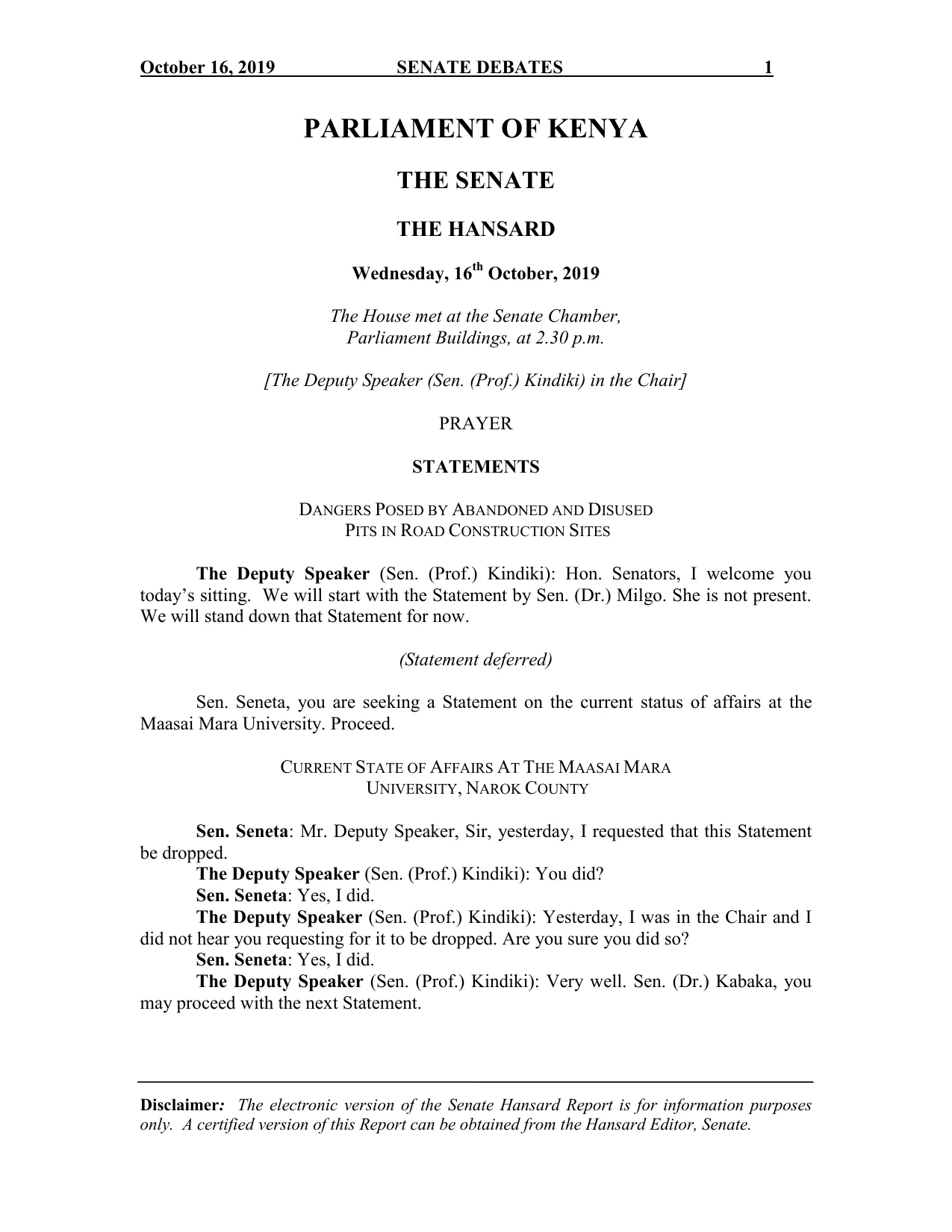
MixedTHE PARLIAMENT OF KENYA
THE SENATE
THE HANSARD
PARLIAMENT OF KENYA
Wednesday, 16th October, 2019
STATEMENTS
DANGERS POSED BY ABANDONED AND DISUSED PITS IN ROAD CONSTRUCTION SITES
Hon. Senators, I welcome you today’s sitting. We will start with the Statement by Sen. (Dr.) Milgo. She is not present. We will stand down that Statement for now.
Sen. Seneta, you are seeking a Statement on the current status of affairs at the Maasai Mara University. Proceed.
CURRENT STATE OF AFFAIRS AT THE MAASAI MARA UNIVERSITY, NAROK COUNTY
Mr. Deputy Speaker, Sir, yesterday, I requested that this Statement be dropped.
You did?
Yes, I did.
Yesterday, I was in the Chair and I did not hear you requesting for it to be dropped. Are you sure you did so?
Yes, I did.
Very well. Sen. (Dr.) Kabaka, you may proceed with the next Statement.
IMPENDING EVICTION OF MAVOKO RESIDENTS
Thank you, Mr. Deputy Speaker, Sir, for giving me this opportunity to seek a Statement on the impending eviction of a section of residents of Mavoko from their land by the East African Portland Cement Company in Machakos County.
Pursuant to Standing Order 48 (1) , I rise to seek a Statement from the Standing Committee on Land, Environment and Natural Resources regarding the impending eviction of a section of residents of Mavoko, Machakos County, from their land by the East Africa Portland Cement Company (EAPCC) .
In the Statement, the Committee should-
This is an important matter. I will therefore exercise my discretion under Standing Order 48 (3) and ask the Committee on
Lands, Environment and Natural Resources to get seized of the matter, liaise with Sen. (Dr.) Kabaka and advice the House on the way forward.
Let us move to the next statement.
DANGERS POSED BY ABANDONED AND DISUSED PITS IN ROAD CONSTRUCTION SITES
Mr. Deputy Speaker, Sir, pursuant to Standing Order No.47 (1) , I rise to make a statement on an issue of general topical concern regarding dangers posed by abandoned and disused excavated pits in road construction sites across the country.
Mr. Deputy Speaker, Sir, it has become common nowadays that behind every road construction, there is a disused excavation site abandoned by road constructors. The road contractors usually excavate stones and murram for construction but after they are done, they do not bother to reclaim the land or put in place safety measures to prevent exposing people and animals to danger.
Last week, in Siongiroi, Kelichek area of Bomet County, two people perished after falling into a deep excavated area filled with water. A few months ago, a high school student also fell in another excavated area around Ndaraeta area of Bomet County and lost her life.
Mr. Deputy Speaker, Sir, such cases happen frequently not only in Bomet County but across the country. The trend of contractors abandoning excavated sites without reclaiming them should be stopped. The Ministry of Transport, Infrastructure, Housing and Urban Development and all other responsible State agencies should formulate stringent measures to ensure road construction companies bear a heavy responsibility for environmental degradation. My concerns are-
Thank you, Sen. (Dr.) Milgo. Kindly, proceed, Sen. Dullo.
CHALLENGES EXPERIENCED IN THE IMPLEMENTATION OF THE UHC PROGRAMME
Mr. Deputy Speaker, Sir, I rise pursuant to Standing Order No. 48
Chairperson, Committee on Health, kindly liaise with the Senator for Isiolo County to address the issues raised in her statement.
Mr. Deputy Speaker, Sir, the statement from my colleague, Sen. Dullo, is noted. I wish to point out that the Committee on Health had visited Machakos County, which is one of the pilot counties and made observations on the same issues that have been raised by Sen. Dullo. However, we will undertake to look at the issues that she has raised together with what we had tabled before this House on 7th August, 2019 and get a comprehensive report from the Cabinet Secretary responsible for the Ministry of Health.
I thank you.
Sen. Dullo, do you have something to say?
Mr. Deputy Speaker, Sir, I did not understand what the Chairperson of the Committee on Health has said. This is a specific statement from me. I would like it to be treated separately. Just because they visited one county, it does not mean that it will address my question.
Chairperson, Committee on Health, the UHC pilot programme is being piloted in four counties including Isiolo. I believe the experiences are not the same. Therefore, even if you had visited one of the four pilot counties, that should not suffice.
Mr. Deputy Speaker, Sir, I am obliged. I will look into Sen. Dullo’s Statement.
Thank you, Chairperson, Committee on Health.
Let use proceed to the Statement by Sen. Halake.
JOBLESSNESS AMONG NYS GRADUATES
Mr. Deputy Speaker, Sir, I rise pursuant to Standing Order 48 (1) to seek a statement from the Standing Committee on Labour and Social Welfare regarding joblessness among graduates of the National Youth Service (NYS) . In the Statement, the Committee should address the following-
Chairperson, Committee on Labour and Social Welfare, kindly address that issue.
Sen. (Dr.) Milgo, kindly give a response on behalf of the Chairperson.
Mr. Deputy Speaker, Sir, we shall take up the issue.
Thank you. Please, do. Order, hon. Members. I direct the Majority and Minority whips to keep the Chairperson informed of the possibility of numbers. We have some divisions to transact in the course of this afternoon.
That is the end of Statements. I will now direct that the Order on Petitions be called out again.
RISING INSECURITY IN LAIKIPIA WEST CONSTITUENCY, LAIKIPIA COUNTY
Thank you, Mr. Deputy Speaker, Sir. I am standing to read a Petition on behalf of the people of Laikipia County.
I, the UNDERSIGNED on behalf of the residents of Laikipia County, draw the attention of the House to the following:-
THAT, the residents of Laikipia County, Laikipia West Constituency, have existed peacefully in minimal cases of insecurity.
THAT, in the recent past, groups of armed bandits have emerged, terrorizing residents of Wangwachi, Ol-moran Ward, Kamwenje, Lubere and Eighteen in Githiga Ward.
THAT, these bandits have continued to rain havoc in many parts of the vast Laikipia County with unabated impunity.
THAT, the presence of the bandits has led to escalated insecurity and conflict, especially in the two wards of Ol-moran and Githiga.
THAT, on 20th January, 2019, the same bandits attacked residents of Wangwachi Village, stealing 14 cows and nine goats.
THAT, further, on 12th February, 2019, the same bandits shot Ann Cheptoo of Matwiku Village leaving her with serious injuries.
THAT, further, on 16th March, 2018, the said group allegedly stole livestock at Kamwenje; that is four cows, two donkeys and 19 goats.
THAT, efforts to resolve this matter have been futile. THAT, on 13th October, 2019, more than seven cows were stolen belonging to Maina at Wangwaci in Sipili, and two people were seriously injured.
Mr. Deputy Speaker, Sir, the matter presented in this Petition is not pending before any tribunal or court of law.
THEREFORE, your humble Petitioners pray that the Senate, through the Departmental Committee on National Security, Defence and Foreign Relations-
Thank you, Sen. Kinyua. Committee on National Security, Defence and Foreign Relations, the issue of insecurity has resurged in very many counties, especially in counties whose police reservists were withdrawn. Therefore, you should take up that Petition.
In accordance with Standing Order No.232, I commit that Petition to the Committee on National Security, Defence and Foreign Relations. Within 60 days, the Committee is directed to report to the Petitioner and file or table that report in the Senate.
Very well. Please, call out the Order on Statements once more.
INSECURITY IN SAMBURU COUNTY
Thank you, Mr. Deputy Speaker, Sir. I rise, pursuant to Standing Order No.47 (1) to make a statement on a matter of countywide, intercounty and national concern; namely the general state of security in Samburu County and the greater northern Kenya region in general.
Mr. Deputy Speaker, Sir, there has been a serious escalation of banditry attacks on residents of northern Kenya, particularly in Samburu County. Statistics from police records indicate that from 2012 to date, over 115 persons have lost their lives. Among them are 42 National Police Service officers, eight National Police Reservists, while approximately 78 persons have sustained injuries related to the attacks over this period. Additionally, 5,838 heads of cattle, 187 camels; 3,666 goats and sheep and 93 donkeys have been stolen from the largely pastoralist communities in Samburu North Constituency.
Mr. Deputy Speaker, Sir, it is regrettable that, recently, firearms in the custody of police reservists in the region were withdrawn by the National Police Service, thereby leaving the communities in Samburu County vulnerable to banditry attacks.
Mr. Deputy Speaker, Sir, there are still many illegal firearms in the hand of civilians in the Northern Kenya region, which are largely to blame for the escalation of banditry, with the resultant loss of lives and livelihoods and increase of orphans and widows, particularly in Samburu North Constituency. The Government should put up interventions to mop up the illegal firearms permanently to address the long-standing problem of banditry in the area.
Mr. Deputy Speaker, Sir, the House will also recall that to date, no conclusive action has been taken to address the killing of the 42 police officers who were killed in Baragoi, Samburu North Constituency, in 2012. This may be the reason police officers are reluctant to pursue bandits.
Mr. Deputy Speaker, Sir, my concern is the fact that there still seems to be little or no Government will or action to address the security situation in Samburu County, more specifically in Samburu North Constituency, whenever these attacks happen.
Mr. Deputy Speaker, Sir, I will highlight the regrettable events in Samburu County from 1st February, 2018, to date as follows-
Very well. I will allow one or two Senators to say few things on that Statement.
I see a request from Sen. Kirinyaga.
Thank you, Mr. Deputy Speaker, Sir. I rise in regards to these two Petitions, one by the Senator for---
One is a Petition which is closed. However, you cannot comment on it in the context of the Statement made by Sen. (Dr.) Lelegwe.
Mr. Deputy Speaker, Sir, I rise because of the importance of the subject matter raised here which involves Samburu and Laikipia belts. I wish to draw the attention of this House to the utmost importance of the Laikipia belt which has the only area that has been left for conservation. It has had security threats because there are people who think that they are above the law. This is a not a case of cattle rustling; this is a matter which is inherent in tribal profiling. They want to chase people out of where they are dully and legally settled.
Mr. Deputy Speaker, Sir, I draw the attention of this House to a lady who has been living on a certain parcel of land in Maralal for many years and was committed to conserve it. However, she was attacked, killed and her place burnt down. So, as you refer this matter to the Committee, you should direct that we are looking at a bigger issue of insecurity in the country which can lead to tribal conflicts. In fact, in some areas, people have been killed not because of cattle rusting; cattle are taken after people are killed. This is trying to drive people out of areas where they have settled.
Mr. Deputy Speaker, Sir, yesterday, we mentioned an incident that happened in some part of North Rift. Therefore, your direction to the Committee should be a clear statement that Kenyans have a right to own property and live anywhere they want. The Government should also protect the lives of the people and their properties.
Thank you, Mr. Deputy Speaker, Sir. I wish to support this Statement. I suggest that as the Statement goes to the relevant Committee, they should look at the issue of the law that was enacted on cattle rustling which criminalized it with the hope that certain actions will be taken. It would be good to know what impact that law has had since it was enacted. From both the Statement and Petition, it seems like what we had about three years ago is coming back.
I know that the Joint Committee on National Cohesion and Equal Opportunities did a lot of work. They went around the various communities and created many initiatives to create peace within these communities. There was a time where there seemed to be some improvement. So, there could have been a gap somewhere or something is resurging again. Therefore, it is important to contextualize along a
continuum what could be happening and the effect of the law that should have been put in place.
That which is being referred to as cattle rustling is actually robbery with violence and is punishable by death under the law. So, Sen. (Dr.) Zani is right. We would like to know why despite these heavy sanctions in the law the problem does not seem to go away.
Mr. Deputy Speaker, Sir, I join my colleagues in supporting this Statement. There is a situation where the fight is within Samburu and not from outside. It is people who live in the same county that are attacking each other. With that kind of situation, this is not inter-county but intra-country fights and rivalry. Therefore, we need to think of how to deal with this situation where people who live together and are from the same county are fighting.
In Laikipia County, it is both of inter-county and intra-county fights. This matter should be put to rest. I do not know how many laws we will have to pass on this matter. We have enough laws. Therefore, what we need to address is why the laws are not implemented. We should seriously think about why we make more laws and not implement them. Therefore, I ask the Committee to take this seriously. There is nothing new; everything that it needs is already in existence.
Thank you, Mr. Deputy Speaker, Sir. Reading this Statement, a person gets a bad impression about the status of security in Samburu.
As Sen. (Dr.) Zani mentioned, in Samburu, West Pokot, and parts of Baringo, where Sen. Moi, comes from, cattle rustling has become a game of polo where people steal, kill and it is business as usual. The statistics that are here are troubling.
Mr. Deputy Speaker, Sir, it appears, like Thomas Hobbes used to say life in Samburu has become nasty, brutish and short. For example, cattle rustlers kill two people and steal 600 herds of cattle, et cetera.
Sen. Murkomen addressed the issue of picking arms from police reservists and others. However, the solution should be that cattle rustling must be a capital offence.
I think that is the only way, so that people can stop making it a sport, that one can steal cattle and then kill people. Maybe that way, we can help. However, if the Committee on National Security, Defence and Foreign Relations should find a solution because the killings have been going on - according to the Statement of Sen. (Dr.) Lelegwe - for a year-and-a-half. It is going on randomly. It is the same thing that was happening in Kitui. It appears the death of a camel and a Kenyan is treated in the same way. In Samburu, the death of a goat, a camel and a human being are treated in the same way. Something is wrong with this country the way it takes the lives of people so casually. We support you, but we ask the Committee to find a good method of resolving this.
I saw the leaders of Kitui County going to visit the Cabinet Secretary for Interior and Coordination of National Government and afterwards, for some strange reason, the insecurity stopped. Perhaps, that is one of the solutions, but there needs to be a permanent solution to loss of lives---
What is sit, Sen. Farhiya? Are you on a point of order?
Mr. Deputy Speaker Sir, it is a point of information.
Sen. Mutula Kilonzo Jnr., would you like to be informed by your sister?
Mr. Deputy Speaker, Sir, do you want me to say “no”? However, I have no problem with that.
I have to inquire. The rules require that I inquire whether you are interested in the information.
Proceed, Sen. Farhiya.
Thank you, Mr. Deputy Speaker, Sir. Thank you, Sen. Mutula Kilonzo Jnr. for allowing yourself to be informed. To a pastoralist, a camel, a goat and a cow are much more important than a human life. The death of these animals can start a conflict more than the killing of a human being. It is our way of life.
Mr. Deputy Speaker Sir, I do not know whether you heard the information that I have been given. Maybe I should have taken your offer.
I did not offer anything, Sen. Mutula Kilonzo Jnr. I just asked you whether you were interested in the information and you said yes.
Yes, Sen. Farhiya has said that in some places in this country, the life of a camel or goat are more important than that of a human being. This means that there are some people in this country who are living in a jungle.
Thank you, Mr. Deputy Speaker, Sir.
Very Well. I think the interest is very high. We will not be able to accommodate everybody, but let us hear from Sen. Halake.
Thank you, Mr. Deputy Speaker Sir. I rise to support this Statement. This Statement could very easily apply to the counties of Isiolo, West Pokot, Wajir and all the northern Kenya counties. Therefore, I support this Statement and this matter should be dealt with very seriously. We have lost people in each of these counties, especially in Isiolo where very recently, I think it was Sen. Dullo who brought a similar Statement. The frequency, intensity and multiplicity of these things has become a bit too much. The media has been awash with this. The socio-economic aspects of this cannot be gainsaid because we have one of the highest poverty rates in northern Kenya, not because the people are lazy, but because people’s lives and livelihoods are wiped out within minutes based on this insecurity.
Also, there is a gross violation of human rights within this insecurity issue---
You are not debating the Motion, just give a few comments and observations. Actually, one minute is enough. Just say one or two things.
Mr. Deputy Speaker Sir, please, allow me to bring the angle of the livelihoods of pastoralists. The fact that the poverty is linked directly to this insecurity, and the fact that there is violation of human rights whereby people from northern Kenya are sometimes not considered under the Constitution precisely because of this.
Thank you, Mr. Deputy Speaker, Sir.
Very Well. Sen. (Eng.) Hargura, please, be brief. We have a short time.
Mr. Deputy Speaker Sir, I will be very brief. However, I would like to add some information which will be of use to the Committee. If you look at that list given by Sen. (Dr.) Lelegwe, some of those people are from my county. Incidentally, when the teacher was killed, I was in Baragoi that night. A statement made by a police officer the next day actually shows what was going on. I was there together with the Member of Parliament for Laisamis and some MCAs. We followed up the issue because the four people who were killed come from Ngurnit Ward of Laisamis Constituency.
In the morning, the OCPD, said that the teacher who died was not meant to die. What he meant was that the teacher was killed outside the lodge where we spent the night. The teacher was with us but when he walked out, he was killed. What the OCPD meant to say was that the teacher was not supposed to be killed; the killing was intended for the leaders who came from Marsabit.
I would like to urge the Committee to take into account that these raids have been there. It is actually an inter-county issue because most of the affected people sometimes come from Marasbit County during the dry season. In 1972, 1976 and 1996, there were raids. To jog your memory, 1996 was when the District Commissioner for Maralal, Henry Nyandoro, was killed when his chopper was brought down by the same bandits. This happened when the Government was trying to recover livestock. When the Government tried to recover livestock in 2012, 42 Government officers were killed. It has reached a point where it appears like Suguta Valley is not a part of Kenya.
When similar situations occur in areas like Mt. Elgon, the Government dispatched the Military there to contain the situation. In Boni Forest - which is part of this country – the Military is there because there are bandits in that forest. What Sen. (Dr.) Lelegwe did not say is that none of these animals are recovered. Once they are taken into the valley, you just forget them. That creates impunity and a myth that there are parts of this country which cannot be governed. If you have that kind of a situation, then you will not be providing security.
Mr. Deputy Speaker Sir, allow me to add that the situation this year is even worse because the Cabinet Secretary for Interior and Coordination of National Government disarmed the National Police Reservists (NPRs) but he did not disarm the illegal gun holders. Now the illegal gun holders are the ones who are doing all this knowing very well that the regular police will not get out of their camps to go and follow cattle rustlers and that the NPRs who the Government has been relying on have been disarmed. It is a Government policy which is causing this insecurity. I would like the Committee to take it up very clearly with the Cabinet Secretary and establish how this policy was
implemented while illegal gun holders are still there and they are the ones causing this mayhem.
Hon. Senators, I may not be able to exhaust everyone. I know this is a matter that is affecting large parts of the country, especially the arid and semi-arid pastoral areas of Kenya. It is a grave matter, especially in connection with the disarmament of the NPRs, but this is a Statement under Standing Order No.47. In fact, we have overshot our time. Nothing prevents the leaders from the affected regions from bringing a Motion calling for concrete measures.
On a point of order, Mr. Deputy Speaker Sir.
What is it, Sen. Dullo? You seem to be having information that could be of help to the House.
Mr. Deputy Speaker Sir, I do not have information that will give us a solution, but there is one point that I really wanted to add.
In the process of disarmament of NPRs, the NPRs at the border level were not disarmed. They are the ones that are actually terrorizing people. We want to know how they are being controlled so that they do not terrorize people.
Secondly, there was a promise regarding those who were disarmed. We were promised that the Government would come up with regulations in terms of how the firearms are going to be used. Up to now, we have not received information on the matter from the Ministry of Interior and Coordination of National Government. Could the Committee look into that? Let them at least give us NPRs so that they can complement the regular police and security.
Thank you, Mr. Deputy Speaker, Sir.
Thank you, Sen. Dullo but the last time I checked you were the Vice Chairperson of that Committee. I do not know who you are addressing when you say; “can the Committee---” I am addressing you because Sen. Haji, who is the Chairperson, is not here. This matter affects large parts of the country because lives are being lost.
The issue of disarmament is sensitive. I heard the Cabinet Secretary (CS) for Interior and Coordination of National Government making certain promises. Therefore, I will exercise my discretion under Standing Order No.47 (3) and commit this matter to the Committee on Security, Defence and Foreign Relations. I direct further that the Committee invites the CS for Interior and Coordination of National Government because he is in charge of security.
I want to make this pronouncement from the Chair that I have overheard some pedestrians and gentlemen misadvising some CSs. They tell them that their mandates have nothing to do with devolution and functions of the Senate. I made a ruling here about one year ago. I am saying this because one of the CSs being misadvised is the CS for Interior and Coordination of National Government. I hope he or his officers are watching the proceedings of the House. The pedestrian argument which was being peddled was that since security is a national Government function, it has nothing to do with devolution. I have never heard of greater absurdity.
I have made a communication from the Chair before that even functions that are 100 per cent devolved, like national security, are matters that impact on devolution. This
is because, for example, a rundown of security and order makes it impossible for counties to perform their ordinary functions under the Fourth Schedule. If there is no law and order, how does a county government deliver on agriculture, livestock, markets, trade and what have you?
I direct the Committee to directly engage the CS for Interior and Coordination of National Government. If possible, they should visit the affected areas and bring concrete findings which will help this Senate create some hope in the counties affected by this problem.
Therefore, the ball is in the court of the Committee on Security, Defence and Foreign Relations. I expect you to table a report in this House within 21 days. It is so ordered. Hon. Senators, we will leave it at that.
Are you ready, Senate Majority Leader? Let us go to the next Order.
PAPERS LAID
CERTIFICATE OF APPROVAL TO THE NEW DEBT CEILING
Mr. Deputy Speaker, Sir, I beg to lay the following Paper before the Senate:-
Certificate of Approval to the new debt ceiling approved by the National Assembly
REPORT OF THE COMMITTEE ON DELEGATED LEGISLATION OF THE NATIONAL ASSEMBLY
Mr. Deputy Speaker, Sir, I beg to lay the following Paper before the Senate:-
Report of the Committee on Delegated Legislation of the National Assembly
MEMORANDUM ON POLICY AND LEGAL JUSTIFICATION FOR PROPOSED AMENDMENT
Mr. Deputy Speaker, Sir, I beg to lay the following Paper before the Senate: -
Memorandum on the Policy and Legal Justification for proposed amendment
REGULATORY IMPACT ASSESSMENT OF THE PROPOSED AMENDMENT
Mr. Deputy Speaker, Sir, I beg to lay the following Paper before the Senate: -
Regulatory Impact Assessment of the proposed amendment
Senate Majority Leader, kindly, approach the Chair for a moment.
Proceed, Senate Majority Leader.
Thank you, Mr. Deputy Speaker, Sir, for your guidance. I should have actually tabled the Regulations because the other documents were just attachments to them. Therefore, allow me to make a correction.
THE PUBLIC FINANCE MANAGEMENT (NATIONAL GOVERNMENT) (AMENDMENT) REGULATIONS, 2019
I will make a communication on that report shortly. Perhaps this is not the right time for any comment unless it is on a different matter, Sen. Mutula Kilonzo Jnr. Once I issue the communication, maybe you can make some remarks on the topic.
Is it not a ruling?
It is not a ruling but a communication.
Sen. Mutula Kilonzo Jnr., you are speaking to yourself.
Since I knew you were going to make a ruling, I thought I should intervene before you make the ruling. This is an important matter. As
the Senate Minority Whip, I request that you allow general comments on it because there are serious issues that we must talk about.
I will see how much I can accommodate but you are definitely right. It is important, and I would like the House to benefit from one or two comments after I issue my communication.
Let us move to Order No.8.
COMMENDATION OF ELIUD KIPCHOGE AND OTHER KENYAN ATHLETES FOR THEIR OUTSTANDING PERFORMANCE
This is a continuation of debate. I will allow a few of us who never spoke yesterday to do so. In the meantime, I request that the Whips inform the Chair if at any given time you are able to raise the required numbers for purposes of carrying out the divisions because we have several of them this afternoon.
Proceed, Sen. Poghisio.
Mr. Deputy Speaker, Sir, I rise to support the Motion on commendation of Eliud Kipchoge and others who have made us proud in the field of athletics. Last week, Kenyans felt proud and the Flag of Kenya was a common occurrence in Vienna and on television screens all over the world. The unity of Kenyans was shown at that time.
I would like to begin by commending Eliud Kipchoge for his effort and prowess and making history by being the first human being to run a marathon in a time that no one has ever done before because he ran a marathon under two hours. In my own small way, I have been organising a small half marathon in Kapenguria every year. It is known as Kalya Half Marathon.
I have run a half marathon and completed. I cannot tell you the time it took me to finish the race but I finished. I will not talk about the consequences of running. For him to achieve that in less than two hours in the glare of the whole world, Kenya gained recognition as it has always. Therefore, I congratulate him.
There was unity at that time amongst our people. I am told that when we have something like that, we become one. When we go to our homes in the evening, we separate and become tribal. Our memories are quite short-lived. Kenya can be great and we do not need to be reminded because we can be one. We can also work together to build our name and retain it internationally.
Mr. Deputy Speaker, Sir, I am a very proud person, and I want to also recognize the other athlete such as Brigid Kosgei who broke the world record in Chicago. That record had been held for 16 years by Paula Radcliffe. However, it had to be broken by a young lady who started not too long ago. Two years ago, she ran the Kalya Half Marathon in Kapenguria. She was the winner that time. Little did we know that she was going on to the international stage and break a world record. You can imagine how much we can do as a country.
I am sorry to say that the state of our training facilities is deplorable. This is the goose that laid the golden egg and yet providing for athletes has been a problem for this country. When you look at how much we have said we will prepare stadia and training places for them; these people run around their farms and still come out and win. They run around whatever hill they can find. There is no particular training facility. They suffer a lot. We, as a country, think very little of them and yet they are the ones who carry our flag every day. When the Kenyan flag is raised everywhere in the world and the National Anthem is sung, “Oh God of all Creation; Ee Mungu nguvu yetu,” we should be proud. That brings us together.
Mr. Deputy Speaker, Sir, I want to appeal from this House that we should take seriously the matter of training facilities, provisions and healthcare for our athletes. They fight for themselves even for healthcare. We need to recognize them. The other day, I
was amused when someone said if you look of people who have gotten State Honors, the Head of State Commendations and other commendations, you do not want to put our athletes in some of them because that is what we have seen. We should raise the level of these athletes because they have denied themselves a lot to reach where they are.
The only reason I could not finish a full marathon is because, probably, I was not well prepared for it. You have to get rid of all elements called lipids from your body. To do so, it is not easy. It takes a lot of work and sacrifice.
Where is the difficulty, Sen. Poghisio?
Yes, they deny themselves quite a bit. So, I would like to commend them. Even though they are not all mentioned here, there are very many Kenyans who have done us proud this year. I do not want to belabour the point that we need to think seriously about our sports facilities in this House because sports is a devolved function. It is a matter which is within our means. We can do a lot in our counties to improve our facilities. It is not true that it is only people from this part of Rift Valley who can be champions. Champions can come from anywhere in this country if we decide to train them properly. In the past, we had champions from other parts of the country.
I do not know what is happening nowadays because we are almost zoning players. This should not be the case. We should have champions from the coast all the way to Turkana. We should have athletes who are running the marathon and participating in other sports activities across the country.
The other thing which I must say is that we are not good at commending people. I think we do not have a language for commending people. Probably, we are good at condemning rather than commending people. When I saw Kenyans commending Eliud Kipchoge, I was happy. But I wondered what could have happened if he did not make it under two hours. Would we have commended him for even trying? We should continue to encourage our athletes and help them to continue winning.
I want to commend and thank the organizations who have continued helping our athletes. There are many people who are not Kenyans, but they help our athletes to excel. They are coaches, managers and organizers of the competitions. I want to commend them for according our athletes opportunities to shine.
I know that many things have been said, and I do not want to repeat them. I am a proud Kenyan. Athletes have made us one and united country. We are more united than before. I was very impressed by Eliud’s own expression of what his goal is: “No human being is limited.” I am just very proud that he can express himself that way so that he can even say to Mr. Obama, the former President of America, come and let us make athletes and this world a running world because with the running world, it will be a peaceful world.
In conclusion, insecurity is still a problem in our region. If we want to bring down this insecurity, let us engage these young people in athletics. Let us take training to them
and allow them to compete in athletics and other sports activities. Instead of competing in shooting each other, they should compete on how to lower Eliud Kipchoge’s time.
Thank you, Mr. Deputy Speaker, Sir.
Thank you, Mr. Deputy Speaker, Sir, for giving me an opportunity to make a few remarks in support of this very important Motion.
Eliud Kipchoge and Brigid did us proud. We are very proud to be associated or identified with them as a nation and as individuals. They have done very well to give us the much accolade we need. There are also other athletes in the past who have contributed positively to giving Kenya a good image. They also deserve our appreciation. There are many more sports persons who continue to give us the good image that we should have as a nation, they equally deserve appreciation.
Mr. Deputy Speaker, Sir, to attain the kind of feat Eliud Kipchoge attained for himself requires discipline, effort and not just knee-jerk effort, but serious effort, training, support and spirituality. I think that all these requirements repose in Eliud Kipchoge. Indeed, he was able to confirm that human limitations are imposed by human beings and can be exceeded or broken any time. This also goes for Brigid Kosgei for what she achieved.
Sports people, particularly young people who engage in sports and who are appreciated for engaging in sports, if you look at their general behaviour in life, you will find that they shun violence, indiscipline and all the vices that good people do not want to be identified with. The reason they do so is that the human mind likes being appreciated. Once people identify you as a hero and say that you are a good person, you begin to see how responsible you should be. You begin to appreciate the fact that human beings have identified you as a leader and you continue walking in the light being a good example to others.
One of the best ways of ensuring that young persons in this nation continue walking in the right path is to create a culture of appreciating success. If our children or our young ones who are successful in school or in any activity that they endevour to get in are appreciated, they confer upon themselves the responsibility of behaving well.
Therefore, Mr. Deputy Speaker, Sir, I plead with colleagues that the institutionalisation of appreciating people who do well will go a long way in ensuring that young persons in this nation are inspired. It is quite timely that in the very good House called the Senate, we are taking our time to discuss the success of Eliud Kipchoge, Brigid Kosgey and other athletes. We are doing a very positive thing, and I hope that this appreciation will not just stop in the context of this Motion. We should think of tangible things that should be done or put in place to support and make life bearable for our heroes and heroines, so that we appear to appreciate heroic acts both in word and deed.
I know that one or two of our previous heroes have had stadia named after them. For instance, we have the Kipkeino or Kipchoge Keino Stadium in Eldoret, Uasin Gishu County. Recently, in this House, we discussed the success of one Joe Kadenge. It was proposed that we name one stadium in memory of that individual, but it has not been done. I hope that those who listen and take note of what we debate here will do that. We should think of what institution, memorable event or place to name them so that we appear to honour Eliud Kipchoge, Brigid Kosgey and all the other persons who have
done this nation proud. That way, we will not appear to be just coming here to make speeches.
Mr. Deputy Speaker, Sir, we should also think of how to reward or appreciate the heroes we have in a material sense. There are many people who have made our anthem to be sung in certain places. In my other life, I was the Minister for Sports, Heritage and Culture, and I traveled to Helsinki, Finland, for an event organised by the International Association of Athletics Federations (IAAF). When I visited that nation, I also had the misfortune of visiting one of our very well renowned athletes in one of the Finnish jails, Billy Konchellah. I found out that he was quite low, and there was no support that was coming from home. There was also no system that had been put in place to try and rescue him from the oblivion that was visiting him in life, after being a very successful athlete.
Mr. Deputy Speaker, Sir, there is also another athlete in the United States of America (USA), who is frequently reported to have fallen out of fortune, and he is currently on drugs and is drinking a lot. There is no system in place to support that kind of athlete so that we know that there was once a great person in that name.
We have the likes of Congestina among the ladies, and I am yet to find one of our colleagues who represent the marginalised gender talking about her. I hope that something will be done to mitigate the adversities that are visiting the life of that poor lady from Siaya County. I hope that my senior colleague, Sen. Orengo, will mobilise us to intervene, in our humble way, to make the life of Congestina bearable. She once made us proud, and to see her suffer in that neglect and poverty is very sad.
Therefore, Mr. Deputy Speaker, Sir, it is right and proper for us to appreciate our athletes, and also to support them as best as we can. There are other forms of support, like trying to provide a social safety net to mitigate their adversities in life, including even putting a pension scheme in place for them. These athletes lead a disciplined life; for example, Paul Tergat, Kipchoge and all of them. They work very hard and someday they retire in difficulty. A few of them make it in life and are quite successful. However, for the ones who do not become successful materially, I do not think that this great nation is poor to the extent that we cannot provide a general pension scheme and medical cover to take care of some of these internationally acclaimed or appreciated athletes. We have had the honour and privilege of being members of the same country with these athletes.
Mr. Deputy Speaker, Sir, if you go to a country like in Ethiopia, you will find that the respect and reverence that they give to a person like Kenenisa Bekele, they respect, support and appreciate their athletes who have done well, but who have not achieved the feat that has been achieved by Eliud Kipchoge. They give them the kind of recognition and support they are supposed to be given. I do not think that Ethiopia, as a nation, is richer than us in terms of spirit or resources. If they are able to do it and they are here in Africa, we should also be able to do it. We are in the same Africa; we drink the same coffee and tea they drink. Therefore, if they appreciate their people, who are Africans, we should also appreciate our people, who are Africans.
Mr. Deputy Speaker, Sir, I believe that these athletes do much more than we do, as politicians. You will find that when a politician is lost or is suffering, all of us come together and remember those politicians. If I am to suffer – and I know I will suffer one day – I would not want to be remembered, but to at least bear my own suffering.
However, if you can do it for Eliud Kipchoge and the other fellows, and ensure that the safety net is given to them, that should take care of their interest and that of all politicians
Summarise and wind up.
Thank you, Mr. Deputy Speaker, Sir.
Thank you very much, Sen. Ochillo- Ayacko. You could have been louder, because you have made very profound remarks and contributions. I hope that next time, you will be a little bit louder.
I have a request from Sen. Seneta, but she is not here. That request is stood down. Proceed, Sen. Kinyua.
He is gone.
That request is also stood down. Proceed, Sen. Mutula Kilonzo Jnr.
Thank you, Mr. Deputy Speaker, Sir. I also join my colleagues in commending Eliud Kipchoge, Brigid Kosgey and our entire team that was in Doha.
Surprisingly, Mr. Deputy Speaker, Sir – and I want the Senate Majority Leader to hear this – Brigid Kosgey is back in the country. She just came back into the country very humbly and quietly, with no fanfare. I am just praying that Eliud Kipchoge---
I am told he is already at home. He came quietly. While we are commending him, he is just somewhere in Eldoret with no motorcades. It feels very sad.
Sen. Orengo and I travelled recently and came across one of the most famous stadiums. We were commending the Brazilian team for the things they have done. When France won the World cup or any other team won the Champions League, they would not go back home quietly. We would not allow them to come quietly. If this lady was from Qatar or any other country, she would not come back home quietly. It is sad that they came in quietly and it was business as usual.
Mr. Deputy Speaker, Sir, I want to agree with Sen. Poghisio that, first, Eliud Kipchoge weighs 57 kilogrammes. I do not know how many Members of this Senate weigh 57 kilogrammes.
I do not weigh 57 kilogrammes. That is why I have included myself.
Order, Sen. Dullo!
When Sen. Poghisio was talking---
What is it, Sen. Murkomen? Are you in defence of your deputy?
On a Point of Order, Mr. Deputy Speaker, Sir. Did you notice that when Sen. Mutula Kilonzo Jnr. asked how many Members weigh 57 kilogrammes and below, Sen. Halake was struggling and lifting her hand? Considering it was a question, could she be given an opportunity to also answer?
I do not want to speak for Sen. Halake, but we know. The challenges that Sen. Poghisio was talking about, not being able to run are real. This is because, first of all, he must lose weight and be as light as this man for him to run fast. However, it is pure sacrifice.
He is also right that we spend so much time commending so many people, but people like these do not get the commendations that this country should give them. There should be a roll of honour for people like Eliud Kipchoge. There should be a street where you can find a star, not just naming a street. I have no problem with having a street in Eldoret named after him, but is that the way to honour somebody, that when you become a hero a street is named after you? It is so primitive! I do not understand some of the things we do.
The third one that worries me is that all over the world, whether it is football or cricket the people who excel in these activities become billionaires, not from earnings of the sport, but from brand endorsements.
I was speaking to Sen. Orengo and Sen. Cherargei and wondered who knows the agreements that Eliud Kipchoge has entered with Nike and INEOS. Do we know? Are we as a country interested in the brand that he was wearing of Nike in terms of earnings? That is where Eliud Kipchoge should be making money from, and it should interest this country. The Ministry of Sports, Culture and Heritage should get involved in this person making money. Sachin Tendulkar, Wasim Akram and others who have played cricket have become billionaires for life because of endorsements by companies.
Eliud Kipchoge was our hero at 1:59:40. For purposes of the Majority side, and Sen. Murkomen is here, it would paint a better picture for me as a person if he was received also by somebody from Eastern, Isiolo, Turkana and Nyanza.
However, he was received by Gov. Sang, the Deputy President and people bearing mursik. We have to change. I know it is an honour welcoming people back to the country by giving them mursik, but we should not tribalise some of these things.
What is it, Sen. Murkomen? What is out of order?
On a Point of Order Mr. Deputy Speaker, Sir. Is Sen. Mutula Kilonzo Jr. in order to reduce the Deputy President of the Republic of Kenya, who was there on behalf of the Republic of Kenya and Gov. Sang, who is building Kipchoge Stadium together with sponsors sought by Eliud Kipchoge? Gov. Mandago was also there as the governor representing Kipchoge from the area where he lives in Eldoret.
More importantly, is he aware that most of those leaders went there out of interest to be there and that no one was blocked from being there?
Sen. Mutula Kilonzo Jr., you have been challenged.
I am simply saying that the optics do not look right. In order to present a better picture to the nation, even if they were going on their own volition, they should have invited people from other regions to accompany them, so that it does not look like a village affair. The delegation comprised of Gov. Mandago from his area and Gov. Sang who is building a stadium. It just looks like a village affair!
Order, Sen. Mutula Kilonzo Jr. What is it, Sen. (Prof.) Kamar?
On a point of order Mr. Deputy Speaker, Sir. Is the son of my friend in order---
Order, Sen. (Prof.) Kamar. We are not at home.
Mr. Deputy Speaker, Sir, with all due respect, is the hon. Senator for Makueni in order to trivialise mursik?
Sen. Mutula Kilonzo Jr., you have compounded your problem. Initially, it was about those who went to receive the champion. You are now being accused of trivialising an important beverage liquid.
What is it, Sen. Murkomen?
Mr. Deputy Speaker, Sir, while I was making a point of order, Sen. Orengo said that I was making the point on behalf of Sen. Mutula Kilonzo Jr. When I sat, I thought that maybe I was wrong. However, when Sen. Mutula Kilonzo Jr. came here, he confirmed my worst fears.
His argument is that the people who went there should not have gone because of the community they come from. I thought his argument would have been, the rest of us who do not come from that region--- If his argument was positive---
Sen. Murkomen, you are now debating.
Mr. Deputy Speaker, Sir, please, allow me to complete. I would have appreciated if his point was to say that the rest of us who do not come from that region with the athletes should also have made an effort to be there to demonstrate that all of us support our athletes no matter where they come from.
However, when he makes the point to say: why did people from that region go there, I think that is an---
Order! Let us hear from the Senate Minority Leader then I will make some directions because this to and fro will have no end.
The Senate Minority Leader (Sen. Orengo) : Mr. Deputy Speaker, Sir, I was just wondering how Sen. Murkomen heard me. I did not stand up; I have not been given a chance to speak.
Absolutely! He could not have heard you.
The Senate Minority Leader (Sen. Orengo) : Mr. Deputy Speaker, Sir, he is collecting gossip and rumours, and that is not part of the official record. No doubt, that is the reason the treatment of our national hero is becoming a village affair because of how he collects what I have said, which is not part of the record. However, more importantly, he has not explained the point that Sen. Mutula Kilonzo Jr. was making; that when there is a national hero, there should be a national reception here or in Berlin.
Yesterday, we were told that even the Ambassador was not there. Even the Senate Majority Leader was not there.
The point being made---
Absolutely! He could not have heard you. The Senate Minority Leader (
Mr. Deputy Speaker, Sir, he is collecting gossip and rumours, and that is not part of the official record. No doubt, that is the reason the treatment of our national hero is becoming a village affair because of how he collects what I have said, which is not part of the record. However, more importantly, he has not explained the point that Sen. Mutula Kilonzo Jr. was making; that when there is a national hero, there should be a national reception here or in Berlin. Yesterday, we were told that even the Ambassador was not there. Even the Senate Majority Leader was not there. The point being made---
Order! The Senate Minority Leader (
I am saying this because there was no national organisation to receive such a hero. When Brazil wins, it is the whole country. If Eliud Kipchoge wins in Berlin or Vienna, the country should be there. I did not hear the Deputy President say that he was there on behalf of the Republic of Kenya. He made it look like an individual affair.
On a point of order, Mr. Deputy Speaker, Sir. You made a good ruling that we must respect all athletes and footballers. I am not in athletics. My type is Victor Wanyama, Olunga and Mariga.
I advise that the matter lies there. Kindly conclude with the beautiful remarks that you were making.
Mr. Deputy Speaker, Sir, you know me to exercise my mind and not leave my brain at home. Sen. Poghisio said, and nobody disputed, that Eliud Kipchoge was a hero for Kenyans by day, but by nightfall he became a tribesperson. That is the point I was making. I was going to get to the point that there is a way we manage our affairs without knowing that we are tribalising them. That is what I was saying.
I said that it is wrong for this country because the gentleman who won eventually had a flag of Kenya, and that is the symbol of the nation. That is how it should look like in his reception and otherwise. It is a way of management. The country has a sports organisation, the Ministry of Sports, Culture and Heritage and an ambassador et cetera. Let us manage our affairs better, so that these matters are treated differently.
The reason I say so is because this afternoon, I met somebody who asked why leaders from Eastern region have not said something about the Likoni Ferry tragedy because the persons who died are Kambas. That is where I am coming from. The persons who died in the Likoni Ferry tragedy are Kenyans and should be treated like Kenyans, and not Kambas because their second names are “X”. In fact, the lady comes from Mombasa, but was married to a Kamba. That is the mistake we make and carry in our national duties, and treat matters that are supposed to be ideally national differently.
These people should be treated like heroes of this country. We should at some point forget their second names. It should be Eliud, 1:59:40 and Brigid. This is because they are Kenyans.
Secondly, there is nothing wrong with being called Eliud Kipchoge. In fact, it should be Kipchoge Kipchumba.
I saw you cheering Gor Mahia?
I am a Gor Mahia supporter. In fact, just to buttress that point, every time I go for Gor Mahia matches or say I am a Gor Mahia fan, few tribal elements say that I am not supposed to support Gor Mahia because of their degenerated minds.
I urge Sen. Mutula Kilonzo Jnr. not to reduce such an important debate. This is because people who congratulated Kenyans in Doha, Brigid Kosgei and Eliud Kipchoge on Twitter and Facebook are from all over Kenya. In fact, videos were posted where children were crying. Family members were laughing and crying because of the happiness that he brought.
If this line is avoided, we will truly be national. The usual thing would have been for me to come here and say that we are celebrating Kipchoge because he comes from “X” or “Y” area.
The way we treated our gallant athletes was wrong.
What in particular? You must relate it to Sen. Mutula Kilonzo Jnr.’s contribution.
Mr. Deputy Speaker, Sir, it is important for us to be serious as a nation. In my view, the way the whole thing was treated is wrong.
What was treated wrongly?
The way we treated our gallant athletes was wrong.
What in particular? You must relate it to Sen. Mutula Kilonzo Jnr.’s contribution.
I support what Sen. Mutula Kilonzo Jnr. has been talking about. Since that was a national issue, it should have been looked at nationally and not as a Rift Valley affair. That was a national issue, but it was treated wrongly. We cannot say that we are trivialising anything if we say that, that was a Rift Valley affair because it was not.
Sen. Mutula Kilonzo Jnr., please, wind up your remarks.
Mr. Deputy Speaker, Sir, in conclusion, the point I made previously is that this country must find one symbol that brings us together because our second names do not. That is why I still think that Kenyans should use the flag as a symbol of national unity, because it is an important tool for bringing us together as opposed to many other issues.
I have made serious comments on serious issues that must be taken for posterity because what has happened has happened, but it should not be repeated. Sen. Poghisio said that if we have sports grounds all over Kenya, it is possible for the next athlete to win a marathon to come from Kwale County. Let us balance the country with that in mind. If there is something like athletics that can make Kenya one, then let us take that opportunity and use it effectively.
Sometimes the Ethiopians run too close to us and it is not very comfortable to us. However, we know very well that if we moved from raw talent to guided, supported, well-practiced and well-nurtured talent, nobody will run anywhere close to us.
Sen. Mutula Kilonzo Jnr. said that the greatest things we should be looking at is, perhaps, endorsements and things like that. I believe very much in deeds and not words. The women movement got where it is today because of deeds and not words. I will challenge Sen. Mutula Kilonzo Jnr. that he and I should look into certain frameworks rather than seeking for endorsements. We need to think of what to put in place, so that international bodies follow certain frameworks that protects the rights of our citizens and for us to get our rightful share in the world.
In terms of the national outlook when our athletes come home, we should practice deeds not words. If we know that he is coming today, for example, what have we done individually? Leadership is about individual action to reach out to the people. Since we know the time he is coming, we need to be at the airport to welcome him, instead of waiting for somebody to call or invite us to go there and welcome him.
We are leaders in this country and free to go anywhere. I am saying this for myself, and have made a note. If we know he is coming on a certain flight because Kenya Airways had tweeted, we could have easily gone and welcomed him. We did not have to wait to be invited by anybody. I will take note, and next time, will be the first one to do so, because I believe in deeds and not words. That is what we need in this country.
I now call upon the Mover to reply.
Order, Sen. Linturi! Approach the Chair.
Mr. Deputy Speaker, Sir, I thank all the colleagues for a job well done in terms of their contributions. I congratulate Sen. Cheruiyot who came up with this Motion and for giving me the opportunity to second it.
I want Sen. Mutula Kilonzo Jnr. to listen. Ms. Brigid Kosgey, the Marathon World Record holder is one of the many world record holders that come from my county. For Sen. Poghisio, it is at the border between Elgeyo-Marakwet and West Pokot. We are very proud to represent these very gallant Kenyans who have done us very proud.
We congratulate Eliud Kipchoge. As Sen. Halake has said, he has been nominated for the Male Athlete of the Year Award together with Timothy Cheruiyot. We can make our contribution by tweeting and re-tweeting because that is part of the voting. Faith Chepkoech, Hellen Obiri and Beatrice Chemngetich who ran the Marathon in Doha have also been nominated for Female Athlete of the Year Award.
Thank you, Mr. Deputy Speaker, Sir. I do not need a lot of time. I rise to support this Motion. I celebrate and salute Eliud Kipchoge, Brigid Kosgei, Timothy Cheruiyot and all the other Kenyans who have ran and done us proud. I also salute all the athletics team that participated in the IAAF World Athletics Championship in Qatar between 27th September and 6th October, 2019.
As I speak, Eliud Kipchoge has been nominated for IAAF Male World Athlete of the Year Award. These are some of the things we need to be campaigning for to make sure he gets it. Of course, he will get it. Sometimes we become spectators in these kinds of things. Hopefully, this county will play its part to ensure that he, for obvious reasons, becomes the Male Athlete of the Year Award, 2019 holder.
Mr. Deputy Speaker, Sir, we have the greatest marathoners both women and men. All this is on raw talent. As my colleagues have said, we need to, perhaps, convert this by providing the right facilities and frameworks within which we can become indisputable.
Order, Senators. Thank you, Senate Majority Leader.
I now call upon the Mover to reply.
Order, Sen. Linturi! Approach the Chair.
All these great ladies and ladies have been nominated and are bound to be recognized by the world any time soon. I believe that at least the male and female Athlete of the Year Award this time round will come from Kenya.
If you remember, Faith Chepkoech ran and led in the 3,000 meters steeplechase from beginning to the end, leaving the rest with a big gap. You will also remember that in July, she broke the world record in the 3,000 meters steeplechase race. Therefore, we have so many world record holders in this country, including David Rudisha and many others, who may not have been running recently.
For the information of Sen. Mutula Kilonzo Jnr. and the rest of the Senators, the official thanksgiving ceremony for Eliud Kipchoge and the team from Doha – the likes of Brigid Kosgei – is going to be communicated to all, including this House. I want to extend a bipartisan invitation to every Senator in this House, as the Senate Majority Leader. We should take that opportunity on that day of the thanksgiving to avail ourselves.
Lastly, I made a request yesterday, which I hope will be honoured in the fullness of time. I strongly believe that if there is a leader who is not holding elective office and I would be more than happy to be given the honour to addresses this House, it is Eliud Kipchoge. That is for his inspiration in terms of what he did – running a marathon in under two hours – and more importantly because he has managed to lead a clean life, as an athlete and inspire others. He was an inspiration when he went to talk to the Tottenham Football Club and the Oxford University. He has continued to be an inspiration in many forums, and I believe given the opportunity, they would do a lot.
Mr. Deputy Speaker, Sir, I just want to confirm what Sen. Mutula Kilonzo Jnr. said here. Eliud Kipchoge just jetted in yesterday and is in Eldoret, where incidentally, he is my neighbour. If you meet him jogging around in the morning, you could never tell that he is a world record holder.
The same applies to Brigid Kosgei. Why should we wish for our athletes the vanity that is associated to largesse, motorcades, red carpets and all those? In fact, in my submission, we should reversing those things. We, as leaders, should be emulating these people by doing great things and go about doing our business in this country, without drawing attention to ourselves with motorcades, sirens, red carpets and big cars. Maybe the true order of things is how these athletes are living.
You do great, go back home; walk in Eldoret normally, associate with people as you have before, and continue helping others. Some of them have built schools, hospitals and made donations to educate children, but they never shout about it. Maybe that is the right order of things, like Jesus did. This is because the only thing we know about Jesus best is that he rode on a donkey. We also know that the Bible says that wherever he went, he did good.
Mr. Deputy Speaker, Sir, those are the things we need to do; that we do good wherever we go without drawing too much attention to ourselves. That is a lesson from our athletes.
Mr. Deputy Speaker, Sir, I beg to move.
Order, Senators. Thank you, Senate Majority Leader.
Will as those of the contrary opinion say nay?
Mr. Deputy Speaker, Sir, is it possible that the HANSARD of these good words of the Senators be forwarded to these good Kenyans as a way of honouring them? That way, they will know that we have spoken about them. Even if nobody else honours them, they should know that the Senate of this Republic has very kind words for them.
Thank you, Mr. Deputy Speaker, Sir.
Very well. Is that the mood of the House, as proposed by Sen. Mutula Kilonzo Jnr.? Will as many of that opinion say ‘Aye?’
Aye!
Will as those of the contrary opinion say nay?
COMMITTEE OF THE WHOLE THE NATURAL RESOURCES (BENEFIT SHARING) BILL (SENATE BILLS NO.31OF 2018)
COMMITTEE OF THE WHOLE THE PUBLIC FINANCE MANAGEMENT (AMENDMENT) BILL (SENATE BILLS NO.3 OF 2019)
COMMITTEE OF THE WHOLE THE COMMISSION ON ADMINISTRATIVE JUSTICE (AMENDMENT) BILL (SENATE BILLS NO.6 OF 2019)
COMMITTEE OF THE WHOLE THE RETIREMENT BENEFITS (DEPUTY PRESIDENT AND DESIGNATED STATE OFFICERS) (AMENDMENT) BILL (SENATE BILLS NO.2 OF 2018)
COMMITTEE OF THE WHOLE THE ELECTION LAWS (AMENDMENT) BILL (SENATE BILLS NO.33 OF 2018)
ADOPTION OF THE CPAIC REPORT ON ACCOUNTS OF COUNTY GOVERNMENTS FOR FY 2013/2014
ADOPTION OF THE CPAIC REPORT ON ACCOUNTS OF COUNTY GOVERNMENTS FOR FY 2014/2015
THE REGISTRATION OF PERSONS (AMENDMENT) BILL (SENATE BILLS NO. 14 OF 2019)
THE CARE AND PROTECTION OF CHILD PARENTS BILL (SENATE BILLS NO. 11OF 2019)
Hon. Senators, all those Orders are deferred, meaning that after I make the communication I am about to make – after which I will allow one or two comments or observations – we shall proceed to conclude the debate on the Motion appearing as Order No.15. Thereafter, time allowing, we will proceed to Orders No.19 and No. 20.
In the circumstances, I now direct that the Order on Communication from the Chair be now called out.
COMMUNICATION FROM THE CHAIR
MESSAGE FROM THE NATIONAL ASSEMBLY ON THE APPROVAL OF THE PUBLIC FINANCE MANAGEMENT (NATIONAL GOVERNMENT) (AMENDMENT) REGULATIONS, 2019
Mr. Deputy Speaker, Sir, I thank you for giving me this opportunity and congratulate you for the great wisdom. That the National Assembly found it wise to send this Message to this House is something that we must appreciate because in the past things that affected this country, whose effect had serious
Mr. Deputy Speaker, Sir, I would like to congratulate you for the important Communication you have made and further agreeing to submit this matter to both the Standing Committee on Finance and Budget as well as the Committee on Delegated Legislation. Ordinarily, it would have been committed to the Committee on Delegated Legislation only, but because of your wisdom, this House will need to tap from the wealth of experience that is in the Standing
Thank you. Please, there is no Motion before us. Therefore, reference should be on the Communication. Given the gravity of these issues, I will allow a few more interventions before we move to the next Order.
Senate Minority Leader, Sen. Orengo, kindly proceed. The Senate Minority Leader (Sen. Orengo) : Mr. Deputy Speaker, Sir, I rise in response to the Communication that you have just made and appreciate the fact that you have made it possible for us to make some comments on it.
Mr. Deputy Speaker, Sir, if you look at the old Constitution, the issue of debt and borrowing was not quite regulated as it is in the current Constitution. It was dealing with a mischief that was experienced in the past, where the Government would borrow or incur loans or debt without accountability and supervision of Parliament, except in regard to limits.
Therefore, when this part has to come us, we are performing one of the most important roles that this Parliament should perform, and the Constitution made it very clear that the Senate must be involved in the process of approving such regulations.
The Senate Majority Leader, in line with the remarks you have made, I would like to further direct that given the gravity of this matter, the two Committees should ensure serious verifiable public participation, so that their report can be based on the thinking and the pulse of the people of our country, when it comes to whatever recommendations they will come up with.
I can see requests from Senators to comment on this Communication. However, the requests should come as interventions and not requests to speak, because this is a Communication from the Chair. Meanwhile, kindly proceed Sen. Linturi as the other Senators organize themselves.
Mr. Deputy Speaker, Sir, I thank you for giving me this opportunity and congratulate you for the great wisdom. That the National Assembly found it wise to send this Message to this House is something that we must appreciate because in the past things that affected this country, whose effect had serious
Mr. Deputy Speaker, Sir, when you made the Communication, it came as a tremendous relief to me. This is because when this matter was passed in the National Assembly, I took an opportunity to call the Majority Leader and ask him if he had heard what I was hearing, and if things were going to be different. He appeared to assure me, although I was skeptical about it, that it was going to end up here.
The former President Hon. Mwai Kibaki resisted temptations to recklessly drive the country into heavy public debt, and he left a very sound economy. If you look at the
Thank you. Please, there is no Motion before us. Therefore, reference should be on the Communication. Given the gravity of these issues, I will allow a few more interventions before we move to the next Order. Senate Minority Leader, Sen. Orengo, kindly proceed. The Senate Minority Leader (
Thank you, Sen. Wetangula. I had already directed the Committee to treat this as an urgent matter of national importance. As we are informed, there is already a legal notice around these regulations and, perhaps, initial steps towards borrowing with the new ceilings in mind.
Mr. Deputy Speaker, Sir, I think there is one of the provisions of the Constitution that probably we are not using as often as we should. This is Article 211, where this House can actually call upon the Cabinet Secretary at any time to explain the amounts of debt, why it is there, how it is being serviced and the structure of that debt. If we just leave it to the Executive without supervision from Parliament, this country may not be able to live to the spirit and principle of the Constitution, which requires that the burden of debt should not be visited to the future generations without some element of responsibility and accountability.
Therefore, I fully agree with the Communication that you made that this matter should go to the two Committees, and particularly, the Committee on Finance and Budget. Although we are not dealing with the regulations or substance of the regulations, it is important to point out that there is a legal notice already out there. This means that the state of affairs may have actually changed on the ground and somebody is assuming that we are going to approve this delegated legislation in terms of the limit, whether it is being measured numerically or against Gross Domestic Product (GDP).
That is a very important question. Why is that change being made? This is one of the things that when it goes to that Committee - we are not saying we are going to say no to it - they should explain to us because, internationally, debt is measured against GDP. This Senate then should be able to explain to the public why that change is necessary.
The two Committees can talk to experts in the manner which was suggested by the Senate Majority Leader; confer with experts so that this change is made in a way that is consumable and understandable to the Senate and the country as a whole.
I just want to speak the words of wisdom from the former President of the Republic of Kenya, President Hon. Mwai Kibaki, where he used to say that one of the most important responsibilities of Parliament in being the institution that should oversee the National Treasury, is to look at the level of borrowing, particularly in the domestic market and look at the levels of expenditure. This is because financial problems that sometimes visit the country arise out of issues of debt and borrowing.
Mr. Deputy Speaker, Sir, I, therefore, fully support the Communication that you have made; that this matter should go to the Committee. When this matter comes, I believe that we will be given opportunity to discuss it thoroughly because whichever decision we make should be well understood by the members of the public.
Thank you, Mr. Deputy Speaker, Sir.
Thank you, Senate Minority Leader. What is it, Sen. Wetangula? You are all on points of order because I just made a Communication.
Mr. Deputy Speaker, Sir, when you made the Communication, it came as a tremendous relief to me. This is because when this matter was passed in the National Assembly, I took an opportunity to call the Majority Leader and ask him if he had heard what I was hearing, and if things were going to be different. He appeared to assure me, although I was skeptical about it, that it was going to end up here.
The former President Hon. Mwai Kibaki resisted temptations to recklessly drive the country into heavy public debt, and he left a very sound economy. If you look at the
On a point of order, Mr. Deputy Speaker, Sir.
What is it, Sen. Murkomen?
Mr. Deputy Speaker, Sir, some of the Members of these two Committees are in the Ad hoc Committee on Impeachment of the Governor of Taita/Taveta County. Therefore, I request that in your discretion, you make it 14 days, so that they can play around the 14 days.
Senate Minority Whip, what do you say? What the Senate Majority Leader has said is important as well because that process is time bound.
Sen. Mutula Kilonzo Jnr. Mr. Deputy Speaker, Sir, I want to assist on this particular issue.
I assume that you are also on your point of order, which you had requested.
Yes, Mr. Deputy Speaker, Sir.
Proceed.
What Sen. Wetangula has said is true. We will fall in the danger of falling foul of the law. Therefore, it is important for purposes of timing in so far as the Public Finance Management Act is concerned, that the date it was submitted is recorded, so that the last date of approval is known.
Mr. Deputy Speaker, Sir, some of the Members of these two Committees are in the Ad hoc Committee on Impeachment of the Governor of Taita/Taveta County. Therefore, I request that in your discretion, you make it 14 days, so that they can play around the 14 days.
Senate Minority Whip, what do you say? What the Senate Majority Leader has said is important as well because that process is time bound.
Sen. Mutula Kilonzo Jnr. Mr. Deputy Speaker, Sir, I want to assist on this particular issue.
I assume that you are also on your point of order, which you had requested.
Yes, Mr. Deputy Speaker, Sir.
Proceed.
What Sen. Wetangula has said is true. We will fall in the danger of falling foul of the law. Therefore, it is important for purposes of timing in so far as the Public Finance Management Act is concerned, that the date it was submitted is recorded, so that the last date of approval is known.
Okay.
Let me dispose of that issue. You have brought out an important aspect. Ordinarily, the regulations ought to have been tabled simultaneously in the two Houses on the same day. However, that was not done. They were tabled in one House and after making their decision, they conveyed a Message to the Senate. My understanding is that such nature of submissions should be done simultaneously.
Today, the Senate received the submission of the Regulations. I determine that the Regulations have been submitted to the Senate, as a House of Parliament, today, 16th October, 2019. Therefore, the 15 sitting days that Sen. Mutula Kilonzo Jnr. is referring to,
Mr. Deputy Speaker, Sir, Section 205 (6) of the Public Finance Management Act states:
“If a House of Parliament does not make a resolution either approving or rejecting any regulation within 15 sitting days after submission for its approval, the House shall be deemed to have approved those regulations.”
Sen. Mutula Kilonzo Jnr., could you take us back?
Mr. Deputy Speaker, Sir, let me repeat. It states that: “If a House of Parliament does does not make a resolution either approving or rejecting any regulation within 15 sitting days after submission for its approval, the House shall be deemed to have approved those regulations.”
So, it is important, for purposes of your Communication that the date of submission, and the 15 days in this Section, are included. The reason is that the Public Finance Management Act is peculiar. It is the only law where a gazette notice is published before approval.
Our experience in the past, as the Committee on Finance and Budget, is that our recommendations on regulations on the Equalization Fund are never considered or amended once they have been gazetted. So, your Communication is important. If the Cabinet Secretary (CS) for National Treasury proceeds to borrow on the basis of these regulations before the approval or rejection by this House, we are in a position to challenge him. It is important from my experience.
While at it, before I allow you to make your other remarks, can I pronounce myself on that issue?
Okay.
Let me dispose of that issue. You have brought out an important aspect. Ordinarily, the regulations ought to have been tabled simultaneously in the two Houses on the same day. However, that was not done. They were tabled in one House and after making their decision, they conveyed a Message to the Senate. My understanding is that such nature of submissions should be done simultaneously.
Today, the Senate received the submission of the Regulations. I determine that the Regulations have been submitted to the Senate, as a House of Parliament, today, 16th October, 2019. Therefore, the 15 sitting days that Sen. Mutula Kilonzo Jnr. is referring to,
That should not have quorum problems. Let us listen to the Senate Majority Leader.
Mr. Deputy Speaker, Sir, in my honest opinion, if you make it 10 days, the impeachment process will end on Friday. It might take a lot of time. We have 35 days in total. If you remove 14 or 15 days, the Senate will still have a balance of 20 days to make a decision in Plenary.
Considering the seriousness of what they will be doing, including public participation, I am convinced that you might need to make it 20 days to allow them to listen to members of the public. We only need one or two days to make a decision here, but they need more time to make a quality presentation.
The danger of stretching it beyond two weeks is that we may be overtaken by events in term of borrowing, where steps have been initiated as reported. Going by my earlier direction, now that impeachment is not one of the activities involved, unless emergencies of the activities of the two Committees are put on hold--- I say so because the Speaker has given other directives on Statements or other House businesses. Unless they are emergencies in the opinion of the Committee, they could hold and the extension is applied pro rata.
On a point of order, Mr. Deputy Speaker, Sir. Sen. Mutula Kilonzo Jnr. has brought out an important point. I suggest two things for purposes of our operation. First, in giving direction on time, we know that it should be 15 sitting days. However, they can operate on calendar days, so that we are safe with time. If you say that they report back within two weeks, we have 14 days of ordinary calendar days, but will have some reserve time in accordance with the law.
Secondly, there is a real temptation of the mandarins of the National Treasury thinking that once the matter has passed in the National Assembly, it has no room anywhere else. The Speaker’s Office and the Clerk should write to the National Treasury informing them that we have received these regulations and the law provides that time runs from today for 15 sitting days and give a specific date. We expect them not to act in any manner in purported conformity with these regulations because they are not regulations until we pass them.
That cannot cause lack of quorum.
We have Sen. (Dr.) Kabaka and Sen. Farhiya who are Members of the Committee on Finance and Budget and the Committee on Delegated Legislation.
That should not have quorum problems. Let us listen to the Senate Majority Leader.
Mr. Deputy Speaker, Sir, in my honest opinion, if you make it 10 days, the impeachment process will end on Friday. It might take a lot of time. We have 35 days in total. If you remove 14 or 15 days, the Senate will still have a balance of 20 days to make a decision in Plenary.
Considering the seriousness of what they will be doing, including public participation, I am convinced that you might need to make it 20 days to allow them to listen to members of the public. We only need one or two days to make a decision here, but they need more time to make a quality presentation.
The editorials in the major dailies from early this week were about Parliament’s irresponsibility in adjusting the debt ceiling. Let the message go out that Parliament has not yet concluded the process. The process is only concluded when the Senate agrees with the National Assembly or when the Senate renders an opinion on the matter. When the two Committees that you have rightly appointed to look into this matter report back to this House, I beg that we shall get an opportunity to debate. In the other House, the matter was put to vote without very serious debate.
I beg that in this particular case, even if we will be required to sit here until midnight like we have done in the past, the country will have an opportunity to hear what the elected representatives are saying about this issue of debt. There is an American philosopher who said: “Blessed are the young for they shall inherit the national debt”.
If this matter will not infuriate the young people of this country, then it is not enough for them to congratulate Kipchoge. Every other day when we are sitting here, the National Executive is piling debt. For them to get away with that, what they do is that they set us up so that the two Houses are fighting.
There are Members who had assured me that this matter would not come to the Senate. I want to congratulate the leadership of the House for making sure that this matter has come to the Senate so that it can be given the depth and clarity that this House is capable of.
Thank you.
Thank you for those great statements, Sen. M. Kajwang’, and also thank you for understanding that the context determined that we step down your Statement and subsume it to the greater issue of what we are doing today.
Thank you so much for being vigilant and proactive. Yes, Sen. Ochillo-Ayacko, Senator for Migori County.
I accordingly direct that a letter be issued tomorrow in the terms suggested by Sen. Wetangula.
Thank you, Mr. Deputy Speaker, Sir. First, I think I am one of the few Members who will be handling this matter because I serve in the Committee on Delegated Legislation. I want to thank you for bringing on board the other Members of the Committee on Finance and Budget.
I think we are between a rock and a hard place because this is one of those issues where we will either affirm or reject. According to the law, we have no room to amend this subsidiary legislation once it comes to the House.
This is happening at a time when the debate out there is that, Parliament is under the capture of the Executive. Most People out there have the feeling that it could be right or wrong, that we vote depending on instructions we receive from either the Executive or leadership of respective parties.
I think this gives us an opportunity as a House to look into this matter very objectively, putting the interests of this country first, more than anything else. I do not mind if the National Assembly can pass this even without any debate because they do not represent counties and their governments.
We all know that the more we borrow, the more we shrink allocations to counties. Before we do any allocations, the first charge is to take care of our public debt. The more we borrow, the more we must warn ourselves that next year, allocations to our respective counties will shrink. That is a fact that we must bear in mind as Senators. I think that is why under Article 96, our first duty is to protect our counties and their governments. I agree with you that we need to ensure that this matter is given due attention. There should be adequate public participation.
Secondly, we need to understand why there is substantive policy shift. Initially, we had been saying that we will base our borrowing on our Gross Domestic Product (GDP) .
We are introducing figures, meaning that we are doing away with those considerations of GDP. Although I am not an economist, GDP is used to measure the ability of our country to repay debts. If we are making this substantive shift, we are doing away with GDP, how are we going to mathematically arrive at a conclusion that we will be able to pay what we are borrowing?
This is a matter that is of serious public interest. We need to warn ourselves that we should allow this country to place itself at risk of being unable to make future repayments of the money we borrow. We need to ensure that we are not placing ourselves in a situation where we are not only mortgaging ourselves, but even the future of our generations.
We need to ensure that we do serious public participation and not understand from the Treasury. What are we projecting in terms of our collection? The Government of Japan can borrow because their liquidity is good. How is our liquidity as our country? We should not compare ourselves with countries like Japan because they have better liquidity than us.
I want to hear the concerns of us the representatives of the people. We should avoid this rapid rise in public debt in the pretext of pushing up public sector development. Is there good value for money? We have borrowed before and we do not know where this money goes.
This is the moment for us as Senators, to prove to the country that we are the “Upper House” and that we can act in public interest. Our public interest will begin with the interests of our counties. I really hope that we will stand up to be counted and that Kenyans can, for once, see that there is a Senate; the “upper House” and acts in the public interest.
Thank you.
Well done Sen. Omogeni. Sen. Mutula Kilonzo Jnr., your reference to 15 days was under which Article of the Constitution; is it under Public Finance Management (PFM) Act?
The editorials in the major dailies from early this week were about Parliament’s irresponsibility in adjusting the debt ceiling. Let the message go out that Parliament has not yet concluded the process. The process is only concluded when the Senate agrees with the National Assembly or when the Senate renders an opinion on the matter. When the two Committees that you have rightly appointed to look into this matter report back to this House, I beg that we shall get an opportunity to debate. In the other House, the matter was put to vote without very serious debate.
I beg that in this particular case, even if we will be required to sit here until midnight like we have done in the past, the country will have an opportunity to hear what the elected representatives are saying about this issue of debt. There is an American philosopher who said: “Blessed are the young for they shall inherit the national debt”.
If this matter will not infuriate the young people of this country, then it is not enough for them to congratulate Kipchoge. Every other day when we are sitting here, the National Executive is piling debt. For them to get away with that, what they do is that they set us up so that the two Houses are fighting.
There are Members who had assured me that this matter would not come to the Senate. I want to congratulate the leadership of the House for making sure that this matter has come to the Senate so that it can be given the depth and clarity that this House is capable of.
Thank you.
Thank you for those great statements, Sen. M. Kajwang’, and also thank you for understanding that the context determined that we step down your Statement and subsume it to the greater issue of what we are doing today.
Thank you so much for being vigilant and proactive. Yes, Sen. Ochillo-Ayacko, Senator for Migori County.
Thank you, Mr. Deputy Speaker, Sir. I want to thank you for the opportunity to say two things: First, I was equally skeptical about the marginalization this House has been suffering in the hands of our younger brothers and sisters in the other House.
In your ruling, you have indicated that you will communicate to Treasury the fact that they should not act on the regulations until this House approves. I want to plead with you to ensure that in the communication you will issue, you will capture the fact that we have five calendar weeks and not 14 days. This is to ensure that they are aware that they should not take any precipitate action earlier than five calendar weeks, not 14 days. They should be aware that it is what the law requires.
Secondly, I want to plead with you to share the same Communication with the Attorney-General (AG) . There is a tendency and we are correctly apprehensive that Treasury might misadvise itself to do certain things. We should as a House share with the AG the same communication so that in the event that the Treasury seeks to misinform the office of the AG, your communication will also be there, so that the AG shares the responsibility.
Thank you.
Thank you, Mr. Deputy Speaker, Sir. First, I think I am one of the few Members who will be handling this matter because I serve in the Committee on Delegated Legislation. I want to thank you for bringing on board the other Members of the Committee on Finance and Budget.
I think we are between a rock and a hard place because this is one of those issues where we will either affirm or reject. According to the law, we have no room to amend this subsidiary legislation once it comes to the House.
This is happening at a time when the debate out there is that, Parliament is under the capture of the Executive. Most People out there have the feeling that it could be right or wrong, that we vote depending on instructions we receive from either the Executive or leadership of respective parties.
I think this gives us an opportunity as a House to look into this matter very objectively, putting the interests of this country first, more than anything else. I do not mind if the National Assembly can pass this even without any debate because they do not represent counties and their governments.
We all know that the more we borrow, the more we shrink allocations to counties. Before we do any allocations, the first charge is to take care of our public debt. The more we borrow, the more we must warn ourselves that next year, allocations to our respective counties will shrink. That is a fact that we must bear in mind as Senators. I think that is why under Article 96, our first duty is to protect our counties and their governments. I agree with you that we need to ensure that this matter is given due attention. There should be adequate public participation.
Secondly, we need to understand why there is substantive policy shift. Initially, we had been saying that we will base our borrowing on our Gross Domestic Product (GDP) .
We are introducing figures, meaning that we are doing away with those considerations of GDP. Although I am not an economist, GDP is used to measure the ability of our country to repay debts. If we are making this substantive shift, we are doing away with GDP, how are we going to mathematically arrive at a conclusion that we will be able to pay what we are borrowing?
This is a matter that is of serious public interest. We need to warn ourselves that we should allow this country to place itself at risk of being unable to make future repayments of the money we borrow. We need to ensure that we are not placing ourselves in a situation where we are not only mortgaging ourselves, but even the future of our generations.
We need to ensure that we do serious public participation and not understand from the Treasury. What are we projecting in terms of our collection? The Government of Japan can borrow because their liquidity is good. How is our liquidity as our country? We should not compare ourselves with countries like Japan because they have better liquidity than us.
I want to hear the concerns of us the representatives of the people. We should avoid this rapid rise in public debt in the pretext of pushing up public sector development. Is there good value for money? We have borrowed before and we do not know where this money goes.
This is the moment for us as Senators, to prove to the country that we are the “Upper House” and that we can act in public interest. Our public interest will begin with the interests of our counties. I really hope that we will stand up to be counted and that Kenyans can, for once, see that there is a Senate; the “upper House” and acts in the public interest.
Thank you.
We agree.
Thank you for those very kind remarks, Sen. Wetangula. Thank you and God bless you.
Next Order.
Mr. Deputy Speaker, Sir, I have never made this request before, but in view of the sentiments made by Sen. Kajwang’, Sen. Omogeni, Sen. Wetangula and others, once that letter is issued, it should be circulated to all of us.
I have never made this request before, but it is a matter of public interest. That way, it answers the question by Sen. Kajwang’ that Parliament has not made a decision yet. That letter should be circulated to us.
Thank you.
I, therefore, direct that once the letter goes out and is received, it be shared to the hon. Senators. In fact, it will even guide the deliberations of the Committee, especially if the Committee chooses – as I hope they will – to engage the Cabinet Secretary (CS) for the Treasury so that they can also clarify the contents of that letter when they engage face to face with the CS.
Mr. Deputy Speaker, Sir, allow me – we rarely take the opportunity when such a matter is disposed of – to appreciate the Chair. I want to record our appreciation to you personally, and to the Chair in general, for the patriotic attitude, tenacity and the manner in which you have guided this very delicate matter.
This is because out there, we are all carrying the original sin; that we have put an additional burden of Kshs3 trillion of public debt on the shoulders of Kenyans, when it is not true. You have allowed the House to ventilate on this issue in the manner we have ventilated and the sound directions that you have given behooves upon all of us to appreciate that the Chair is guiding the House well; he is well informed and is abreast with what is going on.
Above all, he is also conscious of the fact that it is part of the Kenyan issues that we must deal with and protect our country.
We agree.
Thank you for those very kind remarks, Sen. Wetangula. Thank you and God bless you.
Next Order.
ADOPTION OF THE CPAIC REPORT ON ACCOUNTS OF COUNTY GOVERNMENTS FOR FY 2013/2014
Thank you, Madam Temporary Speaker, for the opportunity to speak.
This House has a very onerous responsibility to oversight and ensure that public funds are properly used, as allocated to counties by us. We also have a responsibility to ensure that members of the public in the counties that we represent get value for the money that they give us the privilege to allocate to them. This duty is constitutional and constitutional duties are solemn duties.
Madam Temporary Speaker, as representatives of counties, we have been lampooned, lambasted and attacked both by the Executive and by our younger sister House, the National Assembly. This is because of sitting on our laurels as money is lost or plundered by those to whom we give such monies annually to expend on our behalf, and to do development in the counties we represent.
It has been said that we sit here idling and insisting that more monies be allocated to counties, yet we do nothing when there is evidence of enormous wastage of the resources that we allocate.
Therefore, I want to take this opportunity to congratulate the CPAIC, led by Sen.
Madam Temporary Speaker, I rise to support the Motion to approve these reports. From the outset, this House has the privilege of having Sen. Mwangi and Sen. Ochillo-Ayacko who used to sit in the Public Investments Committee (PIC) . I had the privilege of appearing there as an intern and I saw real grilling of a Government in terms of public accounts.
Recently Sen. M. Kajwang’ and his Committee visited my county to audit the County Government of Makueni. I saw terror in the eyes of that government. I also saw a weapon in the Senate of ensuring that we ask the questions that are supposed to be asked. They have done something very important. I would like Sen. M. Kajwang’ to know that one governor who appeared before the Committee on Finance and Budget today was appreciative of the work they have done particularly by looking at audit reports of FY 2017/2018.
For us from Makueni, we are happy that the audit report of FY 2017/2018 was looked at so that they address historically how they arrived at unqualified opinion. From
the little that Sen. M. Kajwang’ and his team did in Makueni, I can say on the Floor of this Senate that the unqualified opinion that Makueni County got was not a correct one. This is because certain fundamental questions could not be answered in the meeting. If those questions could not be answered at the beginning of the meeting, it then begs the question of how the Auditor-General gave Makueni County an unqualified opinion.
It led to this important aspect because we are not all auditors and we will not go to school, now that we are Senators, to study audit. What are the criteria for an unqualified opinion, qualified opinion, adverse opinion and disclaimer? We Senators must be informed so that we know how to ask appropriate questions.
I would like to suggest one more thing: Sen. M. Kajwang’ noticed that we tackled audit reports of Makueni County because I had reports of the Controller of Budget (CoB) and letters showing how much money they have received and the disbursements that have been sent every quarter. Therefore, I was able to tackle them.
I suggest that the resolutions of every county in respect to audit reports should be sent to the respective county executives and copied to the Senators. That is the only way we will use that platform politically or otherwise, to challenge our governors on the use of public resources.
This afternoon, we were talking about debt. There are two things that will kill counties; corruption and national debt. Therefore, we must take the bull by its horns. We have a very limited period. Unfortunately, in another one year from now, people will be campaigning for different positions. Others will climb down while others will climb up. Therefore, we will not have adequate attention to detail. People will start concentrating on elections.
I suggest to Sen. M. Kajwang’ - I will put this to Senate Business Committee (SBC) - that every day we sit for the next one year, until that time that I envision that we will be campaigning, there should be a report here. If you have 50 reports, you should table one. Let us have one report every day. We can set aside 2:30 p.m. to 3:00 p.m. every sitting day for a report to be tabled.
If we cannot finish, I will suggest that we make a sacrifice and sit on Wednesday mornings to tackle this business. Let us not go to our counties at the end of this term with pending reports of the CPAIC. I would like to carry a dossier about misuse of resources and take it to Makueni County. The way they reacted in Makueni about what Sen. M. Kajwang’ did for just about three hours gives me so much courage. I am full of weapon because I could see panic.
Something important also happened when we were in Kitui and I said it to the Governor and it is on record. I would like to say this on record for purposes of the rest of the Senators. Somebody was brave enough to approach the Members of the CPAIC anonymously as a whistleblower to point out corruption in Makueni County. That means, we the Senate have acted in such a way that people out there trust us to deal with matters in the counties.
I would also like to receive a dossier of Sen. Mwangi’s county anonymously or otherwise. I congratulate Sen. M. Kajwang’ for accepting an anonymous document because we should not prescribe rules.
When the Speaker asked me a question, I told him to let the Governor of Makueni County complain but we shall never prescribe rules for whistleblowers. Let them get foolscaps and write down. They do not even have to print and bring to the Senate issues about corruption happening in the counties because there are other ways of exposing corruption.
We have the Auditor-General and also the CoB. However, both the Auditor- General and the CoB can miss something. The experience in Makueni County showed that the Auditor-General missed a lot of things. He missed, did not want to see or just turned a blind eye or something.
The last thing I want to say is that, if we take the audit of Migori or your county, Sen. Mwangi, and take that document to the public and ask them if that is the audit of their county and whether they agree with it, I am sure they will have one or two comments.
We impeached Governor Wambora here. Wambora went all the way to the Supreme Court for only one question. Was there public participation in the impeachment of Wambora? He was in office for the entire term on one issue of public participation. The Supreme Court has now ruled that there must be public participation in an impeachment of a governor. If it is that important to have public participation on an impeachment on a governor, how much more would it be important to have public participation on audits of county governments?
Let us request for information the same way you request for information in public appointments. Let us send it out there and ask them whether they agree with this information.
In the case of Makueni, there were 26 stalled projects. Money was released and the projects never started, but the contractors were paid. I can assure you that if by the time we went to Makueni, we had asked the people of Makueni to give us that list, it would have been given to us. Sen. M. Kajwang’ stopped the governor from answering the question. What question was he answering if the Auditor-General had not bothered to put the list on his record? He was answering a question that he had not been asked and that is why the proceeding was adjourned. There was no list.
Can we now trust the public by allowing them to give us information? This is because we will then audit the county government and put them to task. More importantly, we will audit the Auditor-General in his work. That is the way to do it because they will most likely give us that information.
When we challenge these governors in their counties and put them to the public like we did in Makueni, they shrink to dwarfs. That is the way to do this thing. I am so energised. This Committee should be given a lot of resources. They should be given additional clerks and additional Members or something that will expedite this process. Yesterday after Sen. M. Kajwang’ stood here for five minutes, he got so much airtime on national television. It tells you how much the country is treating the question of corruption and audits.
I have made a proposal to you Senators and, perhaps, you will start thinking. The money that we were asking for can we find a way of hiring what I would call a Senate audit office composed of a certain number of auditors where we as Senate can do our
own independent verification of information and projects. This will help us do two things; that is financial audit and performance. This is because these county executives have become very clever, but not too clever. They have become clever with the paper work. They do it overnight, forge documents and create a beautiful rosy picture of mega grand projects that only exist in the figment of their imagination. Justice Kwach used to call it a Frankenstein of your imagination in reference to the Goldenberg scam.
Once we get the public to give you information, we must get an auditor ourselves to go to those various projects. Sen. Kibiru was talking about stalled projects and individual Senators are unable to verify anything. How would we do it? What format? If you walked into a building that cost Kshs20 million, how would you audit it? What method would we use? Sen. M. Kajwang’, please, consider bringing a recommendation here to amend the law to have a Senate Audit Office that we can use.
You and I were in the National Conference of State Legislatures (NCSL) in America and we saw how they do legislative auditing. We can do it. We would use our own auditors for those petitions that are here by members of the public and the county assembly members and then we would not bother some of these Committees to do this work where we are asking Senators to become auditors, quantity surveyors, architects or have the expertise that you do not have and do not know where to source from because some of it is very technical.
I want to finish by saying that the prudent use of public resources should not be an option; it should be the norm. I travelled to Germany and the auditor who is called the president was surprised that we audit the auditor. This lady was shocked beyond belief that we, Parliamentarians, can audit an auditor. It means if an auditor tables a report, we are busy auditing. According to her, once the auditor tables a report, it ends there. That is a report for implementation. Perhaps, we will get there.
The Institute of Certified Public Accountants of Kenya (ICPAK) said something very important today. They said that there is very little discrepancy between what the auditor tables at the National Assembly and what they finally approve. In audit terms, they say the difference is negligible. Therefore, there is no reason why the audit of National Assembly should not be a 2017/2018 on the basis that even when they audit, the differences are negligible.
They have proposed that if you do not audit or approve within the time specified in three months in the law, it is deemed approved. The same way in the PFM regulations that if we do not approve the regulations within a specific period, they are deemed approved. Perhaps, in order to improve our audit processes, that is one avenue. I hope that Sen. M. Kajwang’ and we will assist him where we can by giving him the necessary support which includes and not limited to ensuring that his reports are our business every day. There is no business that we should be doing other than audits. No other business is as important as this.
Thank you, Madam Temporary Speaker. First, I want to register my appreciation and hearty congratulations to the Members of the Committee for the good work that they are doing in oversighting our counties and trying to make our governors realise that they are accountable to the people that elected them.
Sen. Poghisio, do you want to be informed?
issues that were raised by the Senate have been taken up by counties, improvements have been made and we move to other issues. That is the only way this Committee will feel encouraged and inspired to continue doing some good work.
Madam Temporary Speaker, I was privileged to sit in the Committee as a friend of the Committee when my governor appeared before it. I was not impressed by the performance of the officers that the Auditor-General sent to the ground. One would be excused to think that the person who has more experience in terms of audit is the Chairman of CPAIC, because he was raising more salient questions on the accounts of Nyamira County than the issues that were being raised by the auditors in their report.
We need to take up this issue with the Auditor-General, because we do not want officers who are incompetent to be the ones going to counties to undertake such very important tasks. Their reports are generalized.
Madam Temporary Speaker, an issue that was raised by Sen. Mutula Kilonzo Jnr., whereby in one financial year, one will find an adverse opinion on audited accounts of a certain counties, such as in the case of Nyamira. Thereafter, in the following year, one suddenly finds that the audit does not have an adverse opinion on the accounts. He has now taken them a bit higher to a soft level, and says that they are only ‘qualified’. Yet when you look at the issues in Nyamira and compare it with another county, such as Embu, you would find that the issues that have led the auditor to return an adverse opinion on the accounts are the same.
Madam Temporary Speaker, the issue of payroll would be a good example, because we have had serious issues in Nyamira. Several officers have been recruited without following the due process, without any public advertisements, and without provisions being made in the budget that certain jobs will be available for recruitment. You will find that in Tharaka-Nithi County, that issue will be picked up by the auditor, but when it comes to Nyamira County, that issue is totally left out
Going forward, Madam Temporary Speaker, the Committee should escalate this issue to the office of the Auditor-General, once he is appointed. That way, officers who may be found to be colluding with governors to return favourable financial reports when there are issues, should be disciplined. We need officers who are men and women of integrity. These are people who can ensure that where there are issues of mismanagement of funds in counties, those issues are picked up.
Thirdly, the issue of poor record keeping is appearing virtually in all the counties. It is as if people do not take it seriously that they have an obligation to ensure that once public money is spent, then you must have proper keeping of accounts so that you can be accountable to the public on how you spent this money. If an entity that has constitutional powers such as the Auditor-General cannot be provided with documents, what about the poor citizen who this Constitution allows access to information?
How can we assure that if this citizen walks to the executive of a particular county, he can demand for documents and they will be provided? This is an issue that we should not excuse. We need to see some proactive action being taken by the officers in charge, be it the DPP or the EACC.
Madam Temporary Speaker, you will be surprised; it is not failure to keep documents where the county is spending little money. I was looking at the case of
Thank you, Madam Temporary Speaker. I clearly needed to be informed. I was a friend of the Committee when West Pokot was in discussion. I realised this at some point and I walked out because it did not make sense.
My suspicion is that some of the counties may have found a way of getting auditors to audit things that will give them a better opinion. That is why you find governors celebrating for getting a particular opinion in the streets of their counties. This is not the way we should do things.
Madam Temporary Speaker, you have heard from the Chairperson that West Pokot County was not treated with the seriousness that it deserves. So, this challenge goes to the auditors from the office of Auditor-General. It causes us to fear and suspect that the things that are more important to us are not covered in the audit.
The Committee needs to communicate back to the Auditor-General that we need to have uniform auditing standards. If they will audit one country for one thing, they should also audit other counties as well so that we know that there is seriousness.
The executive in our counties have decided that they can do what they want with the resources that we have given them. The resources that we have can make our counties great.
Madam Temporary Speaker, it would be good if we could have sessions with this Committee from our counties, so that when our county reports are being done, we can actually raise concerns that we know are true on the ground. We also have responsibilities of oversight and we know exactly what is happening in our counties. We can give views for purposes of communicating feedback to the auditor, so that the auditors can understand what they need to do.
If I may just raise one or two issues in the report, you find a query on the construction of a flat at Kapenguria Sub-County Hospital. Now, Kapenguria Sub-County Hospital is the County Referral Hospital. Already by just naming a sub-county hospital, it removes the burden of how big that hospital is. It is the main and also the referral hospital. The next issue that they raised in No.2 on page 79 is revenue at Kapenguria Sub-County, but it does not say what sub-county. It is the same hospital they are raising queries on. It just goes to show how shoddy the audit in West Pokot County was - raising two issues from the same place about the resources and the funding of Kapenguria Sub- County Hospital.
Madam Temporary Speaker, the next thing they raised is about plastic chairs for nursery schools. The query that they raised was only worth Kshs7 million. There are much more glaring issues in West Pokot County than these that have been raised in the report.
The fourth one that they raised is the purchase of bulk fuel. Can you imagine in a county where a lot of issues are going on, that these are the only issues that were raised as a matter of fact? Those are the only things that make the pages for West Pokot County.
I do not want to belabour the point, but I think our standards in auditing should be relooked. I think sometimes the Auditor-General’s officers find some places to be too far for them to reach an audit. Sometimes they find the people or the places so far removed that they might not care how they audit. I just wish that with appointments that are coming with the new auditor for the Financial Year, if they have to, they should swap the auditors they have.
Maybe some auditors who have been going to some places for so long find that they have actually nothing to report; that their own reporting is wanting. They should
Thank you, Madam Temporary Speaker. I would like to make a few remarks in the way of supporting this report. If you look at the report for West Pokot, you might think that it was an appendix to the reports of all the other counties. It is only two pages long and it addresses the simplest of things. It raises a lot of questions on the standard used to audit.
There is no standard for auditing counties. If we were to audit the auditors, we will be surprised that the things that they have raised from West Pokot would give the county a unqualified opinion, if these were the only things to be raised as worthy of coming into the report.
If you look at Chapter 6, of the report of the West Pokot, the matters raised do not make sense.
On a point of information, Madam Temporary Speaker.
Sen. Poghisio, do you want to be informed?
Yes, Madam Temporary Speaker.
during our meetings. That way, they will be in a much better position to understand the issues raised by the Auditor-General, the manner in which the CPAIC deals with them and the recommendations that need to be put in place.
If we had time and the good Senator for Nairobi City County was around, we would have illustrated how Nairobi City County Government borrowed Kshs5 billion from Equity Bank Kenya Limited many years ago. The money was meant for budgetary support. The County Government defaulted on the loan raising the interest from 14 to 24 per cent. You will not believe it but Nairobi City County Government is servicing a loan at an interest rate of 24 per cent. We have 10 of the 24 per cent that the bank calls “penal interest” because the County Government has defaulted on the loan.
You can imagine paying 24 per cent of Kshs5 billion. That is a quarter of the amount. It means that Nairobi City County is paying more than Kshs1 billion every year. All the money that it collects from Gikomba Market goes to pay a loan sitting at Kenya Commercial Bank (KCB). When Nairobi City County was unable to service the loan in one bank, they sold it to another bank. So they moved it from Equity Bank Kenya Limited and sold it to KCB.
When the Governor of Nairobi City County appeared before the Committee, he proposed to sell the loan to a third bank. The Committee wrote to the National Treasury not to approve that transfer of the loan and recommended that the Nairobi City County Government must come up with proactive measures to ensure that loan is settled. That is contained in this Report. It would be of interest to the people and citizens of Nairobi City County to know how this Committee has treated that matter.
There are various issues that have been raised in the 10 reports for the 10 counties. For now, the way forward is that, once this House adopts this report, then we should move on to implementation. We have made certain suggestions on how we think that implementation can be done in a much more effective manner by this House.
Madam Temporary Speaker, in recognition of the time and considering that there are other 20 reports that are still on the Order Paper, I beg to reply. Pursuant to Standing Order No.61, because this is a matter that affects counties, I request the indulgence of the Chair to defer putting of the question to a later date.
I thank you.
Thank you Chairperson of the CPAIC. Hon. Senators, it is true that the matter concerns counties. Therefore, I will defer the voting to tomorrow.
Hon. Senators, it is now 6.30
probably find new brooms in some of these places and find people who can go and clearly look into this.
As has been said here, sometimes it is good for the Committee to speak to us about the issues that we can raise, so that you can look at it much more clearly. Otherwise, I congratulate the Committee.
This Committee is probably one of the Committees that has done a very good job. I know that their task is to depend on the reports already given from the Auditor-General and what the management has said. However, now in foresight, they can begin to see how they will bring this accountability to bear on the executives of our counties.
Madam Temporary Speaker, I also understand that there are already some Ethics and Anti-Corruption Commission officers who are attached to the Committee. I think some of that information that we have can probably be raised with those particular people so that they can help our Auditor-General with the understanding of the overall situation in the counties.
We raised many issues including the way own-source revenue is collected, employment and the bulk of what has happened with the wage bill. We also raised many issues with how procurement, development and appointments are done.
As I have seen in other places, there was the issue of; how do you account for things which have been purchased which you cannot really put a finger on? How do you know whether fingerlings went to West Pokot County or to another county? How would you know when there are no lists? I have seen those things raised by people.
We have to be much more serious. Sen. M. Kajwang', I think you understand the situation. There are no lists and I have seen that. I have seen those things raised by people. We have to be much more serious. I think Sen. M. Kajwang’ understands the situation and knows West Pokot very well. If I find that the next report is as scanty as this one, I may have to protest.
With those few remarks, I support.
Hon. Senators, there being no other request, I now call upon the Mover to reply.
Madam Temporary Speaker, I thank all the Senators who have contributed to this Motion. I also thank Members of the Committee who have burnt the midnight oil to ensure that these reports come to this House, not forgetting members of staff.
Currently, the clerks attached to this Committee are held up in Naivasha trying to make sure that the reports for FY 2014/2015 and the subsequent years up to FY 2017/2018 are prepared and brought to this House.
I appeal to the Senators whose counties have been mentioned in this Motion to take some interest in the recommendations of the Committee. I thank Sen. Poghisio for pointing out the issues that he has identified with regard to West Pokot which is the county that he represents. It is important that Senators be part of the proceedings of the CPAIC.
Madam Temporary Speaker, all Members of this Senate are qualified and allowed to sit in the CPAIC whenever it is interrogating books of accounts of their respective counties or any other county. I encourage Members to be forming part of the quorum
during our meetings. That way, they will be in a much better position to understand the issues raised by the Auditor-General, the manner in which the CPAIC deals with them and the recommendations that need to be put in place.
If we had time and the good Senator for Nairobi City County was around, we would have illustrated how Nairobi City County Government borrowed Kshs5 billion from Equity Bank Kenya Limited many years ago. The money was meant for budgetary support. The County Government defaulted on the loan raising the interest from 14 to 24 per cent. You will not believe it but Nairobi City County Government is servicing a loan at an interest rate of 24 per cent. We have 10 of the 24 per cent that the bank calls “penal interest” because the County Government has defaulted on the loan.
You can imagine paying 24 per cent of Kshs5 billion. That is a quarter of the amount. It means that Nairobi City County is paying more than Kshs1 billion every year. All the money that it collects from Gikomba Market goes to pay a loan sitting at Kenya Commercial Bank (KCB). When Nairobi City County was unable to service the loan in one bank, they sold it to another bank. So they moved it from Equity Bank Kenya Limited and sold it to KCB.
When the Governor of Nairobi City County appeared before the Committee, he proposed to sell the loan to a third bank. The Committee wrote to the National Treasury not to approve that transfer of the loan and recommended that the Nairobi City County Government must come up with proactive measures to ensure that loan is settled. That is contained in this Report. It would be of interest to the people and citizens of Nairobi City County to know how this Committee has treated that matter.
There are various issues that have been raised in the 10 reports for the 10 counties. For now, the way forward is that, once this House adopts this report, then we should move on to implementation. We have made certain suggestions on how we think that implementation can be done in a much more effective manner by this House.
Madam Temporary Speaker, in recognition of the time and considering that there are other 20 reports that are still on the Order Paper, I beg to reply. Pursuant to Standing Order No.61, because this is a matter that affects counties, I request the indulgence of the Chair to defer putting of the question to a later date.
I thank you.
Thank you Chairperson of the CPAIC. Hon. Senators, it is true that the matter concerns counties. Therefore, I will defer the voting to tomorrow.
ADJOURNMENT
Hon. Senators, it is now 6.30