Hansard Summary
Senators debated a petition highlighting chronic labour and management problems in the health sector, criticizing the Ministry of Health’s focus on equipment over staff welfare and calling for a dedicated medical practitioners commission. They urged the Standing Committee on Labour and Social Welfare to hold a stakeholder forum and deliver a report within 60 days, while also linking the issue to broader devolution and labour harmonisation challenges. The Speaker referred the petition to the committee and pledged timely action. Senators raised urgent concerns over the dismissal of workers at Mumias Sugar Company, warning of severe economic hardship for affected families and urging the Labour and Social Welfare Committee to act swiftly before the recess. The debate also included procedural exchanges and a request for a statement on the stalled electricity connectivity project in Isiolo County, highlighting broader governance and infrastructure issues. Senators debated the unresolved contaminated maize problem, questioning why the grain slated for destruction remains in circulation, and sought direction on implementing the committee's recommendations. Procedural tensions arose over statement timings, while attention shifted to the dismissal of workers at Mumias Sugar Company, with calls for union involvement and a swift investigation. The Deputy Speaker highlighted time constraints but acknowledged the seriousness of both issues.Sentimental Analysis
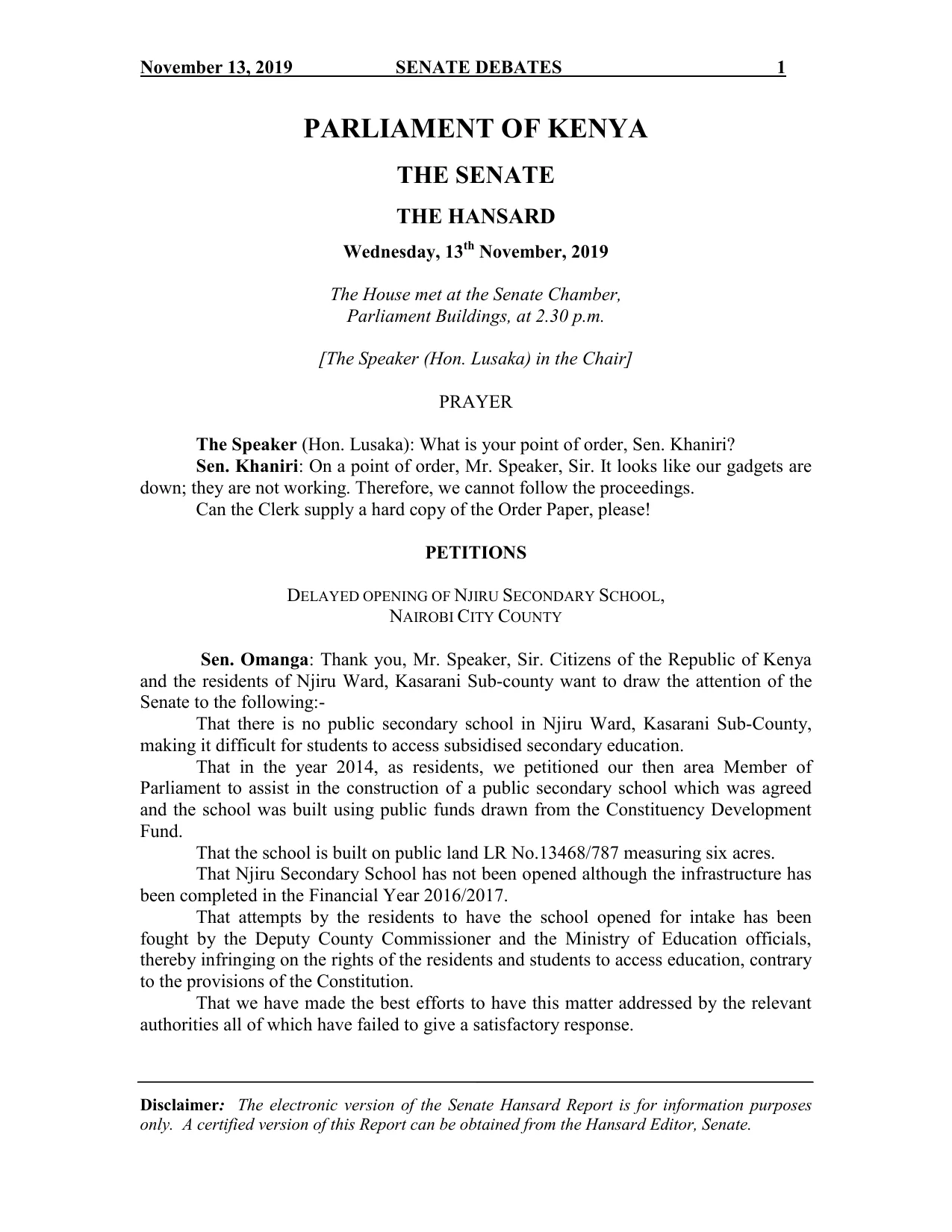
MixedTHE PARLIAMENT OF KENYA
THE SENATE
THE HANSARD
PARLIAMENT OF KENYA
Wednesday, 13th November, 2019
What is your point of order, Sen. Khaniri?
On a point of order, Mr. Speaker, Sir. It looks like our gadgets are down; they are not working. Therefore, we cannot follow the proceedings.
Can the Clerk supply a hard copy of the Order Paper, please!
DELAYED OPENING OF NJIRU SECONDARY SCHOOL, NAIROBI CITY COUNTY
Thank you, Mr. Speaker, Sir. Citizens of the Republic of Kenya and the residents of Njiru Ward, Kasarani Sub-county want to draw the attention of the Senate to the following:-
That there is no public secondary school in Njiru Ward, Kasarani Sub-County, making it difficult for students to access subsidised secondary education.
That in the year 2014, as residents, we petitioned our then area Member of Parliament to assist in the construction of a public secondary school which was agreed and the school was built using public funds drawn from the Constituency Development Fund.
That the school is built on public land LR No.13468/787 measuring six acres. That Njiru Secondary School has not been opened although the infrastructure has been completed in the Financial Year 2016/2017.
That attempts by the residents to have the school opened for intake has been fought by the Deputy County Commissioner and the Ministry of Education officials, thereby infringing on the rights of the residents and students to access education, contrary to the provisions of the Constitution.
That we have made the best efforts to have this matter addressed by the relevant authorities all of which have failed to give a satisfactory response.
That none of these issues raised in this Petition is pending in any court of law, constitutional or any other legal body.
Therefore, our humble Petition prays that the Senate -
Sen. Cherargei.
Thank you, Mr. Speaker, Sir. I want to make a comment on that Petition by Sen. Omanga on the delay of opening of Njiru Secondary School.
The right to education is a constitutional right and the fact that the school remains closed is very unfortunate and many children around and within Njiru should not be in any way denied the basic access to their education.
On the issue of land or ownership of land by many secondary schools in this country; there was a directive by the Ministry of Education that every school must be assisted by the Ministry of Lands to get ownership and possession of their land, where the school is situated, be it a primary school or secondary school.
Therefore, we would have expected the Ministry of Education to come up and ensure that they assist on the issue of land and infrastructure. Therefore, I think these children need the necessary support so that the school can be reopened.
You remember that the Kenya Certificate of Secondary Schools examinations are ongoing and so, it is very unfortunate that this is happening to the residents and children in Njiru Ward, more so, that the Constitution has provided that the right to education is a fundamental right that should not be denied by anybody.
Mr. Speaker, Sir, I support this Petition and I hope the relevant Committee will deal with this matter expeditiously and ensure the people and students who read and study in Njiru get that opportunity.
Thank you.
Hon. Senators, pursuant to Standing Order No.232
IMPLEMENTATION OF CLINICAL OFFICERS’ CBA
Thank you, Mr. Speaker, Sir. This is a Petition on refusal by the Ministry of Health and county governments to conclude the collective bargaining agreement negotiations.
We the undersigned citizens of the Republic of Kenya and officials of the Kenya Union of Clinical Officers (KUCO) , acting on our behalf and more than 20,000 clinical officers registered and practicing in Kenya, draw the attention of the Senate to the following:
Thank you, Mr. Speaker, Sir. I rise to support this Petition. It is unfortunate that clinical workers who are rendering what we would call critical service must resort to the Senate to seek our assistance for them to get a Collective Bargaining Agreement signed.
Labour relations under Article 41 of the Constitution is a fundamental right for all workers; fair work, fair remuneration and fair pay for work done. They are not asking for this country or somebody in the Ministry to lend them a limb. They are just saying “pay us!” Fortunately, this Senate has one person who is from that profession.
Somebody asked yesterday, and I read somewhere, why we are broke. People would not go on strike unless they did not have money. These people work for 16 hours a day. I represented doctors; the young people, some of whom were jailed because they wanted an increase of something close to Kshs20,000.
Why would we not conclude a Collective Bargaining Agreement? It is worse when we read in a Petition that our county governments, through the CoG, is one of the parties that is being belligerent towards this service.
Mr. Speaker, Sir, I do not know how true it is, but I read in one of the articles concerning something that will come up soon; that in fact, there is a proposal for a Health Commission and to take away the function of health from counties to national Government. If this happens, it is because the governors of this Republic have let us down and mismanaged the heath sector, which is a critical service.
If there was ever a constitutional amendment that would make sense, it would ring-fence the budget for health, so that governors and the executives whether it is at the national who do not behave any better---
It is sad to live in a country where Kshs2.9 billion and Kshs1.2 billion respectively is set aside to pay interns, and it is not paid to them. Where does this money go to? It goes to private hands.
The ad hoc Committee on the Managed Equipment Services (MES) has verified that we have wasted billions of shillings buying stretchers and beds that are not needed. The brightest students in our medical schools have become doctors and nurses, and they are being mistreated. It is only in a primitive country where you behave like that.
Mr. Speaker, Sir, I beg to support.
Thank you, Mr. Speaker, Sir. I also rise to support this Petition that has been brought to the House by Sen. Cherargei. Anything that touches on the most vulnerable does not see the light of day in our country, which is really sad. This group consists of people from the community health volunteers, to the community health workers, to what we used to call community health extension workers, to now even our clinical officers. We are seeing real disrespect and disregard for the people that carry the health sector on their backs.
Mr. Speaker, Sir, the Collective Bargaining Agreement (CBA) of 2017 was also part of the return to work formula that was given. However, we have seen wanton disregard for anything that is touching on the most vulnerable communities, and clinical officers are the ones that serve in the dispensaries, in Level Two, Level Three and the lower level hospitals. So far, from what I have seen, the Ministry of Health continues to look down on the health personnel and a lot of resources that are supposed to go down to the counties.
How do we expect to get Universal Health Coverage (UHC) , especially in the counties, even in the pilot counties? Isiolo is one of the pilot counties for UHC, and it was chosen for a reason. The reason was that there was almost near absolute absence of personnel, resources, equipment and the existence of long distances between existing dispensaries.
Now, with the advent of the non-honoring of this CBA, many people that used to work in these dispensaries have gone back. We now do not have anybody looking after people in these places. You will even find mkokoteni’s carrying people for 50 kilometers all the way to town centers where they can find a doctor.
This is unacceptable, and it is about time the Ministry was compelled to do what it is supposed to do, because it is not going to be business as usual. The UHC cannot just be on paper and on podiums. The components of UHC are the personnel, resources and equipment, yet all these are missing. I, therefore, do not know in which vacuum we are going to achieve the objectives and principles of UHC.
Mr. Speaker, Sir, I support and look forward to the Committee of Labour and Social Welfare or the Committee on Health – whichever is the case – going to the bottom of this issue, because counties and our villages are suffering.
Thank you. I beg to support.
Thank you, Mr. Speaker, Sir. I support the Petition and the Petitioner. This is a very timely Petition. Health is a very important issue in life. I believe that it is the most important component of human welfare.
Mr. Speaker, Sir, I request the Committee to which this matter is being forwarded to find out how to deal with the strikes and stand-offs on labour related matters. This is because health in counties, particularly, Migori County, is dogged by incessant strikes. These are things that we can deal with when it comes to negotiations and compromise. We need the committee responsible to find a solution that will make the parties have a framework through which they can dialogue and conclusively deal with the challenges that lead to labour unrest.
If this is not dealt with, then life becomes meaningless; paying taxes becomes meaningless, and we have a society where life is brutish and short. Some of it will be self-instigated or inflicted upon us by our own behavior.
With those remarks, I beg to support the Petition.
Thank you, Mr. Speaker, Sir. I also support this Petition. Apart from health being 95 per cent devolved, it is a very critical component of human life. Under the Geneva Convention, health workers are protected even in war zones in terms of physical protection, nutrition supply and remuneration.
It is disheartening to note that here in our country, a function that is devolved to the extent of 95 per cent still has over 90 per cent of health resources controlled at the center. That is why we have scandalous activities such as MES and others.
It is incumbent upon county governments, having taken up health as a devolved function, to ensure that health workers are properly remunerated, motivated and are enabled to work to save lives. These health workers carry out probably 80 per cent of the treatment of our citizens. If you go to health centers, dispensaries and many of the health facilities in the countryside, you will hardly find doctors. Doctors are found in Level Four and Level Five hospitals. In the other facilities, it is the nurses and other health technicians who do the work, and they heal people.
Today, if you go to the villages, there are too many inexplicable deaths of people. The people are dying from very preventable diseases because of the de-motivated workers in the health sector. Therefore, the Committee on Labour and Social welfare that is likely to be looking at this matter – or whichever committee you refer it to – should make sure that this stand-off between the health workers and the county management system is brought to an end, so that people do not suffer unnecessarily.
Thank you, Mr. Speaker, Sir. I support the Petition as well. Medical personnel in this country suffer a lot. They are in every village and center in this country, where they help the communities. However, when it comes to remuneration and taking care of them, they are usually put in the back seat.
As some of the Senators have already mentioned, UHC is there and there is a lot of money being wasted, like on this so-called MES. Billions of shillings are being wasted while members of the heath profession are suffering. I do not see how we will succeed if we do not have proper personnel. Doctors, nurses and clinical officers are running away from this country; they are going to look for greener pastures overseas.
Mr. Speaker, Sir, when I was in medical school during those days, nobody wanted to go anywhere. With the few shillings we were getting, medical officers, clinical officers and nurses were okay and happy in the country, working for the people. But of late, I do not know where the rain started beating us because things are going haywire in this country.
On this issue, we usually have problems between health and labour, and most likely, it should go to the Committee on Labor and Social Welfare, because they are the ones who deal with remuneration and suffering.
Thank you.
Asante, Mheshimiwa Spika, kwa kunipa fursa hii kuchangia maombi ya Sen. Cherargei.
Kwanza, ninampongeza Sen. Cherargei kwa kuleta maombi haya katika Bunge la Seneti. Juzi tulikuwa safari Tana River ambapo tuliona wananchi walivyokuwa wakipata shida kwa sababu ya kusimamishwa kazi kwa madaktari pamoja na wauguzi. Wagonjwa wengi waliokuwa Hospitali Kuu ya Hola, walikuwa hawana huduma kwa sababu madaktari na clinical officers wote walikuwa kwenye mgomo.
Mhe. Spika, kwa hakika sijui kuna shida gani kwa sababu hata amri za mahakama za wafanyi kazi haziheshimiwi. Hiyo inaonyeshwa kwamba, tunapoteza mwelekeo. Ikiwa mahakama itatoa amri na isitekelezwe inamaana kuwa, tunapuuza tasisisi ambazo zinaweza kutusaidia kutatua mizozo yetu.
Mhe. Spika, ninampongeza Mhe. Cherargei kwa maombi haya. Tunaiomba Kamati husika isizembee katika swala hili. Tunafaa tupate utatuzi wa haraka kwa sababu wananchi wengi ambao wanategemea huduma za madaktari hawa, wanapata shida katika kaunti zetu.
Asante Mhe. Spika.
Thank you, Mr. Speaker, Sir. I rise to support this Petition. Up to very recently, I was quite ignorant on the challenges in the health sector until I received a very interesting phone call. For the four years that I was in high school, there was a gentleman called Kenneth Shinga Mwarabu. He remains to be my good friend. For the four years that we were in high school, he led in every exam that we sat for.
Eventually, when we did our Kenya Certificate of Secondary Education (KCSE) , he was among the best 100 students in the country. He moved on to University of Nairobi (UoN) where he studied medicine. After six years, he moved on to study a Master of Surgery degree at one of the local institutions.
About one month ago, this young man called me requesting if I could assist him secure a working opportunity. I could not reconcile the fact that such a brilliant, talented and gifted person---.
The general thinking is to whom much has been given in terms of intellectual endowment, then with so much ease they will be able to secure employment opportunities. That is how it works the world all over. However, because of the mismanagement of the health sector under this framework of county governments and the poor labour relations that have followed since the onset of devolution, medical practitioners continue to suffer.
Clinical officers who have brought this Petition before this House are an example. I now understand why sometimes the headquarters of the Ministry of Health is mischievously referred to as “Mafia House” as opposed to Afya House. The thinking at the Ministry of Health is the fact that people believe so much in brick and motor as opposed to the soft skills and ensuring that the people who provide the skills in terms of treating people are well taken care of.
They are more interested in the hiring of all these equipment. There is no fool in this House; everybody knows what the motivation is in terms of buying all the equipment
that they are flooding our hospitals with and not ensuring that they take care of our medical practitioners.
Mr. Speaker, Sir, having listened to the request made by the Vice-Chairperson of the Committee on Health, I agree with him that this is a labour issue. When giving your direction, because of the other reasons that are known to them; why they have thought that it would better handled by this Committee, please accede to that request.
Thank you.
Thank you, Mr. Speaker, Sir. I also rise to support the Petition. This could be the sixth or the seventh Statement or Petition with regard to health issues in this country. I personally have brought a Statement to this House. It is high time that we asked ourselves, as a Senate, what is happening.
If it is possible, I would recommend to the Committee to hold a huge stakeholders’ forum where the Senate will pronounce itself on the way forward on issues of health in the counties.
We also need to ask ourselves whether what the doctors have been asking; that they need a medical practitioners commission is probably the way to go, so that this issue of salaries is well dealt with by a commission like the Teachers Service Commission (TSC) .
Mr. Speaker, Sir, we all know that the health sector is ailing. The other day, there were huge cries all over, that there was no insulin, no HIV/AIDS and malaria drugs. Everybody in the Ministry was working in panic. If the Committee can agree, let us have a forum where we will deliberate on the issues once and for all. As the Senate, we will pronounce ourselves on the way forward on this very essential devolved function.
With those few remarks, I support the Petition.
Hon. Senators, in the interest of time, pursuant to Standing Order No.232, the Petition stands committed to the relevant Committee, in this case, the Standing Committee on Labour and Social Welfare.
In terms of Standing Order No.232, the Committee will be required, in not more than 60 calendar days from the time of reading the Prayer, to respond to the petitioner by way of a report addressed to the petitioner and laid on the table of the Senate.
I hope the committee will do a commendable job because as you have heard, we have had similar Petitions and they are lying somewhere.
On a point of order, Mr. Speaker, Sir. Originally, I had assumed that this would go, but I am happy that you have sent it to the Committee on Labour and Social Welfare.
I would like to give you an assurance that the Committee will expedite and deal with it thoroughly. For the record, what we said was directed to other committees. The Committee on Labour and Social Welfare has dispensed with each and every matter that has been brought to it and has brought the reports both to the Members who asked and to the House. It is the most hardworking Committee. I have very serious Members like Sen. Madzayo, Sen. Were and Sen. (Dr.) Milgo who are very outstanding.
Mr. Speaker, Sir, in addition to that, we have a legislative proposal that we are bringing to harmonize what is happening in our counties with respect to labour. We hope
that next year, after we bring the proposal, we will have a National Labour Summit because the biggest challenge today is different schemes of service, different kinds of people hired to do the same job, but different allocations to different counties. I hope that the Senate will be able to support that process as we streamline devolution with labour being a key factor of devolution in our country.
Thank you.
What is your point of intervention, Sen. Kihika?
Thank you, Mr. Speaker, Sir. Now that we have heard the Chairperson of the Committee on Labour and Social Welfare on the Floor, I would like to bring to his attention through you, that I had a Petition here sometimes back. It may be about six months ago where street children from Nakuru County were thrown away into a forest. I have never heard anything regarding that Petition. I would like the Speaker to give direction on that.
What is your point of intervention Sen. Mutula Kilonzo Jnr.?
Mr. Speaker, Sir, in view of your direction, the prayers that were sought, part of them where summaries are being sought, I thought it would be appropriate to truncate this Petition into two. Where there are immediate issues, the Chairperson can possibly inform the Senate before we go for our Christmas holidays whether these people have been paid.
To tell them to come after 60 days is to tell them to go and sleep hungry over Christmas. I do not think it would be fair to them. That would defeat the purpose of having an efficient Senate and Committee on Labour and Social Welfare led by Sen. Sakaja.
I will be making a communication in relation to that. First, I have a Petition to present.
HISTORICAL LAND INJUSTICES AGAINST THE KIPSIGIS COMMUNITY BY THE BRITISH
COMMUNICATION FROM THE CHAIR
VISITING DELEGATION FROM KAJIADO COUNTY ASSEMBLY
Mr. Speaker Sir, I have seen this Petition from the Kipsigis Clans Organization. This is a very critical Petition, considering that in Nandi County, we also have similar problems of historical land injustices.
This House adopted a report on historical land injustices for the Talai, as we stretch from Kericho County, where my good friend Sen. Cheruiyot is Senator, all the way to Nandi.
The issue of historical land injustices does not only affect the Kipsigis and Nandi communities, but it cuts across the country. This issue is very important. Following the adoption of the report on historical land injustices, Sen. Mutula Kilonzo Jnr. and Sen. Dullo, with the former Senator of Nandi visited the Talai community.
The report was adopted by the committee. Up to now, the recommendations of the Senate that were unanimously adopted by the House have not been acted upon by various agencies such as the National Land Commission (NLC) and the office of the Attorney- General.
The request of the Senate was to assist the Talai community pursue justice in London and to also receive an apology from the British. Up to now, the relevant stakeholders who were directed by the Senate---.
I hope that by the time my Committee will have concluded this matter and because of its wisdom, the House will adopt the report on the historical land injustices on the Kipsigis, and thereafter, pronounce itself on how to follow up on this. This is because we have the Mau Mau case where those affected received compensation.
I expected the national Government, through the Attorney-General’s office, in liaison with the British High Commission and with the British Government, to try and conclude this issue. This is because if the issue of historical land injustices on the Talai is addressed appropriately, the percentage of many cases of historical land injustice which have been forwarded by the Kipsigis Clans Organization in Bomet and Kericho counties will be addressed adequately.
Mr. Speaker Sir, it is well that Senators adopted the report on the issue of historical land injustices relating to the Talai community. However, those issues have not been followed up by the relevant stakeholders. Therefore, as we look into this Petition by the Kipsigis on the issue of historical land injustices and by various multinational companies in Kericho, Nandi and Bomet counties, the Senate should have a mechanism of ensuring that directions that are issued by the Senate are followed to conclusion.
On a point of order, Mr. Speaker, Sir.
What is your point of order, Sen. Sakaja?
Mr. Speaker, Sir, kindly allow me to make one quick clarification on the other Petition. There was a request from Sen. Mutula Kilonzo Jnr., as well as an intervention by Sen. Kihika on a Petition she had brought.
On the issue that Sen. Mutula Kilonzo Jnr. suggested, just to divide this into two, the fact of the matter is that it is not a generic issue. All of these unions signed Collective Bargaining Agreements (CBAs) with their respective county governments. There are some county governments that are implementing it while others are not. Therefore, we
will be able to see quickly which ones need urgent intervention, so that the Petition is heard within 60 days. We will not start hearing it after the 60th day.
Order, Sen. Sakaja. Since we are in the middle of another Petition, you can raise this afterwards.
Mr. Speaker, Sir, will you allow me to raise it afterwards, because something remained hanging when Sen. Kihika raised an issue which---?
It is okay, I will allow you.
Thank you, Mr. Speaker, Sir.
Sen. Orengo. The Senate Minority Leader (Sen. Orengo) : Thank you, Mr. Speaker, Sir. I wish to support this Petition and make a brief comment by saying that one of the biggest failures of the National Land Commission (NLC) is on historical land injustices. Under the Constitution, there is a specific mandate given to the NLC to address issues of historical and current land injustices. This is one of the areas that the NLC has failed to address.
When it comes to the question of the Kipsigis community, I am familiar that apart from the Nandi, Kipsigis, Kikuyu and probably some of the communities at the coast, these four communities really suffered out of displacement with regard to colonialism in Kenya.
Of course, I forgot the Maasai community. They lost a lot of land. In fact, if you trace how the Maasai were moved from areas as far as Nanyuki and corridors created from Trans-Nzoia, those injustices need to be addressed.
Mr. Speaker, Sir, there is a clan within the Nandi called the Talai, and some of them are found in Kipsigis. This community really suffered under colonialism. Some of them were shipped to Gwassi. I have met some of them who speak Luo more fluently than I do, yet they are from the Kalenjin community. When you go to Gwassi and talk to some of them who were living in villages - little ghettos in Kericho - if you speak to them about independence, it does not ring a bell because they were removed from their land by the Colonial government. Now, 50 years after the end of colonialism, they are still suffering.
I support this Petition, but hope that the report by the Truth, Justice and Reconciliation Commission (TJRC) will become public so that we get mechanisms of resolving this problem. Something needs to be done, immediately.
If the Jubilee Government cannot do this, I suggest that Sen. Cherargei brings a Bill that will change categories of public land so that those that are placed under the national Government can be placed under the county governments. Hopefully, they will not be managed by the governors because we cannot trust any governor with even a quarter acre of land because of the things that we have seen happening in Nairobi and other urban areas. In fact, it is worse in the cities and major towns.
Some of those tea estates in Kericho own acres and acres of land and the communities have been pushed into tiny pieces of land which is actually part of the problem in Mau. The truth about Mau is that a lot of people were squeezed out of their land and pushed into the forest. We need to find a solution instead of politicizing,
Thank you, Mr. Speaker, Sir. I wish to support this Petition and make a brief comment by saying that one of the biggest failures of the National Land Commission (NLC) is on historical land injustices. Under the Constitution, there is a specific mandate given to the NLC to address issues of historical and current land injustices. This is one of the areas that the NLC has failed to address. When it comes to the question of the Kipsigis community, I am familiar that apart from the Nandi, Kipsigis, Kikuyu and probably some of the communities at the coast, these four communities really suffered out of displacement with regard to colonialism in Kenya. Of course, I forgot the Maasai community. They lost a lot of land. In fact, if you trace how the Maasai were moved from areas as far as Nanyuki and corridors created from Trans-Nzoia, those injustices need to be addressed. Mr. Speaker, Sir, there is a clan within the Nandi called the Talai, and some of them are found in Kipsigis. This community really suffered under colonialism. Some of them were shipped to Gwassi. I have met some of them who speak Luo more fluently than I do, yet they are from the Kalenjin community. When you go to Gwassi and talk to some of them who were living in villages - little ghettos in Kericho - if you speak to them about independence, it does not ring a bell because they were removed from their land by the Colonial government. Now, 50 years after the end of colonialism, they are still suffering. I support this Petition, but hope that the report by the Truth, Justice and Reconciliation Commission (TJRC) will become public so that we get mechanisms of resolving this problem. Something needs to be done, immediately. If the Jubilee Government cannot do this, I suggest that Sen. Cherargei brings a Bill that will change categories of public land so that those that are placed under the national Government can be placed under the county governments. Hopefully, they will not be managed by the governors because we cannot trust any governor with even a quarter acre of land because of the things that we have seen happening in Nairobi and other urban areas. In fact, it is worse in the cities and major towns. Some of those tea estates in Kericho own acres and acres of land and the communities have been pushed into tiny pieces of land which is actually part of the problem in Mau. The truth about Mau is that a lot of people were squeezed out of their land and pushed into the forest. We need to find a solution instead of politicizing,
Thank you, Mr. Speaker, Sir, for giving me a chance to add my voice on this very important Petition but allow me to first welcome the delegation from Kajiado County who are in the Public Gallery. I wish them well as they observe the proceedings of this House and learn the procedures from the respective departments that they are visiting.
The issue of land is a very sensitive issue and I wish that the Committee takes the shortest time to address the issue raised by the Kipsigis community even as they look at other social historical injustices faced by other communities.
We heard of the people of Isiolo whose land is being curved and given to different Government institutions. The same thing is happening in other regions in this country. People have been forced to give their ancestral land to certain Ministries or certain departments because the Government wants to do projects, yet those projects do not benefit those people. This Committee, through the Ministry, should take the shortest time possible to address this Petition, so as to give our people confidence in this Senate.
Thank you, Mr. Speaker, Sir, for giving me this opportunity to also support this critical Petition. Historians like the Senior Counsel, Sen. Orengo, who also served as the Minister for the Ministry of Lands, have spoken. I am also a historian and I need to add that there are two limbs regarding the land that was taken away by the white men.
After the First and the Second World War, the queen sent the soldiers to East Africa with the intention of compensating them for services well rendered during the war. The problem is that the Government retained the land even after Independence. The other problem is how the independent Government distributed that land.
We do appreciate that money was given by the Colonial government to the independent Government for land to be distributed equitably or for land to be given back to the Government just as it happened in Zimbabwe, but the new Government, which took over in 1963, duped Kenyans and that is why we have a problem. That Government did not compensate Kenyans and that is why we have had problems across the country. We have had problems in Mombasa; the one thousand nautical miles land issue and that problem has also been experience in Northern and Western Kenya.
The problem is that certain individuals, who were powerful in the first Government took the land away from the citizens. They even enacted a law, Section 27 and 28 of the defunct Registered Land Act which was very clear and it was put there by the first Attorney-General. I do not want to mention names because I do not want to be asked to substantiate. He said that he will get the best lawyer to fight anybody who was going to touch his private land. This was a way of punishing those people who went to the bush to fight. It was also a way of creating a black bourgeoisie. They are the people
Thank you, Mr. Speaker, Sir, for giving me this opportunity to also support this critical Petition. Historians like the Senior Counsel, Sen. Orengo, who also served as the Minister for the Ministry of Lands, have spoken. I am also a historian and I need to add that there are two limbs regarding the land that was taken away by the white men.
After the First and the Second World War, the queen sent the soldiers to East Africa with the intention of compensating them for services well rendered during the war. The problem is that the Government retained the land even after Independence. The other problem is how the independent Government distributed that land.
We do appreciate that money was given by the Colonial government to the independent Government for land to be distributed equitably or for land to be given back to the Government just as it happened in Zimbabwe, but the new Government, which took over in 1963, duped Kenyans and that is why we have a problem. That Government did not compensate Kenyans and that is why we have had problems across the country. We have had problems in Mombasa; the one thousand nautical miles land issue and that problem has also been experience in Northern and Western Kenya.
The problem is that certain individuals, who were powerful in the first Government took the land away from the citizens. They even enacted a law, Section 27 and 28 of the defunct Registered Land Act which was very clear and it was put there by the first Attorney-General. I do not want to mention names because I do not want to be asked to substantiate. He said that he will get the best lawyer to fight anybody who was going to touch his private land. This was a way of punishing those people who went to the bush to fight. It was also a way of creating a black bourgeoisie. They are the people
You should conclude because our time on petitions is over.
Mr. Speaker, Sir, I hope that you are not helping him. He should tell us the policy that he put in place for people---
He does not need any help. The Senate Minority Leader (Sen. Orengo) : Mr. Speaker, Sir, having too much knowledge can also be dangerous. I will invite the Member to go and look at a document known as the National Land Policy which I prepared, placed before the Cabinet and was passed by the National Assembly but the implementation was left to Government.
Unfortunately, that National Land Policy came towards the end of the NARC Government. If you would still want to know, we were fought by huge land owners in this country who were against that National Land Policy including people in the Cabinet at that time. I said it on the Floor of the House that it is people in the Government who did not want that National Land Policy.
The Mau Mau have never been compensated because all the land which was occupied by the settlers originally belonged to the ‘black’ people who were taken to the Rift Valley and put in Villages. If you go to Nyeri you will find a colonial village there and it looks just like it did in 1963. I think Sen. (Dr.) Kabaka should read a little bit more history and then he will find us.
He does not need any help. The Senate Minority Leader (
Okay, wind up.
Mr. Speaker, Sir, I am guided. Give me one minute, I finish.
Hon. Senators, in the interest of time, pursuant to Standing Order No. 232 (1) , the Petition is required to be committed to the relevant Standing Committee for consideration.
In this case, I direct that the Petition be committed to the Standing Committee on Justice, Legal Affairs and Human rights. The Committee is required in not more than 60 calendar days, from the time of reading the prayer to submit a response to the petitioner by way of a report to the petitioner and laid on the Table of the Senate, pursuant to Standing Order No. 232 (2) .
I thank you. Hon. Senators, I have a Communication to make.
Thank you, Mr. Speaker, Sir. I am guided by Senior Counsel on the same and I will do much digging. The point he has supported is that we should not blame the ‘White Man’ per se as it were. He has confirmed that, indeed, the problem is those senior people, especially those in Cabinet. The problem is from within not without.
I support.
Hon. Senators, in the interest of time, pursuant to Standing Order No. 232 (1) , the Petition is required to be committed to the relevant Standing Committee for consideration.
In this case, I direct that the Petition be committed to the Standing Committee on Justice, Legal Affairs and Human rights. The Committee is required in not more than 60 calendar days, from the time of reading the prayer to submit a response to the petitioner by way of a report to the petitioner and laid on the Table of the Senate, pursuant to Standing Order No. 232 (2) .
I thank you. Hon. Senators, I have a Communication to make.
COMMUNICATION FROM THE CHAIR
ORDER OF BUSINESS IN THE SENATE
Mr. Speaker, Sir, I was on the queue waiting to speak on that Petition, you never---
I think he has heard. Proceed, Sen. Kihika.
I was following the order of how you requested to speak. Even Sen. Wetangula, Sen. Wambua and others were all queuing but you will have an opportunity to contribute. What is your point of order, Sen. Orengo? The Senate Minority Leader (
Mr. Speaker, Sir, it was just a reminder on the time set aside for Sen. Sakaja, Chairman of Labour Committee, to respond to my petition on dumping of street children by Nakuru County.
I think he has heard. Proceed, Sen. Kihika.
THE ALLEGED TRANSFER/DUMPING OF STREET CHILDREN BY NAKURU COUNTY GOVERNMENT
Mr. Speaker, Sir, it was just a reminder on the time set aside for Sen. Sakaja, Chairman of Labour Committee, to respond to my petition on dumping of street children by Nakuru County.
Thank you, Mr. Speaker, Sir. I rise to make a Statement pursuant to Standing Order No.47 on a national matter of general concern regarding the sale of contaminated maize meal products.
On Wednesday, 8th August, 2018, this House voted to establish an ad hoc Committee to investigate the then maize crisis in Kenya. The Motion was co-sponsored by Sen. (Prof.) Margaret Kamar, of Uasin Gishu County and yours truly.
Mr. Speaker, Sir, when the person who asked the question reminds you for the answer, it means there is something to be afraid of. I just want to give a quick clarification on the matter on Nakuru where street children were taken in the dead of the night, dumped into a forest in Baringo because they looked like they come from one part of the country. Six of them still cannot be found; they were around 60 children.
Mr. Speaker, Sir, as a Committee we started working on this matter. We have listened to the Street Families Rehabilitation Trust, the Ministry and the Senator herself. We have received further, a written communication. We had scheduled a county visit but it was not approved because the other counties wanted to visit at the same time.
We will bring the report because it has taken long. The report will be tabled next week; the Committee has adopted it. Beyond that, we will meet the county government during our scheduled county visit which will be earlier on next year. Sen. Kihika should stand assured of our support and my personal support because I have been there.
On top of the county visit, we will visit the Mututho Center and former MP Mututho who took these children under his care without any support from the county government or national Government. He must be applauded for the good work he is doing in Nakuru. So we are on this matter.
Thank you.
Sen. Omanga, consult in low tones. This is a very heavy Statement, please.
STATEMENTS
SALE OF CONTAMINATED MAIZE MEAL PRODUCTS
On a point of order, Mr. Speaker, Sir. Standing Order No.249 about sitting in the Chamber, and one of the people who are allocated seats in the Chamber is the Senate Majority Leader. Why is the Senate Majority Leader moving up and down without a seat?
Mr. Speaker, Sir, I would like to thank Sen. (Dr.) Ali for raising that very important point of order. I was not complaining. When I came to the Chamber, very distinguished lady Senators of Jubilee were consulting over very serious matters of national importance.
Mr. Speaker, Sir, the Committee carried out thorough investigations, including visitations and public hearings in various parts of the country. The Committee was able to establish and bring to the fore the deep rot and decay that was the norm in the operations of the National Cereals and Produce Board (NCPB) . For instance, bean seeds and fertilizer stocked in Nyansiongo Depot in Nyamira County was found to have long expired and farmers were recording a 100 per cent germination failure.
You were able to attend the public hearing in Eldoret during the Senate Mashinani sittings and you saw, heard and felt for yourself the farmers’ outrage on the state of maize farming in the country.
On a point of order, Mr. Speaker, Sir. Standing Order No.249 about sitting in the Chamber, and one of the people who are allocated seats in the Chamber is the Senate Majority Leader. Why is the Senate Majority Leader moving up and down without a seat?
Senate Majority Leader, you have heard. Why are you becoming nomadic in the Chamber? Will you take your rightful seat and listen to Sen. Wetangula?
This startling and frightening report was presented to the Committee sitting and hearing in this Chamber in the presence of the Cabinet Secretary for Agriculture, Livestock and Fisheries; hon. Mwangi Kiunjuri.
When the Committee visited Eldoret NCPB stores in Uasin Gishu County, it was able to notice and note that almost all the maize cereal in the stores was discolored.
On Thursday, 28th February, 2019, this august House unanimously endorsed and approved the Motion adopting the ad hoc Committee’s Report. Members hailed the Committee for an excellent job done and urged speedy implementation of the Committee’s recommendation to improve the maize sector and save Kenyans from possible consumption of harmful maize cereal products.
Mr. Speaker, in the last two (2) weeks, the country has witnessed alarming news about the level of aflatoxin in maize cereal products. Kenya Bureau of Standards has subsequently suspended licenses of five (5) major maize millers and banned the sale of products such as Dola, Kifaru, Jembe and 210 maize flour brands.
Apart from direct purchases from farmers and some direct imports, most maize millers purchase maize cereals from NCPB stores. The begging questions remain:
I wish to suggest to the Senator for Bungoma that sometimes we may be calling the names of other states like Mexico, but I do not think Mexico would export contaminated maize to Kenya because they also export maize to the United States of America. Their reputation is very important. If it is from Brazil, I can say without fear or favour that the contamination is not from there because they have very strict rules.
I am talking of Brazil where one of the most popular leaders who was sent to jail, a former President and my hero, Lula, is out. Those who fought for freedom should rejoice at the release of Lula. The system of Brazil is so effective that even if you are a President and convicted you go to jail. He served with honour in prison and now he is out.
Mr. Speaker, Sir, this Statement is very important at this time in this Republic. We need to be very concerned not just about maize, but also about the kind of food that Kenyans are eating.
When it is export commodities, such as peas, tomatoes et cetera, the inspection process is very stringent. However, if you go to Marikiti today to buy your normal domestic vegetables, nobody cares where it has come from. We have no authority that inspects the kind of food that Kenyans are consuming. The last time I checked, the pesticides residuals that we are consuming are shocking.
The other day in my Committee, we had issues of glyphosates and other pesticides. We, as a Committee of this House, are very concerned, and we are checking those issues. The information availed to us is that Kenyans are consuming high levels of pesticide residues. Maybe the high occurrence of cancer in this Republic is due to lack of stringent measures to inspect the kind of food we are consuming.
Mr. Speaker, Sir, I do not want to preempt where you will direct this issue to, but I believe that this is a situation that requires very urgent attention, so that we may save Kenyans from most of the things that are happening. As a Committee, we were thinking of establishing a food and drug authority. However, when we checked around we were informed that the National Assembly has already drafted such a Bill and it has been read the First Time. We, as a country, need that kind of an authority that will take care of the kind of foods that we are eating. All of us consume ugali. We do not know the kind of ugali we will consume this evening or what we have already consumed. It is so serious.
Mr. Speaker, Sir, I am happy that the Senator of Bungoma saw it fit to bring this matter to the attention of this House. I hope the Committee that will deal with this issue will give it the urgency and importance that it deserves.
This startling and frightening report was presented to the Committee sitting and hearing in this Chamber in the presence of the Cabinet Secretary for Agriculture, Livestock and Fisheries; hon. Mwangi Kiunjuri.
When the Committee visited Eldoret NCPB stores in Uasin Gishu County, it was able to notice and note that almost all the maize cereal in the stores was discolored.
On Thursday, 28th February, 2019, this august House unanimously endorsed and approved the Motion adopting the ad hoc Committee’s Report. Members hailed the Committee for an excellent job done and urged speedy implementation of the Committee’s recommendation to improve the maize sector and save Kenyans from possible consumption of harmful maize cereal products.
Mr. Speaker, in the last two (2) weeks, the country has witnessed alarming news about the level of aflatoxin in maize cereal products. Kenya Bureau of Standards has subsequently suspended licenses of five (5) major maize millers and banned the sale of products such as Dola, Kifaru, Jembe and 210 maize flour brands.
Apart from direct purchases from farmers and some direct imports, most maize millers purchase maize cereals from NCPB stores. The begging questions remain:
I wish to suggest to the Senator for Bungoma that sometimes we may be calling the names of other states like Mexico, but I do not think Mexico would export contaminated maize to Kenya because they also export maize to the United States of America. Their reputation is very important. If it is from Brazil, I can say without fear or favour that the contamination is not from there because they have very strict rules.
I am talking of Brazil where one of the most popular leaders who was sent to jail, a former President and my hero, Lula, is out. Those who fought for freedom should rejoice at the release of Lula. The system of Brazil is so effective that even if you are a President and convicted you go to jail. He served with honour in prison and now he is out.
Mr. Speaker, Sir, this Statement is very important at this time in this Republic. We need to be very concerned not just about maize, but also about the kind of food that Kenyans are eating.
When it is export commodities, such as peas, tomatoes et cetera, the inspection process is very stringent. However, if you go to Marikiti today to buy your normal domestic vegetables, nobody cares where it has come from. We have no authority that inspects the kind of food that Kenyans are consuming. The last time I checked, the pesticides residuals that we are consuming are shocking.
The other day in my Committee, we had issues of glyphosates and other pesticides. We, as a Committee of this House, are very concerned, and we are checking those issues. The information availed to us is that Kenyans are consuming high levels of pesticide residues. Maybe the high occurrence of cancer in this Republic is due to lack of stringent measures to inspect the kind of food we are consuming.
Mr. Speaker, Sir, I do not want to preempt where you will direct this issue to, but I believe that this is a situation that requires very urgent attention, so that we may save Kenyans from most of the things that are happening. As a Committee, we were thinking of establishing a food and drug authority. However, when we checked around we were informed that the National Assembly has already drafted such a Bill and it has been read the First Time. We, as a country, need that kind of an authority that will take care of the kind of foods that we are eating. All of us consume ugali. We do not know the kind of ugali we will consume this evening or what we have already consumed. It is so serious.
Mr. Speaker, Sir, I am happy that the Senator of Bungoma saw it fit to bring this matter to the attention of this House. I hope the Committee that will deal with this issue will give it the urgency and importance that it deserves.
In the interest of time, I will only give one Senator. Sen. Were.
Thank you, Mr. Speaker, Sir, for the opportunity to contribute to this Statement by Sen. Wetangula. I was in the Ad hoc Committee that investigated the crisis in the maize sector. As Sen. Wetangula said, we found maize that was already in bad state in silos in Eldoret. We recommended in our Report that it be destroyed. We met KeBS and suggested to them to destroy it. However, it seems like that maize was never destroyed. It is in our shelves in supermarkets and on our dining tables.
On a point of order, Mr. Speaker, Sir. As much as I agree with Sen. (Dr.) Ali, I do not agree with his remark that there are Statements and Petitions from nowhere. I do not think it is in order to suggest that they have come from nowhere, because there are no strangers in this House.
Thank you.
I think that is clarified.
Mr. Speaker, Sir, my apologies about the comment “from nowhere”. I meant on the Order paper.
Mr. Speaker, Sir, we would also wish to get direction from you on this important Statement from Sen. Wetangula on the contaminated maize because this is a very important issue.
You have it.
Mr. Deputy Speaker, Sir, I was saying that we need direction from the Chair on this important Statement concerning contamination of maize.
I thought that matter has been disposed of---
Order, Senator. I thought the Speaker has already given direction on what is to be done on that matter. Am I right?
On the timelines?
On what to do and the timelines. You are demanding for my attention and it is you who had not paid attention to the Speaker.
We have run out of the Statements time allocation. We will proceed with precision and brutality to finalise all the other items in the next 10 minutes.
The next one is the Statement pursuant to Standing Order 48 (1) requested by Sen. (Dr.) Musuruve.
We need to also hear from the Committee on Agriculture regarding the implementation status of that report because we did some work on contaminated maize---
Order, Senator. I thought the Speaker has already given direction on what is to be done on that matter. Am I right?
On the timelines?
On what to do and the timelines. You are demanding for my attention and it is you who had not paid attention to the Speaker.
We have run out of the Statements time allocation. We will proceed with precision and brutality to finalise all the other items in the next 10 minutes.
The next one is the Statement pursuant to Standing Order 48 (1) requested by Sen. (Dr.) Musuruve.
DISMISSAL OF WORKERS AT THE MUMIAS SUGAR COMPANY
As you say, Mr. Deputy Speaker, Sir. On behalf of Sen. (Dr.) Musuruve, I stand to request for a Statement on the dismissal of workers at Mumias Sugar Company.
Who delegates to who?
No, on this particular Statement.
So, on this matter you are Sen. (Dr.) Musuruve’s delegate.
As you say, Mr. Deputy Speaker, Sir. On behalf of Sen. (Dr.) Musuruve, I stand to request for a Statement on the dismissal of workers at Mumias Sugar Company.
Mr. Deputy Speaker, Sir, the first thing to do is to invite the union as well as the Receiver Manager promptly.
Very well. Thank you.
Thank you, Mr. Deputy Speaker, Sir. This is a very important issue, particularly where responsible people with families are affected. Right now, that decision to send them home has hurt the families. The children of those employees will suffer because the parent who is a breadwinner cannot earn a living as a result of unfair dismissal.
I believe that this is a very serious matter because it will bring economic death on the doorsteps of certain families for no reason at all. This is synonymous with Mumias Sugar Company. I would like to emphasise more because I sit in the Committee on Labour and Social Welfare. We will work very closely with the Chairman to ensure that justice is served to the people who have been dismissed.
Thank you, Mr. Deputy Speaker, Sir.
Thank you Mr. Deputy Speaker, Sir. The case of Mumias Sugar Company is a very sad one. You may recall that 15 to 20 years ago Mumias Sugar Company was a case study of a successful rural enterprise in the entire Commonwealth.
Mr. Deputy Speaker, Sir, the first thing to do is to invite the union as well as the Receiver Manager promptly.
Very well. Thank you.
Thank you, Mr. Deputy Speaker, Sir. This is a very important issue, particularly where responsible people with families are affected. Right now, that decision to send them home has hurt the families. The children of those employees will suffer because the parent who is a breadwinner cannot earn a living as a result of unfair dismissal.
I believe that this is a very serious matter because it will bring economic death on the doorsteps of certain families for no reason at all. This is synonymous with Mumias Sugar Company. I would like to emphasise more because I sit in the Committee on Labour and Social Welfare. We will work very closely with the Chairman to ensure that justice is served to the people who have been dismissed.
Thank you, Mr. Deputy Speaker, Sir.
Thank you Mr. Deputy Speaker, Sir. The case of Mumias Sugar Company is a very sad one. You may recall that 15 to 20 years ago Mumias Sugar Company was a case study of a successful rural enterprise in the entire Commonwealth.
Mr. Deputy Speaker, Sir, it is on both. I encourage him to expedite the process because these workers are suffering. The company used to house them, but now that they have been dismissed from work, there is a plan to eject them from their houses.
I think you should give a ruling even on the timeline for the Committee to ensure that it is done immediately before we break for our long recess. This will ensure that we focus on helping the workers of Mumias Sugar Company.
As Sen. Wetangula has clearly put it, Mumias Sugar Company has been a pillar of the economy of the entire former Western Province. It is, therefore, important as leadership for us to have a focal attention towards reviving Mumias Sugar Company and
Thank you very much. Sen. Malalah, are you satisfied with the Committee’s undertaking?
Mr. Deputy Speaker, Sir, I am satisfied. I have a lot of confidence in the Committee led by Sen. Sakaja. I encourage the Committee---
Is the confidence on the Committee or the Chairperson of the Committee?
Mr. Deputy Speaker, Sir, it is on both. I encourage him to expedite the process because these workers are suffering. The company used to house them, but now that they have been dismissed from work, there is a plan to eject them from their houses.
I think you should give a ruling even on the timeline for the Committee to ensure that it is done immediately before we break for our long recess. This will ensure that we focus on helping the workers of Mumias Sugar Company.
As Sen. Wetangula has clearly put it, Mumias Sugar Company has been a pillar of the economy of the entire former Western Province. It is, therefore, important as leadership for us to have a focal attention towards reviving Mumias Sugar Company and
It is not a question of whether or not you are willing. The issue is that you have left the microphone, but he can inform the House.
Mr. Deputy Speaker, Sir, this just came to mind when the Senator was speaking because every time, I see him, I think about Kakamega. There was a taskforce that was led by the Governor of Kakamega. Some of the reports we are getting by one Kassim Were, who happens to be the CEC for Trade, are that the receiver is implementing the recommendations of that taskforce.
At some point, I think they wanted to include Senators on that taskforce, but we refused. We will first summon the taskforce to come and tell us whether its recommendations are being implemented before we go to the receiver manager, who might just be implementing those resolutions.
You will inform the Senator and the Committee at the Committee level.
Hon. Members, let us go to the second last Statement.
I am willing to be informed.
It is not a question of whether or not you are willing. The issue is that you have left the microphone, but he can inform the House.
Mr. Deputy Speaker, Sir, this just came to mind when the Senator was speaking because every time, I see him, I think about Kakamega. There was a taskforce that was led by the Governor of Kakamega. Some of the reports we are getting by one Kassim Were, who happens to be the CEC for Trade, are that the receiver is implementing the recommendations of that taskforce.
At some point, I think they wanted to include Senators on that taskforce, but we refused. We will first summon the taskforce to come and tell us whether its recommendations are being implemented before we go to the receiver manager, who might just be implementing those resolutions.
You will inform the Senator and the Committee at the Committee level.
Hon. Members, let us go to the second last Statement.
STATUS OF FUNDS DONATED TO COUNTIES BY DANIDA
ELECTRICITY CONNECTIVITY IN ISIOLO COUNTY
Thank you very much Mr. Deputy Speaker, Sir. Pursuant to Standing Order 48 (1) , I rise to seek a Statement from the Standing Committee on Energy regarding electricity connectivity to Isiolo County, and specifically, on the stalled Kina- Mbarambate-Mbiliko Power Line Connectivity Project.
In the Statement, linking to the fact that Isiolo is one of the pilot counties for most of our strategic initiatives in our country, including the Universal Health Care (UHC) and others, it is important that the Committee establishes the following: -
Let us hear the Chairperson first. It is about commitments and electricity.
It is not a Motion. What are you contributing on? Maybe you can make an observation or comment.
One minute, Sen. Dullo.
Mr. Deputy Speaker, Sir, I thank Sen. Halake for bringing this Statement. Secondly, in addition to what she has asked, as a county we have a lot of problems that I want the Committee to look into. We have several issues such as the one she has mentioned on Mbarambate. The wires are lying idle and the contractor was given the job. It is important for the Committee to look into why the contractor abandoned the work.
Secondly, in that area, there is a problem of connectivity or anything to do with electricity. Members of the public have to travel all the way to Meru County to sort out those issues. I remember in the last Senate, we requested that an office be opened in Garbatulla. They could look for a possibility of following up on that.
Thirdly, most of our schools have problems with connectivity. I think it is important that at this time of the 21st Century these issues be sorted out.
Mr. Deputy Speaker, Sir, the final one is on the issue of Oldonyiro Electricity where the Government promised in 2016, which is still outstanding. The Committee can look into that and also assist us.
Very well.
Proceed. Sen. Wetangula, for one minute.
Thank you, Mr. Deputy Speaker, Sir. As I support this Statement, I thought the distinguished Senator for Isiolo would mention that last week, as the Ad hoc Committee on the Managed Equipment Scheme (MES) , we visited Garbatulla Hospital. Radiography equipment delivered in Garbatulla in 2016 to date is not working because there is no sufficient electric power. Even when there are power pylons connected to Garbatulla, the strength of the power is not enough to power the equipment, yet the suppliers of that equipment are being paid every year. That is the mess that Isiolo County is in.
I ask the Committee that you will direct this matter to look at the entire profile of power supply in the country. The case of Isiolo as enumerated by Sen. Halake is everywhere. When you go to rural areas, there are power pylons, last mile, last kilometre or whatever, but there is no power. It is just Public Relations (PR) stunts.
The Senate Majority Leader should take it upon himself to save us from these gimmicks.
First, they refused to name and shame the officers. Two, they have only been interdicted. The offences committed by these officers are under the Penal Code. The worst part is that adult men of sound mind and armed to the teeth were beating up a lady while striking her head and kicking her like a goat. It is a pity that the most we can do is interdict theses officers. The Committee must seek serious answers.
If there is a time we should name and shame police officers who use brute, this is the time.
EXCESSIVE USE OF FORCE BY POLICE ON STUDENTS OF JKUAT
Thank you, Mr. Deputy Speaker, Sir. I rise pursuant to Standing Order 48 (1) to seek a Statement from the Standing Committee on National Security, Defence and Foreign Relations regarding excessive use of force by police and abuse of human rights against students of the Jomo Kenyatta University of Science and Technology (JKUAT) .
In the Statement, the Committee should -
Thank you, Sen. Omanga, for raising this issue. This matter is appalling because after the hue and cry from the public on social media, the National Police Service (NPS) has taken action. However, the action appeared to be a slap on the wrist of the officers concerned.
When the coin is turned – and I do not think it will be long - I hope none of them will come here and say that the police were watching and doing nothing.
Are you predicting something?
Mr. Deputy Speaker, Sir, I know how these things happen. The late Hon. G.G. Kariuki used to sit here with us and always reminded us that one of the things that blinds many politicians is the illusion of power. I am talking of the late Hon. G.G. Kariuki who when the former President Daniel Arap Moi took power, him and Sir. Charles Njonjo used to share the presidential limousine.
He was here and told us that there is something that is called illusion of power that blinds many politicians. We end up celebrating negative acts the moment we are on the side of power. However, when the power is not there, we become victims of the same brutality. Therefore, we must condemn this act.
Please, summarize.
When the coin is turned – and I do not think it will be long - I hope none of them will come here and say that the police were watching and doing nothing.
Are you predicting something?
Mr. Deputy Speaker, Sir, I rise pursuant to Standing Order 51 (1) (b) to make a Statement on the activities of the Standing Committee on Energy for the period commencing 1st July to 30th September, 2019.
During the period under review, our Committee held a total of nine sittings and considered three Statements. With regard to Statements, pursuant to Standing Order 48
This House must go out of its way to do thorough investigations. One of the Members of that Committee is Sen. Sakaja, who was a previous student leader. I was in the student leadership too and know the importance of student leadership in agitating for student rights and rights of the rest of us.
We condemn that kind of brutality. I support and ask that the Committee does a good job.
very well. We have run out of time. The Chairperson Committee on Energy should give their Statement.
The Vice Chairperson was here during the issue of violence on university students. It is almost 5.00 p.m. and we are still on Statements.
Finally, let us go to Statements pursuant to Standing Order 51 (1) (b)
ACTIVITIES OF THE COMMITTEE ON ENERGY
Mr. Deputy Speaker, Sir, I rise pursuant to Standing Order 51 (1) (b) to make a Statement on the activities of the Standing Committee on Energy for the period commencing 1st July to 30th September, 2019.
During the period under review, our Committee held a total of nine sittings and considered three Statements. With regard to Statements, pursuant to Standing Order 48
Thank you, Sen. Seneta. Good luck in your next quarterly activities.
Next is the Chairperson of the Standing Committee on Finance and Budget. That item is deferred.
ACTIVITIES OF THE COMMITTEE ON FINANCE AND BUDGET
ACTIVITIES OF THE COMMITTEE ON HEALTH
Mr. Deputy Speaker, Sir, I rise pursuant to Standing Order 51 (1) (b) to make a Statement on the activities of the Standing Committee on Health for the period commencing 1st of July to 31st September, 2019.
Mr. Deputy Speaker, Sir, during the period under review, the Committee held a total of 13 sittings, considered three Bills, two Petitions and three Statements.
The Committee also held five engagements with the stakeholders. In respect of the Bills, the following were considered:-
How long is your Statement, Chairperson?
Mr. Deputy Speaker, Sir, I will be through in a minute. The Committee is also considering a Petition concerning individuals with autoimmune connective tissue disorders.
During the period under review, the Committee participated in the Health Summit held on 14th and 15th of August, 2019, which was organized by the Ministry of Health.
Mr. Deputy Speaker, Sir, during the period under review, the Committee held meetings with the BIBA International to deliberate on a process of making the public aware on the issues concerning the environment, food safety, health and biodiversity.
The Committee also held a meeting with Blood Link Foundation regarding proposed legislation of the Kenya National Blood Transfusion Service and its necessity, owing to the withdrawal of funding to the fund operations by the National Blood Transfusion Service.
Mr. Deputy Speaker, Sir, to summarize, the Committee intends to carry out the following activities during the next quarter:
That is the end of that particular item. Hon. Senators, I will reorganize the Order Paper as follows: Orders No. 8, 9, 10, 11, 12, 13, 14 and 16 are deferred. Next Order!
ADOPTION OF CPAIC REPORT ON INQUIRY INTO FINANCIAL OPERATIONS OF VARIOUS COUNTIES FOR FY2014/2015
Executives for Financial Year 2014/2015 (1st July, 2014 to 30th June, 2015), laid on the Table of the Senate on Wednesday, 9th October, 2019. (Motion deferred)
COMMITTEE OF THE WHOLE THE RETIREMENT BENEFITS (DEPUTY PRESIDENT AND DESIGNATED STATE OFFICERS) (AMENDMENT) BILL (SENATE BILLS NO. 2 OF 2018)
COMMITTEE OF THE WHOLE THE KENYA MEDICAL SUPPLIES AUTHORITY (AMENDMENT) BILL (SENATE BILLS NO. 38 OF 2018)
COMMITTEE OF THE WHOLE THE CANCER PREVENTION AND CONTROL (AMENDMENT) BILL (SENATE BILLS NO. 9 OF 2019)
COMMITTEE OF THE WHOLE THE COUNTY HALL OF FAME BILL (SENATE BILLS NO. 39 OF 2018)
COMMITTEE OF THE WHOLE THE COUNTY TOURISM BILL (SENATE BILLS NO. 5 OF 2019)
COMMITTEE OF THE WHOLE THE STREET VENDORS (PROTECTION OF LIVELIHOOD)
BILL (SENATE BILLS NO. 10 OF 2019)
THE REGISTRATION OF PERSONS (AMENDMENT) BILL (SENATE BILLS NO.14 OF 2019)
THE CARE AND PROTECTION OF CHILD PARENTS BILL (SENATE BILLS NO.11 OF 2019)
Let me start by thanking several people who have walked with me in this journey. I wish to thank this House because we started this process with a sensitization breakfast courtesy of the Chartered Institute of Arbitrators Kenya (CIAK), where Senators learnt the different process of ADR. They were listed down for us to understand that mediation, conciliation, traditional justice systems are a part of what we call ADR.
I also thank the Rt. Hon. Speaker, Kenneth Lusaka, for giving me this challenge. After the sensitization breakfast, he said that we should live on and do a Bill. I took up the challenge, and I am grateful that he saw the capacity in me to do so.
I also thank the Chartered Institute of Arbitrators Kenya, of which I serve as a Committee member in the branch, for being champions of ADR in the country and giving me the support to do what we are doing here today.
I also want to thank the Attorney-General’s Office for giving me the encouragement and support, and also for facilitating some of the drafters who came from there when we started this process.
Let me also thank the Nairobi Center for International Arbitration (NCIA) and the Judiciary because we started this journey together and they facilitated consultative meetings that led to the first draft of this Bill.
Let me also thank the court-annexed mediation team; National Security Council (NSC) from the Judiciary, who run the court annexed mediation programme that has been very successful in the country. They have been rolling out quite effectively around the counties. This committee has been very instrumental in this journey, and I want to thank them very much for their support.
I also want to thank the International Development Law Organization (IDLO), who have been a key organization that has really supported the Judiciary when it comes to matters of mediation, as well as all research towards alternative dispute resolution - and especially the traditional justice systems.
In a very special way, I want to thank Dr. Charles Otieno, who was my consultant when it comes to matters legislation and policy. He was very instrumental in spearheading and guiding the process towards the policy and the legislation towards ADR. His commitment and the sacrifice that he gave to the process is absolutely commendable. I pray that God blesses him for what he has done for this purpose.
THE ALTERNATIVE DISPUTE RESOLUTION BILL (SENATE BILLS NO.19 OF 2019)
Sen. Kasanga, are you ready or should we go to the next Order first? If you are ready, proceed.
Sen. Cherargei, be patient. I am sure when you sit, you will exhaust your mission.
Thank you, Mr. Deputy Speaker Sir. I beg to move that The Alternative Dispute Resolution Bill (Senate Bill No.19 of 2019) be now read a Second Time.
Mr. Deputy Speaker, Sir, I want to notify the House that Alternative Dispute Resolution is also referred to as ADR. So, when I make the reference to ADR, I am referring to it. At least, it will help us to move faster.
Mr. Deputy Speaker Sir, the aim of this Bill is to put a legal framework for the settlement of certain civil disputes by conciliation, mediation and traditional disputes resolution mechanisms. As we know, we always have disputes in life and have come to learn that not all disputes need to go to court. As it is, the courts are already overwhelmed.
I was privileged to be invited for an ADR consultative meeting that was hosted by the Judiciary on Monday this week. It was graced by the Chief Justice himself. When the statistics on the costs of taking disputes as opposed to an alternative in other countries
Who is being blessed?
His name is Dr. Charles Otieno. He is a consultant on legislative matters.
Okay.
Mr. Deputy Speaker Sir, the aim of this Bill is to put a legal framework for the settlement of certain civil disputes by conciliation, mediation and traditional disputes resolution mechanisms. As we know, we always have disputes in life and have come to learn that not all disputes need to go to court. As it is, the courts are already overwhelmed.
I was privileged to be invited for an ADR consultative meeting that was hosted by the Judiciary on Monday this week. It was graced by the Chief Justice himself. When the statistics on the costs of taking disputes as opposed to an alternative in other countries
Mr. Deputy Speaker, Sir, I will not dwell too much on it. Let me just give highlights, so that the Senators can debate on this one.
Clause 40 seeks to protect the Employees and Members of the Mediation Accreditation Committee that was established under Section 59 (a) of the Civil Procedure Act.
You can take time to finish in style; you have a bit of time. Finish in the manner you would have wanted to.
Thank you, Mr. Deputy Speaker, Sir. Clause 40 of the Bill protects Employees and Members of Mediation accreditation Committee that was established under Section 59 (a) of the Civil Procedure Act.
Clause 41 partly says: “Registers kept registration effected and certificates issued- -- Let me go into the depth of this change that we want to make in the Civil Procedure Act. The Civil procedure Act, under Section 59 (a) and (d) , provides for resolution of disputes through ADR processes. However, there is a bit of detail that lacks in there. As a result, this Bill proposes under Clause 34 to amend this part, so that we can seek to rename Mediation Accreditation Committee as an Alternative Dispute Resolution Committee, so as to take into account conciliation and traditional dispute resolution mechanisms. They can all fall under that.
Secondly, we want to reduce the number of the membership of the Committee from 12 to 7. We want to provide the term for the members in the committee to be three years renewable once. This is not provided in the Civil Procedure Act. We want to revise the functions of the Committee and provide for the designation of the ADR registrar, staff and functions of the registrar. We want to set out under what circumstances a Member of the Committee ceases to be.
That is why I am saying I am not sure.
Mr. Deputy Speaker, Sir, I will not dwell too much on it. Let me just give highlights, so that the Senators can debate on this one.
Clause 40 seeks to protect the Employees and Members of the Mediation Accreditation Committee that was established under Section 59 (a) of the Civil Procedure Act.
You can take time to finish in style; you have a bit of time. Finish in the manner you would have wanted to.
Thank you, Mr. Deputy Speaker, Sir. Clause 40 of the Bill protects Employees and Members of Mediation accreditation Committee that was established under Section 59 (a) of the Civil Procedure Act.
Clause 41 partly says: “Registers kept registration effected and certificates issued- -- Let me go into the depth of this change that we want to make in the Civil Procedure Act. The Civil procedure Act, under Section 59 (a) and (d) , provides for resolution of disputes through ADR processes. However, there is a bit of detail that lacks in there. As a result, this Bill proposes under Clause 34 to amend this part, so that we can seek to rename Mediation Accreditation Committee as an Alternative Dispute Resolution Committee, so as to take into account conciliation and traditional dispute resolution mechanisms. They can all fall under that.
Secondly, we want to reduce the number of the membership of the Committee from 12 to 7. We want to provide the term for the members in the committee to be three years renewable once. This is not provided in the Civil Procedure Act. We want to revise the functions of the Committee and provide for the designation of the ADR registrar, staff and functions of the registrar. We want to set out under what circumstances a Member of the Committee ceases to be.
Yes, it is alleged that there is no money. Mr. Deputy Speaker, Sir, whereas there is no data as to the number of disputes resolved through ADR processes in the country, it is believed there are no more disputes resolved through the ADR than through the judicial processes.
We accept that the backlog in the Judiciary is so big and we are losing a lot of money because of how long disputes take. I remember when we were at the ADR forum on Monday, where the Chief Justice (CJ) graced the occasion, there were statistics from the United States of America (USA) that were presented. They had actually gone ahead and done the statistics of showing when a case goes through the formal judicial process vis-à-vis if it goes through an ADR process. The savings in terms of time and cost are so significant. They are in the ten-folds.
It is only now that we have data because of the court annex mediation process that is going on. The Judiciary can tell us they have 2,500 cases so far that have been resolved successfully through the court annex mediation. We then know that we have a lot of success.
The fact that we have never documented before, we do not really know the impact of ADR. Through this process and amending the civil procedure Act to set up the dispute resolution committee and have the registrar with his functions described in the Bill, we shall begin to have tangible data. We can say for sure that the impact that ADR has in our economy is significant. The Cabinet Secretary (CS) , Hon. Adan, who was at the function also alluded to this.
Additionally, through this Bill, we look forward to not only putting a lot more structure than just the dispute resolution aspect of it, but also our country in a platform where we can say that even others can come and resolve their disputes here. Given our international and huge contracts, we can have their disputes settled here. As you know, for many of our big contracts, the seat of resolution is not in this country. So, we miss out on the gains that we would have through this – I do not know whether I would call it dispute resolution tourism. There are countries where people go to resolve their disputes,
We hear.
We just hear or read it in social media. So, I cannot quote anyone or anything.
It is alleged that there is no money.
Yes, it is alleged that there is no money. Mr. Deputy Speaker, Sir, whereas there is no data as to the number of disputes resolved through ADR processes in the country, it is believed there are no more disputes resolved through the ADR than through the judicial processes.
We accept that the backlog in the Judiciary is so big and we are losing a lot of money because of how long disputes take. I remember when we were at the ADR forum on Monday, where the Chief Justice (CJ) graced the occasion, there were statistics from the United States of America (USA) that were presented. They had actually gone ahead and done the statistics of showing when a case goes through the formal judicial process vis-à-vis if it goes through an ADR process. The savings in terms of time and cost are so significant. They are in the ten-folds.
It is only now that we have data because of the court annex mediation process that is going on. The Judiciary can tell us they have 2,500 cases so far that have been resolved successfully through the court annex mediation. We then know that we have a lot of success.
The fact that we have never documented before, we do not really know the impact of ADR. Through this process and amending the civil procedure Act to set up the dispute resolution committee and have the registrar with his functions described in the Bill, we shall begin to have tangible data. We can say for sure that the impact that ADR has in our economy is significant. The Cabinet Secretary (CS) , Hon. Adan, who was at the function also alluded to this.
Additionally, through this Bill, we look forward to not only putting a lot more structure than just the dispute resolution aspect of it, but also our country in a platform where we can say that even others can come and resolve their disputes here. Given our international and huge contracts, we can have their disputes settled here. As you know, for many of our big contracts, the seat of resolution is not in this country. So, we miss out on the gains that we would have through this – I do not know whether I would call it dispute resolution tourism. There are countries where people go to resolve their disputes,
but people cannot come to Kenya. Until we have our systems correct or deal with the issues of code of conduct of our members, we continue to lose out on these potential areas.
There are potential areas where as a region we could be the centre. Kigali is already doing much better than we are through the centre. Increasingly, we are seeing a lot of disputes being resolved through Kigali. Kenya needs to wake up because we are losing a lot to the region. We are losing our centre and hub as being the pioneers and the best at doing some of these things.
Through this Bill, we will become a centre and let our mediators, conciliators and traditional justice system be in line with the Constitution. Let us show that we also have world class and standards towards our dispute resolution processes. As I beg for support from the House, I have shared a lot of notes, so that Members can acclimatize to the Bill and, at least, give their contributions to it.
I beg to move and request Sen. Faki to second. Thank you, Mr. Deputy Speaker, Sir.
nyingi, kiasi ambacho Wakenya hawawezi kupeleka kesi zao mahakamani ili zitatuliwe. Kwa hivyo, upatanishi na usuluhishi utasaidia pakubwa kupunguza gharama ya kupata haki katika jamii yetu.
Kfungu cha nne, yaani Part 4, kinatoa fursa kwa wale ambao labda hawakuweza kuelewana, kwenda mahakamani kutatuliwa tatizo lao, baada ya kushindwa kutatua tatizo hilo kupitia kwa upatanisho na usuluhishi. Hii sheria inaleta mwongozo, kwamba kabla ya kwenda mahakamani, watu waweze kupewa fursa ili wakae chini, wajaribu kutatua mzozo ule bila ya kwenda kwa mahakama, kama nafasi ya kwanza ya kujaribu kutatua tatizo hilo. Sheria hii inatoa nafasi ya kukaa chini kabla ya kwenda mahakamani; na baaadaye, ikiwa hawataweza kuelewana, vile vile mwisho wanaweza kwenda mahakamani ili kutatua tatizo hilo.
Bw. Naibu Spika, sheria hii pia inatoa fursa ya kwamba yale makubaliano ambayo yataweza kupatikana, yataandikishwa na kupelekwa mahakamani kama makubaliano ambayo yamekubaliwa katika mzozo ule. Hii itasaidia pakubwa kuona kwamba haki inatendeka. Mara nyingi, makubaliano yanayofanywa katika vikao vya wazee huishia kwa chifu. Chifu anaposhindwa kuyatekeleza, mara nyingi huyapeleka kwa polisi, ilhali swala lile si la kupelekwa kwa polisi, bali ni swala la kupelekwa mahakamani kuhakikisha kwamba kunapatikana makubaliano.
Bw. Naibu Spika, fursa hii ya kuandikisha makubaliano yale na kuyapeleka mahakamani itasaidia pakubwa kuhakikisha kwamba haki inatendeka. Ile amri ya mahakama itakuwa rahisi kutekelezwa kuliko zile ambazo zinafanyika hivi sasa.
Sheria hii inatoa fursa ya kuhakikisha kwamba mbinu mpya za kutatua mizozo, suluhisho na upatanishi zinatumika katika kutatua mizozo kama hii. Kuna taasisi kadhaa ambazo zimeanzishwa nchini ambazo zinatoa mafunzo ya taaluma ya upatanishi na usuluhisho. Hizi taasisi zitasaidia pakubwa kuhakikisha kwamba watu wanapata mbinu mpya ambazo zitasaidia kutatua matatizo hayo. Pia, sheria hii inatoa mwongozo kwamba wale ambao wataweza kufanya upatanisho na suluhisho kuandika ripoti yao, ambayo itaashiria ya kwamba ule mzozo umetatuliwa ama haujatatuliwa, na kupelekwa mahali pengine.
Bw. Naibu Spika, sheria hii itasaidia pakubwa kupunguza malimbukizi ya kesi, na gharama ambazo ziko mahakamani. Kama ni tatizo la biashara na mahakama imechelewa kutoa uamuzi, ina maana kwamba pesa za mwekezaji zitafungwa katika mzozo ule, na vile vile hatutaweza kukuza uchumi wetu vile inavyotakikana.
Ningependa kutaadharisha kwamba kuna maswala mengine ambayo yanahusiana na mipaka. Kwa mfano swala la wasichana kubakwa. Wengine wangependa kupeleka kesi hizi mbele ya wazee ili walitatue; na wengine watasema kuwa lipelekwe mahakamani ili polisi waweze kulishughulikia. Maswala kama haya ni lazima yaangaliwe, kwa sababu mara nyingi haki haipatikani. Juzi, tulipozuru Gereza la Kitui, tulipata kwamba vijana wengi ambao wameekwa ndani, wameekwa kwa makosa ya kusingiziwa, kwamba walibaka, na wale ambao walidaiwa kubakwa wako nje. Wameendelea na maisha yao na labda wameolewa na watu wengine, wakati wale wanatumikia vifungo na kuzuiliwa katika rumande kwa maswala ambayo yangeweza kutatuliwa.
Asante, Naibu Spika, kwa kunipa fursa hii kuunga mkono Mswada wa Sheria ya Mbinu M’badala za Kutatua Mizozo ya Kibiashara na ya Kijamii.
Kwanza, ningependa kumpongeza Sen. Kasanga, kwa kutayarisha Mswada huu; na pia kwa hisia nzito ambazo amezionyesha kwa kutaka kupitishwa Mswada huu. Namuunga mkono na kumshauri kwamba aendelee na moyo huo huo, ili aweze kuweka alama katika kazi yake katika Bunge hili la Seneti.
Pili, maswala ya kutatua mizozo kwa mbinu mbadala sio maswala ya sasa; bali yamekuwa nasi kwa muda mrefu katika nchi yetu ya Kenya. Kabla ya kuja Mkoloni, kila jamii Kenya ilikuwa na mbinu zake za kutatua mizozo. Kuna wengine ambao walikuwa wanatumia viapo. Wengine walikuwa wanachimba shimo, halafu unaambiwa ukiruka shimo hili, basi itakuwa haukufanya makossa. Iwapo utatumbukia katika hilo shimo, basi utakuwa umefanya makosa. Kwa hivyo, kila jamii ilikuwa na mbinu zake m’badala za kutatua mizozo yake.
Walipokuja Wakoloni, walituletea mahakama za kisasa, ambazo zilitumika kama njia ya sawa sawa ya kuamua matatizo na mizozo ambayo tulikuwa nayo, kama jamii; na pia baina ya Serikali na wananchi. Lakini jinsi muda unavyokwenda, tumeona kwamba mahakama zimelemewa na kazi hii.
Kwanza kabisa, ningependa kupongeza mahakama kwa kujaribu kupunguza mlumbiko wa kesi. Lakini utapata pia kwamba kwa sababu ya upungufu wa rasilimali za fedha, za binadamu na pia majengo, utapata kwamba mahakama nyingi zinakaa na kesi kwa muda mrefu, hadi baadhi ya wahusika wanafariki dunia kabla ya matatizo yao kutatuliwa. Kuna haja ya kuangalia mbinu mbadala ya kuweza kutatua mizozo kama hii. Ndivyo Katiba yetu, katika Kifungu cha 159 (2) , kinasema kwamba katika kutekeleza haki, mbinu za kitamaduni za kutatua mizozo zitatumika ili kuhakikisha kwamba haki inapatikana katika mahakama zetu. Kifungu cha 48 pia kimetilia mkazo kwamba kila mtu
Very well. Order, Members.
nyingi, kiasi ambacho Wakenya hawawezi kupeleka kesi zao mahakamani ili zitatuliwe. Kwa hivyo, upatanishi na usuluhishi utasaidia pakubwa kupunguza gharama ya kupata haki katika jamii yetu.
Kfungu cha nne, yaani Part 4, kinatoa fursa kwa wale ambao labda hawakuweza kuelewana, kwenda mahakamani kutatuliwa tatizo lao, baada ya kushindwa kutatua tatizo hilo kupitia kwa upatanisho na usuluhishi. Hii sheria inaleta mwongozo, kwamba kabla ya kwenda mahakamani, watu waweze kupewa fursa ili wakae chini, wajaribu kutatua mzozo ule bila ya kwenda kwa mahakama, kama nafasi ya kwanza ya kujaribu kutatua tatizo hilo. Sheria hii inatoa nafasi ya kukaa chini kabla ya kwenda mahakamani; na baaadaye, ikiwa hawataweza kuelewana, vile vile mwisho wanaweza kwenda mahakamani ili kutatua tatizo hilo.
Bw. Naibu Spika, sheria hii pia inatoa fursa ya kwamba yale makubaliano ambayo yataweza kupatikana, yataandikishwa na kupelekwa mahakamani kama makubaliano ambayo yamekubaliwa katika mzozo ule. Hii itasaidia pakubwa kuona kwamba haki inatendeka. Mara nyingi, makubaliano yanayofanywa katika vikao vya wazee huishia kwa chifu. Chifu anaposhindwa kuyatekeleza, mara nyingi huyapeleka kwa polisi, ilhali swala lile si la kupelekwa kwa polisi, bali ni swala la kupelekwa mahakamani kuhakikisha kwamba kunapatikana makubaliano.
Bw. Naibu Spika, fursa hii ya kuandikisha makubaliano yale na kuyapeleka mahakamani itasaidia pakubwa kuhakikisha kwamba haki inatendeka. Ile amri ya mahakama itakuwa rahisi kutekelezwa kuliko zile ambazo zinafanyika hivi sasa.
Sheria hii inatoa fursa ya kuhakikisha kwamba mbinu mpya za kutatua mizozo, suluhisho na upatanishi zinatumika katika kutatua mizozo kama hii. Kuna taasisi kadhaa ambazo zimeanzishwa nchini ambazo zinatoa mafunzo ya taaluma ya upatanishi na usuluhisho. Hizi taasisi zitasaidia pakubwa kuhakikisha kwamba watu wanapata mbinu mpya ambazo zitasaidia kutatua matatizo hayo. Pia, sheria hii inatoa mwongozo kwamba wale ambao wataweza kufanya upatanisho na suluhisho kuandika ripoti yao, ambayo itaashiria ya kwamba ule mzozo umetatuliwa ama haujatatuliwa, na kupelekwa mahali pengine.
Bw. Naibu Spika, sheria hii itasaidia pakubwa kupunguza malimbukizi ya kesi, na gharama ambazo ziko mahakamani. Kama ni tatizo la biashara na mahakama imechelewa kutoa uamuzi, ina maana kwamba pesa za mwekezaji zitafungwa katika mzozo ule, na vile vile hatutaweza kukuza uchumi wetu vile inavyotakikana.
Ningependa kutaadharisha kwamba kuna maswala mengine ambayo yanahusiana na mipaka. Kwa mfano swala la wasichana kubakwa. Wengine wangependa kupeleka kesi hizi mbele ya wazee ili walitatue; na wengine watasema kuwa lipelekwe mahakamani ili polisi waweze kulishughulikia. Maswala kama haya ni lazima yaangaliwe, kwa sababu mara nyingi haki haipatikani. Juzi, tulipozuru Gereza la Kitui, tulipata kwamba vijana wengi ambao wameekwa ndani, wameekwa kwa makosa ya kusingiziwa, kwamba walibaka, na wale ambao walidaiwa kubakwa wako nje. Wameendelea na maisha yao na labda wameolewa na watu wengine, wakati wale wanatumikia vifungo na kuzuiliwa katika rumande kwa maswala ambayo yangeweza kutatuliwa.
I thought I was not the next one.
It is your request that has ambushed you.
Mr. Deputy Speaker, Sir, I rise to support this very important and timely Bill, The Alternative Dispute Resolution Bill, brought by Sen. Kasanga. She has been bringing very innovative pieces of legislation to this House. I would like to congratulate her for the innovation that she is bringing to the legislative process, and for being very persistent in making sure that the rights of citizens are assured, through very innovative pieces of legislation.
Why are you smiling like you have been ambushed?
Thank you, Mr. Temporary Speaker, Sir, for the opportunity to contribute in support of this Bill by the distinguished Senator from Makueni, Sen. Kasanga. As usual, this is a well-researched Bill. She does a very good job and I am privileged to contribute to it. It seeks to provide for settlement of civil disputes by other ways other than the court.
Our forefathers had no courts, but no matter the complexity of the disputes or problems, including marital disputes, they were resolved in this manner that is suggested by this Bill. We had no divorce in those years, although there were no courts. This is because there was a better way of resolving issues.
Cases come about as a result of an emotional reaction to an issue. Most of the times when we have an issue, we react emotionally to it, and we sometimes drive the matter all the way to court when still carrying that emotion. Once that emotion wears down, which does not take long, regrets follow. For example, a case will have already been lodged in court. Therefore, there is need for alternative dispute resolution so that when you reach that point and your emotions are down, you can go back and say, “I need this resolved in other ways.”
Mr. Temporary Speaker, Sir, this Bill seeks to recognise and officialise, through legislation, the process of alternative dispute resolution. Court processes take a long time and a lot of money and energy, not just on the courts themselves, but for the parties involved.
In my small village in my county of birth, Busia County, there is a land case that has been going on since I was born. Over the years in market centres and in watering halls, we hear issues of that case. When I think about it, I realise that that matter could easily have been resolved through an alternative dispute resolution mechanism. This is because if you listen to the issues around the case, even if you have not gone to court yourself, in those market centres and watering halls, they are issues that elders could have sat down and resolved. It is case that has gone through a grandfather, a father, a son, and it sometimes takes lives. These are issues which could have easily been resolved by elders.
Mr. Temporary Speaker, Sir, Part II of this Bill seeks to accredit and register conciliators and mediators by a committee that is already established in law in the Civil Procedure Act. These conciliators and the mediators are checked and supervised by the said committee. This Bill also provides that both parties to the matter must agree to the alternative dispute resolution, the mechanism, the conciliator, the resolver, or the mediator. They must be agreeable and even the process must be agreeable to both parties.
It is your request that has ambushed you.
Mr. Deputy Speaker, Sir, I rise to support this very important and timely Bill, The Alternative Dispute Resolution Bill, brought by Sen. Kasanga. She has been bringing very innovative pieces of legislation to this House. I would like to congratulate her for the innovation that she is bringing to the legislative process, and for being very persistent in making sure that the rights of citizens are assured, through very innovative pieces of legislation.
Thank you, Mr. Temporary Speaker, Sir, for the opportunity to contribute in support of this Bill by the distinguished Senator from Makueni, Sen. Kasanga. As usual, this is a well-researched Bill. She does a very good job and I am privileged to contribute to it. It seeks to provide for settlement of civil disputes by other ways other than the court.
Our forefathers had no courts, but no matter the complexity of the disputes or problems, including marital disputes, they were resolved in this manner that is suggested by this Bill. We had no divorce in those years, although there were no courts. This is because there was a better way of resolving issues.
Cases come about as a result of an emotional reaction to an issue. Most of the times when we have an issue, we react emotionally to it, and we sometimes drive the matter all the way to court when still carrying that emotion. Once that emotion wears down, which does not take long, regrets follow. For example, a case will have already been lodged in court. Therefore, there is need for alternative dispute resolution so that when you reach that point and your emotions are down, you can go back and say, “I need this resolved in other ways.”
Mr. Temporary Speaker, Sir, this Bill seeks to recognise and officialise, through legislation, the process of alternative dispute resolution. Court processes take a long time and a lot of money and energy, not just on the courts themselves, but for the parties involved.
In my small village in my county of birth, Busia County, there is a land case that has been going on since I was born. Over the years in market centres and in watering halls, we hear issues of that case. When I think about it, I realise that that matter could easily have been resolved through an alternative dispute resolution mechanism. This is because if you listen to the issues around the case, even if you have not gone to court yourself, in those market centres and watering halls, they are issues that elders could have sat down and resolved. It is case that has gone through a grandfather, a father, a son, and it sometimes takes lives. These are issues which could have easily been resolved by elders.
Mr. Temporary Speaker, Sir, Part II of this Bill seeks to accredit and register conciliators and mediators by a committee that is already established in law in the Civil Procedure Act. These conciliators and the mediators are checked and supervised by the said committee. This Bill also provides that both parties to the matter must agree to the alternative dispute resolution, the mechanism, the conciliator, the resolver, or the mediator. They must be agreeable and even the process must be agreeable to both parties.
The Bill encourages the courts to consider or refer matters to Alternative Dispute Resolution (ADR).
This Bill also requires that a court first establishes if other mechanisms have been sought, mainly the ADR, before a matter goes to court.
Mr. Temporary Speaker Sir, Clause 16(2) provides that the mediators are also guided accordingly, so it is not just something that will be done according to the whims of the mediator. There are certain procedures or guidelines that the mediator will follow. The decisions of that dispute resolution mechanism are binding to both parties.
I thank Sen. Kasanga and this Senate for coming up, as usual, with very good Bills that seek to make this country run better, and that are in the true interest of Kenyans.
Mr. Temporary Speaker, Sir, I beg to support.
Proceed, Sen. Wambua.
them hostile amongst themselves. It is also affordable, because it does not have unnecessary costs of filing a case, and maybe hiring a lawyer. Also, the individual and the community are involved in sorting out that dispute. Right now where we come from, you will find that because of the absence of normal judicial mechanisms, we only use the traditional ways. We have been running on that.
Disputes arise because where there are people, there must be disputes. Therefore, those kind of mechanisms help solve these disputes and communities move together. This also helps to boost cohesion, which is also part of the objectives of the Bill. The Bill aims at fostering peace and cohesion within the communities. That itself creates a positive way of dispute resolution.
The Bill also has limitations. It does not apply to all cases, as shown in Clause 4. This approach is also voluntary and, in the process, the person seeking out the arbitration will have right to information. There will be confidentiality and impartiality in terms of determination, which we expect from the mediators and the traditional dispute resolution elders. Then that way, we have a better alternative way of sorting out our disputes and communities will be able to co-exist.
As we move on, even the issues of congesting our courts will not be there. As it has been clearly stated by my colleagues, who contributed earlier, our prisons and remands are full of people, whose cases would have been sorted out, as much as they would be criminal cases. But still, once they come before the traditional mechanisms or through these conciliation or mediation, then we can sort some cases out, thus decongesting our courts. That is why the Constitution envisaged that when a case comes before the court, let people consider these other means of settling dispute, instead of just going into the regular system, where you have to come with your lawyers.
The other day, we had a civil case that concerns land. The judge referred that case back to the county assembly to mediate between the two parties. If we had a structure like this, maybe it would have been better. Maybe the people to whom it was referred to did not have the qualifications to do that mediation. However, if we have a law which registers the mediators or the conciliators, then it would have added value to that particular process. It required the county assembly Speaker to look for a qualified and registered mediator to start the process. However, if a law like this was in place, may be the court would have directly referred it to that mediator.
This is the best way to go, because justice is always good if it is served speedily and impartially, unlike what Kenyans are going through when we have a lot of cases in court. This is because they have to go to civil courts, and there is no alternative mechanisms to solve their disputes.
I support the Bill, and I hope that it will go a long way in making sure that Kenyans access justice and resolve their issues amicably. At the end of the day, it will assist in bolstering cohesion, because everybody will be satisfied. The Bill says that if you are not satisfied, you still have the option of going to court. It will be the fast way. If disputes occur in a community, they could best be handled by people of that community. That is why it is always good that if a dispute occurs, it can be best handled by people in that community. That is why some of us have been telling the police that whenever they
arrest people on civil issues, they should refer those cases to the elders. If the elders sort them out, that will be good for that community, because no one will feel offended.
Sometimes the systems we have in the place make cases so skewed because of the police practices of who has given what. Other people end up losing what is duly theirs because they did not deal with the police the way the other person dealt with them. This is unlike when you are dealing with elders or people you know, where you will present your case and justice will be served without usurping someone else’s right because you know your way round the courts.
I hope that the other Members will support this Bill so that we have a system which will institutionalize our traditional systems of dispute resolutions. This is so that we do not necessarily suffer going to courts, which illiterate people do not understand how they operate. Some of them lose their own rights because they could not defend themselves, or could not afford to hire a lawyer; or the lawyer could not understand their traditional systems of why they behaved in a certain manner. Some of these people end up losing what is rightfully theirs, because those who made the laws did not provide them with the necessary laws which are friendly to the users. However, in this case, you can comfortably defend your case in front of the mediators or elders, whom you know; and coming from that community, they understand how the systems work.
Thank you, Mr. Temporary Speaker, Sir.
Thank you, Mr. Temporary Speaker, Sir, for this opportunity. From the outset, I congratulate Sen. Kasanga for this wonderful Bill.
I have interacted with this Bill for some time now through my Committee. I am happy that, in her own remarks, she has overwhelmingly noted various aspects that we have raised at the Committee level. We look into the future as the Bill comes to full life on some of those critical issues being handled properly.
This Bill is timely considering that the Judiciary and the Chief Justice David Maraga, as we speak, is meeting in Naivasha today the various prosecution organs of Government, led by the Ministry of Interior and Coordination of National Government, the Director of Criminal Investigation (DCI) , the Director of Public Prosecutions (DPP) . They will be discussing on ensuring speedy and timely conclusion of cases in the Judiciary. This comes at a time when the Judiciary, through Chief Justice Maraga, has raised concerns over the supplementary budget that has already been submitted to the National Assembly on the intended budget cuts to the money that has already been appropriated to the Judiciary.
Kenyans complain because they say, “Justice delayed, is justice denied.” We are complaining that Kenyans file over 400,000 to 500,000 cases in courts of law, where only a third of them are normally concluded within a year. If this Bill can be employed and be fully accepted by Kenyans--- Kenyans are litigious; they like litigation, which is good for the country, because it means that they know their rights. In as much most Kenyans are filing cases in courts, it means that they are aware of their rights.
How should we assist in ensuring that we have a timely, speedy conclusion and access to justice, which is one of the critical constitutional rights, that every Kenyan should be given access to justice?
Mr. Temporary Speaker, Sir, it is quite ironical that the Chief Justice of the Republic of Kenya, Hon. David Maraga, is meeting the Executive, yet barely a week ago, he was complaining about the same Executive imposing budget cuts against the Judiciary? These things are funny.
The other day, the Chief Justice of the Republic of Kenya and the Ministry of Interior and National Coordination, investigatory and prosecutor powers let by the Director of Public Prosecution (DPP), Directorate of Criminal Investigation (DCI) and Ethics and Anti-Corruption Commission (EACC) had a discussion on how the Judiciary is slowing majorly the economic crimes and the corruption cases. A few weeks ago, the same Executive were purporting to cut the budget that is meant for the Judiciary. It is in the public domain that the Chief Justice complained that the cutting of resources that are meant to assist in speedy and timely conclusion of many cases, which we have a backlog in our Judicial System. It is ironical that these are the same people who are now sitting with him.
Mr. Temporary Speaker, Sir, I hope that this matter will be concluded in the fullness of time. This is because any serious country or democracy should allocate at least
arrest people on civil issues, they should refer those cases to the elders. If the elders sort them out, that will be good for that community, because no one will feel offended.
Sometimes the systems we have in the place make cases so skewed because of the police practices of who has given what. Other people end up losing what is duly theirs because they did not deal with the police the way the other person dealt with them. This is unlike when you are dealing with elders or people you know, where you will present your case and justice will be served without usurping someone else’s right because you know your way round the courts.
I hope that the other Members will support this Bill so that we have a system which will institutionalize our traditional systems of dispute resolutions. This is so that we do not necessarily suffer going to courts, which illiterate people do not understand how they operate. Some of them lose their own rights because they could not defend themselves, or could not afford to hire a lawyer; or the lawyer could not understand their traditional systems of why they behaved in a certain manner. Some of these people end up losing what is rightfully theirs, because those who made the laws did not provide them with the necessary laws which are friendly to the users. However, in this case, you can comfortably defend your case in front of the mediators or elders, whom you know; and coming from that community, they understand how the systems work.
Thank you, Mr. Temporary Speaker, Sir.
Mr. Temporary Speaker, Sir, I support this Bill and, as I do so, I am moved by a case that happened in Nandi, two weeks ago involving land. It was a dispute between buyers of land and sons of the former owner of the land. The case was filed in court in
Mr. Temporary Speaker, Sir, it is quite ironical that the Chief Justice of the Republic of Kenya, Hon. David Maraga, is meeting the Executive, yet barely a week ago, he was complaining about the same Executive imposing budget cuts against the Judiciary? These things are funny.
The other day, the Chief Justice of the Republic of Kenya and the Ministry of Interior and National Coordination, investigatory and prosecutor powers let by the Director of Public Prosecution (DPP), Directorate of Criminal Investigation (DCI) and Ethics and Anti-Corruption Commission (EACC) had a discussion on how the Judiciary is slowing majorly the economic crimes and the corruption cases. A few weeks ago, the same Executive were purporting to cut the budget that is meant for the Judiciary. It is in the public domain that the Chief Justice complained that the cutting of resources that are meant to assist in speedy and timely conclusion of many cases, which we have a backlog in our Judicial System. It is ironical that these are the same people who are now sitting with him.
Mr. Temporary Speaker, Sir, I hope that this matter will be concluded in the fullness of time. This is because any serious country or democracy should allocate at least
Hon. Senators, it is now time to adjourn the House. The Senate, therefore, stands adjourned until Thursday, 14th November, 2019, at 2.30 p.m.
The Senate rose at 6.30 p.m.
Mr. Temporary Speaker, Sir, I support this Bill and, as I do so, I am moved by a case that happened in Nandi, two weeks ago involving land. It was a dispute between buyers of land and sons of the former owner of the land. The case was filed in court in
Order, Hon. Senators.
ADJOURNMENT
Hon. Senators, it is now time to adjourn the House. The Senate, therefore, stands adjourned until Thursday, 14th November, 2019, at 2.30 p.m.
The Senate rose at 6.30 p.m.