
Hansard Summary
Senators debated the Deputy Speaker's interpretation of Standing Order 75, arguing that the ruling exceeded the order's limits and could set a dangerous precedent by expanding the Speaker's powers. While some remarks were light‑hearted, the majority expressed concern over the potential unlimited authority and urged adherence to the prescribed 10‑day rule. Senators questioned the status of the Cereals Board revolving fund and highlighted broader food‑security challenges linked to the Big Four agenda, urging the Agriculture Ministry and committees to address input subsidies, storage and market access. They also raised procedural concerns about delayed tabling of a statutory instrument and the need for timely communication on the national debt, while noting pending matters with the Kenya Meat Commission. Senators debated allegations that county governments are spending massive legal fees, potentially to defend governors in personal or impeachment matters, and called for a CPAIC audit of such expenditures. The discussion highlighted the Senate's constitutional role in adjudicating impeachment cases, emphasizing the need to hear evidence from all parties before reaching a verdict. While criticism of possible fund misuse was evident, members also expressed a constructive intent to investigate and ensure accountability.Sentimental Analysis
MixedTHE PARLIAMENT OF KENYA
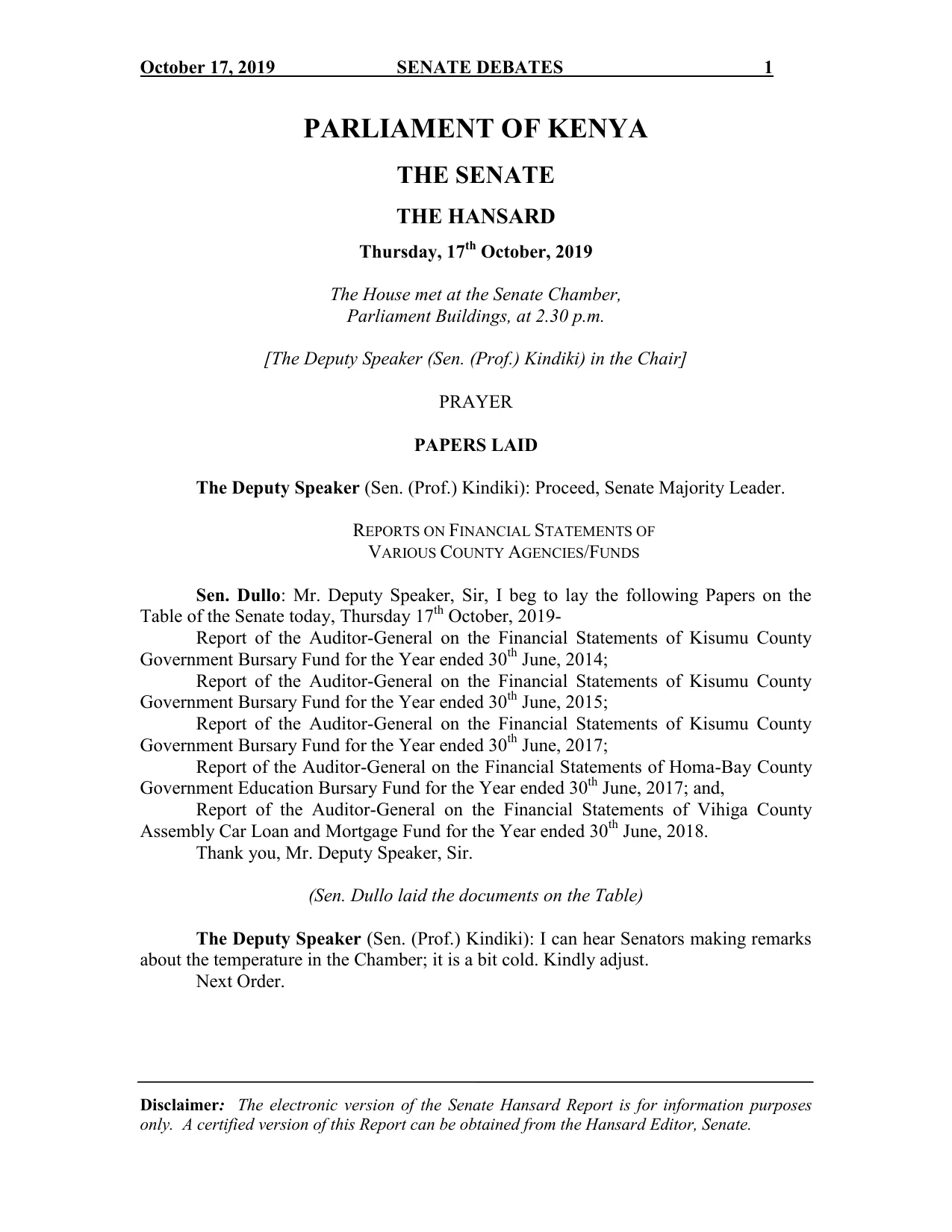
THE SENATE
THE HANSARD
PARLIAMENT OF KENYA
Thursday, 17th October, 2019
PAPERS LAID
Proceed, Senate Majority Leader.
REPORTS ON FINANCIAL STATEMENTS OF VARIOUS COUNTY AGENCIES/FUNDS
Mr. Deputy Speaker, Sir, I beg to lay the following Papers on the Table of the Senate today, Thursday 17th October, 2019-
Report of the Auditor-General on the Financial Statements of Kisumu County Government Bursary Fund for the Year ended 30th June, 2014;
Report of the Auditor-General on the Financial Statements of Kisumu County Government Bursary Fund for the Year ended 30th June, 2015;
Report of the Auditor-General on the Financial Statements of Kisumu County Government Bursary Fund for the Year ended 30th June, 2017;
Report of the Auditor-General on the Financial Statements of Homa-Bay County Government Education Bursary Fund for the Year ended 30th June, 2017; and,
Report of the Auditor-General on the Financial Statements of Vihiga County Assembly Car Loan and Mortgage Fund for the Year ended 30th June, 2018.
Thank you, Mr. Deputy Speaker, Sir.
I can hear Senators making remarks about the temperature in the Chamber; it is a bit cold. Kindly adjust.
Next Order.
STATEMENTS
FINANCIAL AND OPERATIONAL PREPAREDNESS OF THE NCPB TO RECEIVE THE 2019 CEREALS HARVEST
Sen. (Prof.) Kamar is not here. I stand down her statement.
Let us move to the next Statement by the Senate Majority Leader, after which I will give directions, under Standing Order 40, that the Order on Communication from the Chair is called out.
BUSINESS FOR THE WEEK COMMENCING TUESDAY, 22 ND OCTOBER, 2019
Thank you, Mr. Deputy Speaker, Sir. Pursuant to Standing Order 52 (1) , I hereby present to the Senate, the business of the House for the week commencing Tuesday, 22nd October, 2019.
On Tuesday, 22nd October, 2019, the Senate Business Committee (SBC) will meet to schedule the Business of the Senate for the week. The following Bills are due for Second Reading and the Committee of the Whole stages, and will be scheduled accordingly. The Bills at Second Reading Stage are-
Order, Senator for Murang’a County! You are notoriously noisy in the Chamber for no good reason. You are a good lawyer, and you should know that a good lawyer is circumspect, always studious and stoic.
Mr. Deputy Speaker, Sir, if you can remember, Sen. Kang’ata and I were both your students, and he was always like that.
Order, Senate Majority Leader!
Sen Mutula Kilonzo Jnr., is laughing because he was his client at the same period of time.
Mr. Deputy Speaker, Sir, I was reading the Bills on the Second Reading stage. I have read the first three. The rest are as follows:-
Thank you, Senate Leader of Majority. I will indulge Sen. (Prof.) Kamar so that we finish with that particular order.
Proceed, Sen. (Prof.) Kamar.
FINANCIAL AND OPERATIONAL PREPAREDNESS OF THE NCPB TO RECEIVE THE 2019 CEREALS HARVEST
Thank you very much, Mr. Deputy Speaker, Sir, for giving me the opportunity.
I rise, pursuant to Standing Order 48 (1) to seek a Statement from the Standing Committee on Agriculture, Livestock and Fisheries concerning the financial and operational preparedness of the National Cereals and Produce Board (NCPB) to receive the 2019 cereals harvest.
In the Statement, I would like to request the Committee to do the following-
Sen. (Prof.) Kamar, are you requesting for a Statement or are you making a Statement?
Mr. Deputy Speaker, Sir, I am only qualifying the Statement.
The request for a Statement should last 45 seconds. You should ask in terms of questions and sit down. If you have an ally or two who gets the favour of the Spekaer to make observations, you will be lucky.
Thank you, Mr. Deputy Speaker, Sir. May I only mention that previuosly, I asked another question, and I was told that the CS was coming, but he has postponed twice. Therefore, I have a back log in that docket.
Thank you, Mr. Deputy Speaker, Sir.
Thank you, Sen. (Prof.) Kamar. Proceed, Sen. Wetangula.
Thank you, Mr. Deputy Speaker, Sir. I support the request for the Statement. Luckily today, the Chairperson of the Committee on Agriculture, Livestock and Fisheries – the distinguished Senator for Embu County – is here.
In answering those raised questions, the Chairperson and the Ministry should tell this House, because when you go to the western part of Kenya today, Siaya, Busia, Kakamega, and Bungoma have already harvested all the maize. Trans Nzoia and Uasin Gishu will be harvesting from the end of this month, up to the Pokot area. These are huge quantities of maize. To date, the National Cereals Board (NCPB) offices are permanently closed, and there is no activity going on there. There is no evidence or indication that they are, in fact, preparing to buy the cereals to feed other parts of the country that do not grow maize, but eat maize.
Mr. Deputy Speaker, Sir, there is also no indication that the NCBP are restocking subsidized fertilizer and seeds for the next season’s planting. There is no indication that the satellite buying centres – which are ordinarily opened in areas where the NCPB buys maize and transports to the silos for storage – are going to be opened.
Mr. Deputy Speaker, Sir, could the Chairman, when he brings the Statement, tell the House what happened to the revolving fund of the Cereals Board, where they sell subsidized farm inputs and stock the money for the next season?
What is happening to farming in this country, given that the so-called Big Four Agenda includes food security as the pillar of the legacy that the current President wants to leave behind? I correctly heard him yesterday saying that the only legacy he wants to leave behind is a united Kenya, after realising that the Big Four Agenda is a mirage.
Order, Sen. Wetangula!
On a point of order, Mr. Deputy Speaker, Sir.
Proceed, Sen. Seneta, and be brief; this is not time for debate.
Thank you, Mr. Deputy Speaker, Sir. I support the Statement raised by Sen. (Prof.) Kamar. I urge the Committee to implement the recommendations of the ad hoc Committee that we set.
Mr. Deputy Speaker, Sir, the issue of preparedness is a serious one, not only in terms of harvests, but also during dry spells, when we will experience drought. We are also not prepared on how to store the food during harvest or search for markets for farmers. Therefore, the Committee should seriously engage the Ministry of Agriculture and Irrigation to find out how they will promote food security by preparing our farmers during planting and harvesting seasons.
Sen. Wamatangi, please approach the Chair.
Hon. Senators, I now direct that the Order on Messages be called out. After that, the Order on Communication from the Chair will be called out, pursuant to Standing Order 40.
On a point of order, Mr. Deputy Speaker, Sir.
What is it, Sen. Ndwiga?
Mr. Deputy Speaker, Sir, I need to add my voice to the request.
Yes; that Statement is under your Committee.
Thank you, Mr. Chairman, Sir. My Committee is seized of this matter. Today, together with my Vice Chairperson, we had a meeting with the Ministry of Agriculture and Irrigation on the backlog of issues which have emanated from this House and have not been resolved.
Apart from the issue of maize, there is also the issue of the Kenya Meat Commission (KMC) , where farmers have not been paid to date. It has been agreed that that the CS will be invited. We will let all Members know the day when the he will come to the Committee so that we can raise most of these issues and rest this matter. I promise that we will finish this matter within the next two weeks.
We now go to Orders on Messages, and then to Communication from the Chair. I will give further directions after that.
MESSAGE FROM THE NATIONAL ASSEMBLY DECISION OF THE NATIONAL ASSEMBLY ON THE REVISED DEBT CEILING OF THE NATIONAL GOVERNMENT
committed to the Standing Committee on Finance, Commerce and Budget, as well as the Sessional Committee on Delegated Legislation. The Committees were directed to consider the Regulations within 14 calendar days.
Hon. Senators, I reiterate and implore the relevant Committees to expedite the consideration of this matter so that this House can deal with the issue and make a pronouncement as required by the law and the Constitution.
I thank you. Hon. Senators, we had an extended session yesterday around this issue where I conveyed this Message, off the cuff. I gave as many of us as possible an opportunity to make observations.
We have already made a determination. The only thing I want to inform the House is that, as requested by Sen. Mutula Kilonzo Jnr. and approved by the rest of the House Members, the Senate shall in the course of today, write to the CS conveying in specific terms what the House decided with regard to this matter of the national debt. This is so that the record is set clear and straight in the future. That will be done and, once again, as requested and approved by the House, we shall circulate that communication to every Member of this House. On that note, let us end this matter.
Next order.
On a point of order, Mr. Deputy Speaker, Sir.
What is it, Senate Minority Leader? The Senate Minority Leader (Sen. Orengo) : Mr. Deputy Speaker, Sir, this is a very important issue, and I know that we are already seized of the matter. However, what you have read out, to the effect that the statutory instrument must be tabled within seven days after publication, from what I can remember from the documents we had here yesterday, I do not know whether there has been compliance with that requirement. In your Statement, you have emphasized that it should be tabled in Parliament, which means both Houses. In case there was a delay in tabling that statutory instrument as required by the law, I am pleading that in that communication to the CS, that issue should be brought out. Maybe we are being taken for granted. That is all that I wanted to say.
Absolutely. Fortunately, the letter
Mr. Deputy Speaker, Sir, this is a very important issue, and I know that we are already seized of the matter. However, what you have read out, to the effect that the statutory instrument must be tabled within seven days after publication, from what I can remember from the documents we had here yesterday, I do not know whether there has been compliance with that requirement. In your Statement, you have emphasized that it should be tabled in Parliament, which means both Houses. In case there was a delay in tabling that statutory instrument as required by the law, I am pleading that in that communication to the CS, that issue should be brought out. Maybe we are being taken for granted. That is all that I wanted to say.
Absolutely. Fortunately, the letter
On a point of order, Mr. Deputy Speaker, Sir. The Senate Minority Leader (
What is it, Sen. Mutula Kilonzo Jnr.? Is it the same matter?
Hon. Senators, I have a communication to make as follows-
On Tuesday this week, the Senator for Taita Taveta County, on a point of order which was supported by several other Senators, thereafter, brought to the attention of the Speaker that with regard to the Motion that was debated and passed on the same day regarding the establishment of a Select or Special Committee to investigate the allegations concerning the Governor of Taita/Taveta County, Hon. Granton Samboja.
The Senator of Taita/Taveta wanted to know whether it was in order for the House to continue deliberating on the Motion and taking further action while, according to the specified Senator, there were active proceedings. The Chair, after listening to the said Senator and other Senators who made interventions based on that point of order, ruled as follows-
That is very encouraging; thank you. Please proceed accordingly.
Next Order.
COMMMUNICATION FROM THE CHAIR RULING ON ISSUES RAISED BY SEN. MWARUMA REGARDING THE ESTABLISHMENT OF A COMMITTEE TO INVESTIGATE THE IMPEACHMENT OF GOV. SAMBOJA
Hon. Senators, I have a communication to make as follows-
On Tuesday this week, the Senator for Taita Taveta County, on a point of order which was supported by several other Senators, thereafter, brought to the attention of the Speaker that with regard to the Motion that was debated and passed on the same day regarding the establishment of a Select or Special Committee to investigate the allegations concerning the Governor of Taita/Taveta County, Hon. Granton Samboja.
The Senator of Taita/Taveta wanted to know whether it was in order for the House to continue deliberating on the Motion and taking further action while, according to the specified Senator, there were active proceedings. The Chair, after listening to the said Senator and other Senators who made interventions based on that point of order, ruled as follows-
Additionally, I have taken notice now – and that is after the Tuesday sitting – that there were some proceedings which were active, as alleged by Sen. Mwaruma and supported by Sen. M. Kajwang’ and others. What the Senators did not do on Tuesday – and this is encouraged for the future – is that they were trying to invoke the sub judice rule, but improperly so. They never provided any evidence; they just brought letters from town and there was no court order. The provisions of Standing Order 98 are very clear on the conditions that must be met; and the kind of evidence that must be produced for the invocation of the sub judice rule. They were completely out of order, although I entertained them for quite a while.
After the Tuesday meeting, it has come to my attention that there were some proceedings. I want to specify that the Senate was not a party in those proceedings. I also want to specify on the alleged injunction, which Sen. Mwaruma and company were relying on and which I have verified, that there was, indeed, an injunction. That injunction was not addressed to the Senate, and so we had nothing to do with it. We are neither parties in the proceedings, now were we injuncted.
However, hon. Senators, as I move towards the conclusion, I would like us to look at Standing Order 98 with a little detail, and I will allow a few observations and comments, because we have the best brains this country can ever have, both legal and non-legal. We have all the experience that we require in this House. I will allow a bit of that experience, because what we are trying to do is to create law which will be relied on, in posterity.
If you look at Standing Order 98, which Sen. Mwaruma and Sen. M. Kajwang’ had tried to use unsuccessfully, they did not succeed because they did not read the Standing Order. I think it was an afterthought or something like that. Standing Order No. 98 states:-
“(1) Subject to paragraph (5), no Senator shall refer to any particular matter which is sub judice or which by the operation of any written law, is secret.” I can summarize the other paragraphs under that Standing Order. They tell you how to make a case for sub judice. You must tell us that, “This is the evidence; there is a criminal or civil matter, and these are the pleadings; it is before this court.” You must then also tell us whether the determination of that matter or rather the involvement of the Senate in deliberating on that matter may have an implication on the determination of that matter. All those conditions ought to be met, but they were never met when they were adduced on Tuesday.
As I turn to paragraph 5, which is the last paragraph in that Standing Order, I also want to say that Standing Order 98 has nothing to do with court injunctions. It has zero relevance to court injunctions. It is a Parliamentary Standing Order, where Parliament, on its own Motion – as the lawyer says suo motu; on its own motion – decides in deference and respect to other arms of Government, looks at a matter, evaluates the facts and assesses that matter and says, “The way we look at this matter, we can hold deliberations on it, allow the courts to finish this process and later on we can discuss it again.” My point is that the sub judice rule is suo motu; it is on volition and discretion of Parliament. It has nothing related to court injunctions.
Secondly, similarly, the Judiciary sometimes – and I have the authority of Senior Counsel, Sen. Orengo and other lawyers in the House – when Parliament is passing legislation, they also normally withhold making any determinations until the process is over. In the same spirit of saying if an arm of Government is dealing with the matter, allow the processes to continue and then the other arm can review. In our case, the Judiciary can review a decision of Parliament.
Hon. Colleagues, it is in this connection on the specific matter of impeachment, that I want to determine that courts cannot injunct Parliament. They cannot and should not. I will not be that Speaker who supervises or overseas a process where Parliament is paralyzed by another arm of Government. That would be like suicide, and I am not a suicide bomber.
I also want to say that the Supreme Court, with tremendous respect to all the courts, has already given guidance on this jurisprudence and philosophy in the Wambora cases. I am, therefore, a bit concerned that, as much as we respect court decisions, we can disagree with them. I am a bit concerned when I see other courts not taking cue from the very explicit guidance given by Supreme Court in the Wambora cases, where the Supreme Court said that on matters impeachment, courts should be reluctant to intervene; they should allow the process to go through the Senate and, thereafter, they can get seized of that matter.
Thank you, Mr. Deputy Speaker, Sir. You have done so well, until the last Statement.
If you look at our Standing Orders, there is no mention anywhere about an injunction; either Parliament injuncting itself or anybody else injuncting Parliament; there is no mention. I have the distinction of being one of those who drafted these Standing Orders with the late Dr. Godana, Julius Sunkuli and the late Henry Obwocha. Even at that time---
Order, Senators. This is an important matter. I request that you pay absolute attention so that we can make the best decision possible.
Mr. Deputy Speaker, Sir, at that time, we visited comparable jurisdictions in the United Kingdom (UK) , Canada, Australia, Zambia, South Africa, Nigeria and New Zealand, and we found absolutely no provision where Parliament can be injuncted by any authority.
Mr. Deputy Speaker, Sir, you have analyzed Standing Order 98 very well, and I agree with you that even if the courts issued a restraining order, it will be invalid against Parliament. You have rightly said that we are not party to the proceedings that you are taking cognizance of. More importantly, this House has already set up a Committee.
I want to bring to the attention of the House that Standing Order 98, the Marende ruling as expounded by your own ruling that goes even further than the Marende ruling, makes it very clear that no court out there will be so weak as a judge or magistrate to be sitting, listening as to whether anybody is commenting about what is before him or her so as to be influenced. Then that is neither a judge nor a judicial officer.
There is no reason whatsoever justifiable in law and, in fact, for this House to stay the proceedings of the Committee for any number of days. This is because, the Committee has been established, it is time bound, and it has had its first sitting. Once it has had its first sitting, it must proceed to the end and report back to the House.
Therefore, Mr. Deputy Speaker, Sir, there is no room for stay and, in fact I have tremendous trust in your clear thinking, and it has never been wanting. There is no provision and you cannot use Standing Order 1 to stay the proceedings of a Committee with a time bound structure. I want to urge you to rescind that position, because even when we went to court to challenge certain matters, as a House, I watched very keenly how the court was conducting itself. I wanted to hear whether the court would say, “Now that this matter is before us, as a court, Parliament must stop discussing it.” They never did that. In fact, the courts then encouraged Parliament to resolve the matter quickly and come back to resolve it for them. Therefore, courts also understand. In fact, any judge who purports to injunct Parliament acts per incuriam and any act per incuriam is not capable of obedience.
Mr. Deputy Speaker, Sir and colleagues in this House, I urge you that, as we say in Swahili, meli imeng’oa nanga, it has set its sail. It is like when you go to swim, you can go to the pool and change your mind and go home. You can go to the diving board, change your mind and go home; but the moment you dive, you cannot change your mind
as you wish. You must hit the water. We have taken a dive and we must hit the water. After yesterday’s proceedings, we will be sending a very dangerous signal for this House to start---
It is Sen. Orengo who said yesterday that at no time should a House of Parliament ever imagine limiting its jurisdiction on its own Motion. The world over, everybody looks for more and more jurisdiction. Look at the judgments of Chief Justice Madan; his says, jurisdiction is so sweet that even when you are given, you grab it. This is what this House must do; we must allow the Committee to go on. Let us face anything that will come along the way.
As far as I am concerned and from what you have said, we have not been served with any court restraining orders. We have not been served any court proceedings, apart from what you have described as “papers from town” that were brought here by our distinguished colleague from Homa Bay. We have not seen anything and we cannot, therefore, encourage any act or omission that appears to indicate that we are limiting our jurisdiction on our own Motion.
Order! Did you say “cheeky” or was it on a light note?
the Business of a Committee of Parliament. In the case of Ruaraka, one of the suspects rushed to court seeking a court order to bar the Committee from summoning him to appear before it. We took a firm positon on that.
When I read Standing Order 75--- You started so well and even when you made cheeky remarks about people who come with papers from all over town, I did not have a problem.
Mr. Deputy Speaker, Sir, it was not too far, but it was on a light note.
Mr. Deputy Speaker, Sir, I followed 97 per cent of your Communication, and when I felt it was done, you delivered a bombshell in the remaining three per cent. Standing Order 75 does not give you the power that you purport to exercise today. It does not allow you to stop a Committee that has been established by this House, and given a specified number of days by the Standing Orders. For avoidance of doubt, it says “within 10 days,” and the words used are “shall” and not “may”.
Mr. Deputy Speaker, Sir, it was more on a light note.
Cheeky is bordering on mischief.
Mr. Deputy Speaker, Sir, it was not too far, but it was on a light note.
Mr. Deputy Speaker, Sir, I followed 97 per cent of your Communication, and when I felt it was done, you delivered a bombshell in the remaining three per cent. Standing Order 75 does not give you the power that you purport to exercise today. It does not allow you to stop a Committee that has been established by this House, and given a specified number of days by the Standing Orders. For avoidance of doubt, it says “within 10 days,” and the words used are “shall” and not “may”.
Yes.
Thank you, Sen. M. Kajwang'. You were one of the key proponents of the Tuesday Standing Order. However, you seem to have intellectually summersaulted today.
Mr. Deputy Speaker, Sir, I will not take a lot of time, especially after the change of heart by my very good friend, Sen. M. Kajwang'. The Senate now has its proper place on this issue.
Mr. Deputy Speaker, Sir, two or three things come to fore. First of all, when you were making your presentation, I wrote down the word “sagacious,” because that is what I thought about your ruling. Only until you got to the last sentence of your ruling, especially when you mentioned the word “however;” my stomach churned. This is because I realised that we were about to make a decision that will be extremely unpopular, but also very dangerous as a precedent to this House.
In addition to the fact that now, what this ruling is doing, it is extending the boundaries of Standing Order 1 to be limitless; that the Speaker can operate in whichever and whatever form and manner they deem fit to what they consider to be before the House. That is not a power that I want to donate to anyone; not even my own father.
An hon. Senator: Yes.
Sen. M. Kajwang', we have not given an indefinite stay. It is for 30 days, and I said that it can be varied even now or tomorrow. I want you to know that whatever we do from where we sit, is to advance two things. One, the interest of the sovereign vote of the people of Kenya, including the people of Taita/Taveta County. Two, to advance the dignity and stature of this House collectively. We can, therefore, vary the order and you should not make a big issue out of it. You should learn from Sen. Wetangula, who actually said harder things, but in a fairly soft way. Sen. Wetangula has started using his skills of his previous life, as the Minister for Foreign Affairs and the top Diplomat of the country.
Mr. Deputy Speaker, Sir, I will not take a lot of time, especially after the change of heart by my very good friend, Sen. M. Kajwang'. The Senate now has its proper place on this issue.
Mr. Deputy Speaker, Sir, two or three things come to fore. First of all, when you were making your presentation, I wrote down the word “sagacious,” because that is what I thought about your ruling. Only until you got to the last sentence of your ruling, especially when you mentioned the word “however;” my stomach churned. This is because I realised that we were about to make a decision that will be extremely unpopular, but also very dangerous as a precedent to this House.
In addition to the fact that now, what this ruling is doing, it is extending the boundaries of Standing Order 1 to be limitless; that the Speaker can operate in whichever and whatever form and manner they deem fit to what they consider to be before the House. That is not a power that I want to donate to anyone; not even my own father.
Order! Are you suggesting the Chair is out of order?
No, Mr. Deputy Speaker, Sir. Nothing could be further from the truth.
Proceed.
that, please, for the sake of the people of Taita/Taveta County--- I do not have many friends in that county, but I can assure you that in the last few days, I have received so many phone calls from friends who are from that County.
They are looking to this House to save their County from all that has been going on. They look at the circus that has been going on, and their leaders perhaps not agreeing or carry the residents of the County with them. They look upon the collective wisdom of this House to dock the ship so that they can enjoy the fruits of devolution, like the rest of the other 46 counties.
Therefore, with a lot of humility, I beg that we should let those 30 days be varied this afternoon and not any other time. It cannot be tomorrow or at 5 o’clock; it must be now.
Thank you, Mr. Deputy Speaker, Sir.
Thank you, Mr. Deputy Speaker, Sir. At some point when I was young, there was a case in which Sen. Orengo argued in the Mwai Kibaki versus Moi case---
Mr. Deputy Speaker, Sir, the confusion continues. Assuming that you have been served, the order would have a date of when the matter is going to proceed, which would dictate the process. The reasons Senators are confused is that assuming you have been served, the court order would say that this matter will proceed on 10th, 11th and 12th; which means we cannot proceed until the matter is heard.
The third issue is not even about the 30 days. If we are not parties to that order, I would think that the wisdom would be that the Senate would be interested in that proceeding by attending to the matter to say it is unprocedural and unconstitutional for co-equals to “injunct” one another. If we cannot “injunct” the Judiciary, they should not “injunct” us. However, we should do it on the Floor of the court by telling the judge that he has made a mistake and acted unconstitutionally.
First, I do not know whether you have revived, in your ruling, the objection raised by the Senator for Taita/Taveta County; or have you made an application and ruled on it? That is the confusion I have.
However, what is worse, Mr. Deputy Speaker, Sir, although it is good practice and I say this---
Sen. Mutula Kilonzo Jr., we said that I was served with that court order after Tuesday in the office. However, on the matter involving the Assembly, we were not party to it, but there was a court order. I took judicial notice that there were active proceedings ongoing.
Mr. Deputy Speaker, Sir, the confusion continues. Assuming that you have been served, the order would have a date of when the matter is going to proceed, which would dictate the process. The reasons Senators are confused is that assuming you have been served, the court order would say that this matter will proceed on 10th, 11th and 12th; which means we cannot proceed until the matter is heard.
The third issue is not even about the 30 days. If we are not parties to that order, I would think that the wisdom would be that the Senate would be interested in that proceeding by attending to the matter to say it is unprocedural and unconstitutional for co-equals to “injunct” one another. If we cannot “injunct” the Judiciary, they should not “injunct” us. However, we should do it on the Floor of the court by telling the judge that he has made a mistake and acted unconstitutionally.
Your direction would read as such, so that where we have been saying for the last few days, that “no human being is limited,” we should say that Parliament is not limited too. We want you to also protect the jurisdiction of this place.
Lastly, Mr. Deputy Speaker, Sir, the mischief of having an endless and infinitum sort of or ambiguous stay which you have issued, is the case of Gov. (Prof.) Kibwana. He held office after he had been impeached until the elections. This is because when I said we should exercise circumspection on this Floor, Sen. Murkomen thought otherwise. That matter never came to us because an injunction was issued by the court and it was misused by the parties and the matter never came here.
Order, Senate Majority Leader. If you will need to provide information, you know what to do.
Although good practice would dictate that what you have done is what the court was saying, that Parliament is wise, but we cannot leave it endless.
Lastly, I would have preferred that the Committee would have come to you and said, “Please, give us direction;” and say that an order arrived yesterday. You give a direction so that the Committee does not just look as if you have hanged them with a shoe lace, like they appear to.
There was a word introduced by Sen. (Dr.) Zani recently, which did not go down well.
That is why I asked you, what is wrong with “stay?”
“Parliamentary stay” is non-existent.
It simply means freeze. It is just a way a Committee is handling something and the House can decide that matter to wait for something.
That is why I asked you, what is wrong with “stay?”
“Parliamentary stay” is non-existent.
It simply means freeze. It is just a way a Committee is handling something and the House can decide that matter to wait for something.
The reason being?
First, it does not exist. Two, it is ambiguous, as we have not defined it; and 14 or 30 days for a parliamentary stay is not a word that should ideally come on the Floor. I would rather you find a better term that we will use in the future.
You will provide the Chair with some suggestions.
Thank you, Sen. Mutula Kilonzo Jr. Senate Minority Leader, I would have asked you to speak last with the Majority Leader, but since you have requested, the Floor is yours.
The Senate Minority Leader (Sen. Orengo) : Mr. Deputy Speaker, Sir, I probably would have been better listening, but I have asked you to give me a lot of time. I could see the mood of the House. I wish Sen. Mutula Kilonzo Jr. to give the Deputy Speaker a little bit of time.
The communication you have made today is very pertinent. Looking at the Constitution and the Standing Orders with regard to the removal of a president or a governor, either with regard to incapacity or by way of impeachment, they are time- bound. That is very important to declare at the outset; they must be done within a maximum of 21 days.
A lot of the matters that go before the courts tend to forget that the questions of impeachment are time-bound. The reason is that the issue of a governor or a president being impeached should not be a matter that occupies the country or institutions for months and days. That is why the framers of the Constitution wanted the matter to be settled as quickly as possible.
Mr. Deputy Speaker, Sir, the problem with our Constitution is that it belongs to the new type of constitutions, which have been described as constitutional democracies. It is quite different from the American constitutional structure. For example, nobody in the United States of America can ever imagine that when an impeachment process is ongoing, anybody can go to court. Since the impeachment of President Trump is ongoing, nobody can imagine going to court. However, in the modern democracy, which includes South Africa, Nigeria and ourselves, and where the Bill of Rights are at the center stage of our written Constitution, you find that judicial interference is something that occurs every now and again.
I want to begin with Sen. Wetangula. There was a time when the Speaker wanted to gazette him, that he is no longer a voter, and thus he ceases to be a Member of Parliament. We had to go to court to make that intervention and ensure that decision was
The reason being?
First, it does not exist. Two, it is ambiguous, as we have not defined it; and 14 or 30 days for a parliamentary stay is not a word that should ideally come on the Floor. I would rather you find a better term that we will use in the future.
You will provide the Chair with some suggestions. Thank you, Sen. Mutula Kilonzo Jr. Senate Minority Leader, I would have asked you to speak last with the Majority Leader, but since you have requested, the Floor is yours. The Senate Minority Leader (
Hon. Colleagues, I want to remind us a bit because I am also a legal expert and some of these things need to be pruned a bit, so that we go within the Constitution and the law. I respect Senior Counsel, Sen. Orengo’s, remarks about harmony. In my comments, I said that the institutions need one another. Parliament does not exist by itself. When we have a case we go to the courts. When courts want money, they come to Parliament and so forth.
Montesquieu, one of the greatest philosophers in constitutionalism explained why there is need for checks and balances. He also explained why one institution as much as it is in harmony with others, it should guard its own terrain. He said and I quote:
“Every man invested with power has the tendency to push it as far as it can go.” Every man or institution invested with power, the natural tendency is for him or institution to push it as far as it can go. For that reason, it is important for the three arms of Government to have some checks and balances. When one institution wants to encroach on the other too much, it says: “Come on, your freedom to thrown fists in the air stops where my nose is. This is because that freedom to throw fists in the air does not involve you punching my nose.”
Hon. Colleagues, checks and balances are important. I am for institutional harmony and inter-harmony. However, the Senate is not a parastatal board. I want that to be clear. It is a House of Parliament and works within the law and structures. I do not know why anybody would think, for example, that the Senate is a place where are unsafe and their rights will not be respected. I am saying this because of the comments which have already been made, especially by Sen. Orengo.
The governor has a right to be heard, but he does not have a duty to appear. It is a right. If he exercises his right not to appear, the Senate will continue with its business. This is because this is not about the governor; it is about the law and the people of Taita/Taveta. However, let me hear a few other comments. Please, relax and do not tense the discussion.
Senate Majority Leader, I can see you have carried authorities and entireties.
made; whereas on gazettement, it would have been taken as a done deal. However, because he could go to court and get conservatory orders, that process could be stopped.
Mr. Deputy Speaker, Sir, what I am appealing is that whereas everything that you have said is correct, this Constitution wants the organs of Government to work in harmony, otherwise, then we would be inviting anarchy. I wish to pose the question that if we decided to go on and the governor has got, for example, an order in his hands, can we summon him? My answer is that we cannot summon him because he has already got an order of the court which is staying the proceedings as it were. We should persuade the courts that once an impeachment process starts, they should not stop it until it comes to an end.
What they forget is that the issues that were raised by the governor before the county assembly, the Committee and the Senate now siting as a court are bound by the Constitution. In fact, Article 10 binds all persons and all state institutions in this exercise. Those same complaints could be made before the Senate sitting as a court. He could say that he was not served or properly heard by the county assembly. All those arguments can be made. However, now we face a situation or circumstance where the proceedings we are undertaking would not have legal efficacy.
Mr. Deputy Speaker, Sir, I did mention that because the issue of service had been raised in the Governor Wambora’s case in the High Court that he was not served and that an order of court had already been served - whether we were served or not – I said we should stay those proceedings. However, the House went the other way round, I even became a Member of that Committee and proceeded with the impeachment proceedings.
Mr. Deputy Speaker, Sir, I am trying to plead with the House so that there should be some institutional harmony. Maybe the courts, over time seeing what they are doing to be ludicrous, may change position and take the advice from the Supreme Court that they should not interfere with an ongoing exercise in Parliament. However, now that there is a stay, I think for harmony of institutions of Government, it will be appropriate to stay the proceedings in this House.
‘Stay’ is a term of the Constitution or art, and this Senate cannot be barred from using it. We use all other terms that are defined in the Constitution to bring institutional harmony. Otherwise, if the Committee decides to proceed, then we will end up in a legal quagmire. That is not to say that the powers of the Committee have been taken away. At the end, the Committee will still be seized of the matter and be able to deal with it.
I so submit.
Floor of this House that the Senate is not a liquor licensing board to be injuncted. Those were your words.
Hon. Colleagues, I want to remind us a bit because I am also a legal expert and some of these things need to be pruned a bit, so that we go within the Constitution and the law. I respect Senior Counsel, Sen. Orengo’s, remarks about harmony. In my comments, I said that the institutions need one another. Parliament does not exist by itself. When we have a case we go to the courts. When courts want money, they come to Parliament and so forth.
Montesquieu, one of the greatest philosophers in constitutionalism explained why there is need for checks and balances. He also explained why one institution as much as it is in harmony with others, it should guard its own terrain. He said and I quote:
“Every man invested with power has the tendency to push it as far as it can go.” Every man or institution invested with power, the natural tendency is for him or institution to push it as far as it can go. For that reason, it is important for the three arms of Government to have some checks and balances. When one institution wants to encroach on the other too much, it says: “Come on, your freedom to thrown fists in the air stops where my nose is. This is because that freedom to throw fists in the air does not involve you punching my nose.”
Hon. Colleagues, checks and balances are important. I am for institutional harmony and inter-harmony. However, the Senate is not a parastatal board. I want that to be clear. It is a House of Parliament and works within the law and structures. I do not know why anybody would think, for example, that the Senate is a place where are unsafe and their rights will not be respected. I am saying this because of the comments which have already been made, especially by Sen. Orengo.
The governor has a right to be heard, but he does not have a duty to appear. It is a right. If he exercises his right not to appear, the Senate will continue with its business. This is because this is not about the governor; it is about the law and the people of Taita/Taveta. However, let me hear a few other comments. Please, relax and do not tense the discussion.
Senate Majority Leader, I can see you have carried authorities and entireties.
Mr. Deputy Speaker, Sir, I am happy in terms of how the discussion is going.
First of all, I need your attention because that is the Vice-Chairperson of the Committee and I also need his attention, because I respect his legal mind.
Mr. Deputy Speaker, Sir, I am glad that you have clarified that we are not here to score points or compete against each other, but to inform the House where we are going. I also must confess that I have tremendous respect for you, having been my lecturer, senior and the Senate Majority Leader here. I remember in a similar situation you said on the
Let me help you a bit. Just resume your seat. You will continue.
I think I set the stage for the discussion we are having. I said this is about our institution. I encourage you, the Senate Majority Leader, and those who have not spoken that you can correct the Speaker. Even lawyers go to court and tell judges that courts have no certain powers. That is okay so long as the language is measured, respectful and does not create innuendos.
Secondly, Senate Majority Leader, the issue you are bringing about on institutional relationship is important. I agree with you because we should ask ourselves whether courts also defer to us. However, in support of Sen. Orengo, you will recall that when went to court on Reference No.3, the Chief Justice, Hon. Maraga, encouraged us, as Parliament, to deal with the matter unless we insisted. Therefore, the idea of moderating our proceedings is not farfetched, but you are also right that it has to be tempered.
The Senate Majority leader (Sen. Murkomen) : Mr. Deputy Speaker, we respect the institution of the Speaker with a lot of fear. I appreciate your magnanimity in terms of agreeing that this debate should be as free as possible. However, my concern is the point of the question of a decision.
Sen. Mutula Kilonzo Jnr. argued the case of Hon. Abu Chiaba. We were with him in my earlier law career, but I was too junior. The argument we made that time was that Kibaki versus Moi’s case was made per incurium. We were looking for a way to run away from Kibaki versus Moi. We argued that nobody brought to the attention of the Court of Appeal then that there was a certain provision of the law that you can vary your own decision if it was made per incurium.
Mr. Deputy Speaker, Sir, based on the arguments we will have here, I hope that you will vary your own decision because our colleagues here could point to certain issues and you might say that the decision was made without looking at other Standing Orders.
Lastly, we cannot run away from the determination as to whether Parliament can be injuncted. I cannot remember which day, but Sen. Orengo was in this House when we were arguing and he ran away before your ruling. Now today---
Order, Senator! Running away is not a good term. He left the Chamber.
Mr. Deputy Speaker, Sir, I also gave my 100 per cent attention to the Senate Minority Leader, but in this very situation, it is in his capacity as a Senior Counsel. I have said that I respect you and so, I hope the next comment will not mean that I am taking anything from you.
I totally associate myself with Sen. M. Kajwang’, who like Paul, got his Damascus moment. As we said, everyone has an opportunity to change their mind. Sen. Mutula Kilonzo Jnr. was making this point that I am about to make, but veered off somewhere on the way. I do not know if someone whispered to him behind there.
This is with regard to Standing Order No.98. Where did you get the powers? I am sorry because we are not supposed to question the Speaker. This Standing Order is about debate when a Member is referring to a matter that is pending before court. One other Member will stand on a point of order and alert the Speaker. In fact, this heading and Sen. Orengo was part and parcel of drafting these Standing Orders, for this part is something to do with rules of the debate.
When we debate, one of things we must not refer to is a matter pending before a court of law. So, a Member should stand here on a point of order and say that the matter is pending before a court of law and, therefore, we should not refer to it or debate it and so on and so forth.
What we are discussing here is a matter that is time bound. If you read Standing Order No.75, Article 181 of the Constitution, and Section 33 of the County Governments Act, all these provisions relate to removal of a governor and there is time bound.
Sen. Orengo said here that Parliament must not be in a hurry and it should ensure that it is in harmony with the other institutions. We have the Intergovernmental Relations Technical Committee (IGRTC) and others. However, let us not beat about the bush. We have to make a decision on the Floor of this House in two ways. It either that Parliament has been injuncted or Parliament has not been injuncted.
I know we are struggling to produce a jurisprudence of in-between which is self- injunction and very dangerous, if I may say so. This is because if that rule is applied to the Committee Chaired by Sen. Ndwiga, then there is nothing that stops the Speaker tomorrow, on an influence of another person from the streets, from stopping the Committee investigating medical equipment. Nothing will stop the Speaker from injuncting indefinitely the Committee that is investigating the issue of debts.
We will have introduced, through a Standing Order that is non-existent, a jurisprudence that will put this House in a lot of problems. I am saying this with tremendous respect. You can imagine what may happen if the House is divided and the Speaker decides to support one side of the House. Someone may stand and say that for
the goodness of the House and institutional relationship with the Executive--- If this applies to the Judiciary, there is nothing that stops institutional relationship with the Executive. Somebody here could say that for good institutional relationship with the Executive, we should stay our proceedings for 30 days to be reviewed backwards or forwards.
Mr. Deputy Speaker, Sir, I am not saying this because I disrespect you. I fear that this precedent will affect the Committee that Sen. M. Kajwang’ chairs and other committees that could be formed. It will also affect proceedings of this House against the Executive. Therefore, that will set a dangerous precedent.
Secondly, I want to state my position---
I can say without fear of contradiction here that it is the impeachment process of this House that made Governor Wambora to go and improve himself such that he was re- elected in the second term.
Many of the governors who were brought here for impeachment were re-elected because it was a wakeup call for them to go and serve the people and correct their ways. I want to disabuse this House or any citizen of this nation that this House is intending to have impeachment or removal of a governor by all means. Those who want to stop the Senate process because the only concern they have is the fear of the removal of the governor; I want to tell them that we are a fair House.
My request to the Chair, is for you to relook your decision. Look at the implications of that decision, not just on impeachment processes, but on all matters of inquiry on serious issues. Remember we are already priding ourselves, as a Senate, as the only House which is ready to take on bold decisions across the country.
If we are going to be injuncting ourselves, we are falling into the danger that another Speaker fell into. The Speaker, while sitting there, whether it is the substantive Speaker or the Deputy Speaker, is a Speaker or a Member of the panel. Tomorrow, another Member of the panel will sit here at around 5.30 p.m. or 5.40 p.m. and issue a ruling that he has injuncted. Whether malicious or not, in his or her own wisdom, they will stand here and say that they have issued a temporary injunction of up to 30 days on a Committee that is investigating the matter of a Dam busting in a certain place .
Mr. Deputy, Speaker, Sir, I beg of your office---
Where did you get the word “injunction” from? I have not used it.
Mr. Deputy Speaker, we respect the institution of the Speaker with a lot of fear. I appreciate your magnanimity in terms of agreeing that this debate should be as free as possible. However, my concern is the point of the question of a decision. Sen. Mutula Kilonzo Jnr. argued the case of Hon. Abu Chiaba. We were with him in my earlier law career, but I was too junior. The argument we made that time was that Kibaki versus Moi’s case was made per incurium. We were looking for a way to run away from Kibaki versus Moi. We argued that nobody brought to the attention of the Court of Appeal then that there was a certain provision of the law that you can vary your own decision if it was made per incurium. Mr. Deputy Speaker, Sir, based on the arguments we will have here, I hope that you will vary your own decision because our colleagues here could point to certain issues and you might say that the decision was made without looking at other Standing Orders. Lastly, we cannot run away from the determination as to whether Parliament can be injuncted. I cannot remember which day, but Sen. Orengo was in this House when we were arguing and he ran away before your ruling. Now today---
Order, Senator! Running away is not a good term. He left the Chamber.
Mr. Deputy Speaker, Sir, I agree that it was not a part of your ruling. I can understand where you are coming from. There is no one in this House who does not understand you. Our request is that the Speaker reflects on this matter. If that reflection could come today, we would be very happy so that this Committee can proceed with its work.
Let the governor say that he is not going to appear before the Committee. Even if someone is injuncting, it is only one party who is saying that they will not appear. Let the county assembly and other witnesses, including citizens of Taita Taveta County appear. Let the Committee say:
“We never made an ultimate decision of impeachment because we did not have enough information; or we came to the conclusion that he should be impeached.” Impeachment is not absolute. It will come back to the Floor of this House and Members will decide here, out of 24, whether the decision of the Committee was a wise decision.
On a point of information, Mr. Deputy Speaker, Sir.
Yes, he left the Chamber to attend to other matters in the middle of a serious debate.Mr. Deputy Speaker, Sir, when you make a decision finally, you should also consider that all of us were here. Sen. Orengo’s submission was that Parliament can be injuncted. He went straight to the argument that you can injunct Parliament. This House must make that decision.If you agree with Sen. Orengo’s submission that we are part of the new constitutional order and constitutional democracy where Parliament can be injuncted, then make that ruling in black and white, so that we know that any time these characters out there are investigated---What Members of the CPAIC are struggling with is that governors refuse to appear before us despite the fact that Article 125 says that Parliament can summon anybody. You can come and disagree on what you submit in the Committee, but you must appear before Parliament when summoned. That section will also be suspended because someone could go to court and say they will obey Article 125 of the Constitution because there is a court order. If that is the case, we will never do anything.Mr. Deputy Speaker, Sir, my point is that it is not about the Governor of Taita/Taveta County. I said last time that we carried our investigations on impeachment, but acquitted all those people. Secondly, in Governor Wambora’s case where I sat in the Committee, there was an injunction, but we still summoned him to come. There was a court order, but he came.He said he would make all arguments without prejudice. We did our investigations and impeached him. That impeachment forced him to go through all the processes of court up to the Supreme Court of Kenya that made a ruling. It also forced him to behave because he knew there was already a process of accountability.We are not saying that when we impeach someone and they survive - like the other ones who survived - that they are not going to correct their ways. Our report of this House still informs how that governor and how that county will behave. Our intention here is not to remove a governor by all means. It is the impeachment process that will inform this.You cannot tell me that the impeachment process of President Bill Clinton did not impact on how he was going to behave and on how other presidents were going to behave in the White House with interns.
Yes, Mr. Deputy Speaker, Sir.
After the information, please, wind up because we have two or three other speakers.
Mr. Deputy Speaker, Sir, I want to inform the distinguished Senate Majority Leader that, in fact, any party that fails to appear after proper summons and constitutional proceedings, then the Committee is entitled to pass an adverse inference against it and proceed to make a sound legal justifiable decision.
The Senate Majority Leader (Sen. Murkomen) : Thank you, Mr. Deputy Speaker, Sir. That is very important information.
To add on that, this House is not seeking to have an impeachment so that then after they can rush it to be enforced by court. No. We are not intending to subject our decision to court. It is other people who will subject it to a court process.
I heard Sen. Orengo trying to argue that let us not do things which later will be in vain. How many legislations have we passed in this House that have been struck to be unconstitutional? We never came back and said let us not pass laws because they are likely to be in vain.
How many court decisions are overturned by superior courts?
Exactly, Mr. Deputy Speaker, Sir. The same way we make our decision here, let the aggrieved person go to court and deal with it. We will relax. We are not excited that our decision was upheld or not. We will proceed with our processes until another one is brought to this Chamber then we will make another decision. It is not personal. It is not like we are trying to win. There is nothing to win; it is just to respect the constitutional process.
Thank you, Senate Majority Leader. Once the Senate makes a decision, it becomes functus officio meaning our job is over. Whoever wants to go to court, can go to court. I agree with you, Senate Majority Leader.
Thank you, Mr. Deputy Speaker, Sir, for giving me an opportunity to make my remarks on this matter. This is a very difficult matter. I have listened to your ruling and 90 per cent, in my view, is agreeable. However, there are a few matters that I want you to relook them.
One, today’s ruling has arisen from no Motion. There is no Motion. Nobody has come before you to move you to make a decision today. Given the fact that this is a weighty matter and it is a matter upon which you have a made a decision, that before you made the decision, it was not subjected to the feeling of the House on either side; it would be very kind on your part to perhaps rescind that decision. The feeling of the House is that in spite of what Sen. M. Kajwang’ raised yesterday, the House felt that we should set up a Committee and a Committee has been set up.
Secondly, if look at the Standing Orders, you will find that there is no Standing Order that allows for today’s decision by the Speaker. I have been sitting here trying to look at the Standing Orders and I have found Standing Order No.1 which is about procedural matters.
Yes, Mr. Deputy Speaker, Sir.
speak, that sobriety and seriousness disappears. You start marauding around the Chamber.
Mr. Deputy Speaker, Sir, I want to inform the distinguished Senate Majority Leader that, in fact, any party that fails to appear after proper summons and constitutional proceedings, then the Committee is entitled to pass an adverse inference against it and proceed to make a sound legal justifiable decision. The Senate Majority Leader (
Thank you, Mr. Deputy Speaker, Sir. That is very important information. To add on that, this House is not seeking to have an impeachment so that then after they can rush it to be enforced by court. No. We are not intending to subject our decision to court. It is other people who will subject it to a court process. I heard Sen. Orengo trying to argue that let us not do things which later will be in vain. How many legislations have we passed in this House that have been struck to be unconstitutional? We never came back and said let us not pass laws because they are likely to be in vain.
Mr. Deputy Speaker, Sir, I was listening to you your ruling as I walked into the Chamber. I was agreeing with you until the last sentence which totally confused me. The statement confused me because when I was here, I looked up the word ‘process’.
In my view, a process is like an erection. You erect a building straight for it to stand because you cannot erect it halfway and leave it at that.
What is your point of order, Sen. Kajwang’?
Thank you, Senate Majority Leader. Once the Senate makes a decision, it becomes functus officio meaning our job is over. Whoever wants to go to court, can go to court. I agree with you, Senate Majority Leader.
Order, Sen. Kajwang’! We must preserve the dignity of the House so that in case we impeach someone, they will feel that they have been impeached by the right people.
What is it Sen. Wetangula?
speak, that sobriety and seriousness disappears. You start marauding around the Chamber.
Mr. Deputy Speaker, Sir, I have a lot of respect for the distinguished Senator for Bungoma County. I believe that he is one of the well-spoken distinguished Senators in this House who understands who has mastered the Queen’s language. However, in this case, I completely disagree with him. If you take the Black English Dictionary, we do erect structures. If I was to read to him---
Sen. Olekina, you are right. Structures can be erected. Since the Speaker has agreed with you on behalf of the House, kindly restrict yourself on your comments on the Speaker’s Ruling.
Mr. Deputy Speaker, Sir, Standing Order 75 on the procedure for the removal of a Governor is very clear. Standing Order 75 (1) (a) states that:-
‘Within seven days after receiving notice of a resolution from the speaker of a County Assembly supporting the removal of a governor of the county pursuant to Article181 of the Constitution—
Thank you, Sen. Olekina. I invite colleagues who are lawyers to reflect on the issue that I have introduced today and which can be developed. The issue is whether we can freeze timelines provided within our own Standing Orders as opposed to the County Government’s Act or the Constitution that Sen. Olekina has made reference to.
Is it a blanket position that we should take that we cannot stay our own proceedings where there are timelines. I am of the view that we can control our own timelines for the convenience of the House. However, we cannot control statutory and constitutional timelines. That is food for thought.
What is your point of information, Sen. Murkomen?
On a point of order, Mr. Deputy Speaker, Sir. I know Sen. Olekina to be proficient in the English language. I do not what to imagine that he meant an election. If he truly used the word that he has used, would you rule that he is using unparliamentary language that has no place in this House and at this particular point in time. Maybe it can have a place later on at night but not now in this House.
Mr. Deputy Speaker, Sir, statutes are born from the Grundnorm which is the Constitution. These Standing Orders are also born from the Grundnorm. They get their legality and foundation from the Constitution.
In fact, these Standing Orders enjoy stronger constitutional protection than ordinary statutes because it is through these Standing Orders that we create those statutes. This is the departure point, that the Standing Orders, where they give you time bound process, the House has absolutely no opportunity to expand that timeline. This is born out
On a point of order, Mr. Deputy Speaker, Sir. The distinguished Senator for Narok County must know that in the Queen’s English, we construct houses. We do not do the other thing that he has said when dealing with houses.
Proceed,
Mr. Deputy Speaker, Sir, I have a lot of respect for the distinguished Senator for Bungoma County. I believe that he is one of the well-spoken distinguished Senators in this House who understands who has mastered the Queen’s language. However, in this case, I completely disagree with him. If you take the Black English Dictionary, we do erect structures. If I was to read to him---
Sen. Olekina, you are right. Structures can be erected. Since the Speaker has agreed with you on behalf of the House, kindly restrict yourself on your comments on the Speaker’s Ruling.
there have been other rulings that have been made by previous Speakers sitting where you are speaking from; what is the procedure of departure from precedence set by the House before? I remember when the former Speaker Ekwee Ethuro was confronted by the Governor Wambora’s case, he made a very lengthy ruling that he read for almost half an hour. So, to depart from that kind of precedence and another Speaker who may come after you have made this precedent supposing it was to go through, then what does one need to do as a Speaker when you sit on that seat to depart from precedence that have been set before?
Thirdly, I believe the mood that the House has right now picked because after you gave really firm and solid affirmations as to one of the reasons why this House cannot be injuncted and why we should be independent with strength, Mr. Deputy Speaker, Sir, your ruling seemed to have emanated from or lacked what one would call “flow”. I would call it flow because---
Thank you, Sen. Olekina. I invite colleagues who are lawyers to reflect on the issue that I have introduced today and which can be developed. The issue is whether we can freeze timelines provided within our own Standing Orders as opposed to the County Government’s Act or the Constitution that Sen. Olekina has made reference to.
Is it a blanket position that we should take that we cannot stay our own proceedings where there are timelines. I am of the view that we can control our own timelines for the convenience of the House. However, we cannot control statutory and constitutional timelines. That is food for thought.
What is your point of information, Sen. Murkomen?
Mr. Deputy Speaker, Sir, following from your conversation, for those of us who have not spoken,I would like us to reflect on whether we can freeze a timeline that is in the Constitution? All the timelines that are in the County Governments Act were borrowed from the Constitution in so far as impeachment of the president and the deputy president is concerned.
Should Parliament in future face the situation we are facing today when impeaching a president or his deputy, will a president or his deputy be held accountable through a process of impeachment if there is this back and forth?
The Senate Majority Leader, that is a good point. It is something that we can reflect on as we go on. There are ways of introducing the matter in the subsequent sittings. There are a million ways of introducing the issue. Before I allow Sen. Wetangula to speak briefly on this matter, my thinking is around freezing our own timelines in the Standing Orders versus freezing timelines that are statutory or constitutional. I hold the view that we can freeze our own timelines but if they are statutory or constitutional, we cannot freeze them. The question on how to do it is a different issue.
Kindly proceed, Sen. Wetangula.
We do not have, unless you are on a point of order. What is it?
of the philosophy that a President, Deputy President, and a Governor are elected by people to hold serious constitutional offices; that when they are subjected to the trauma of impeachment, it cuts like a saw. It cuts back and forth. It cuts the governor and the people over whom they have authority.
So, we must not let the people of Taita Taveta; for example, go without their governor, neither should we let the Governor of Taita Taveta have his fate hanging in the balance without knowing which direction he is going. That is why the time limits are set. The time used, as set out under Standing Order No. 75, that my distinguished colleague from Narok has mentioned, is not “may”, it is “shall” within 10 days. There is no room for maneuver.
Mr. Deputy Speaker, Sir, I have been looking through the Standing Orders since you used the term “stay”. I am unable to find any reference to freeze or stay of proceedings. The Standing Orders only talk of adjourning. You can adjourn proceedings. You can only adjourn proceedings on a causation from a member.
Therefore, in this regard, well intentioned, and we must expand our jurisprudence, I encourage you that when you come to make your final ruling, to say that you acted per incuriam, on that matter. Just like Mr. Gibson Kamau Kuria one time told a judge, that Mr. Judge, one of us is definitely not telling the truth and it is not me.
Proceed,
Thank you, Mr. Deputy Speaker, Sir. In the future, we will also be begging the Chair that when there is such a debate, try to mix the opportunities we give because when all the lawyers speak before those of us who are not practitioners at the bar, then the debate not only becomes harder but most of the things we would want to say in layman’s language, are complicated by the legalese; but needless to say, I would like to point out two things.
On a point of order, Mr. Deputy Speaker, Sir.
Thank you, Mr. Deputy Speaker, Sir, when I was talking about flow - and pardon my language - I was looking for a word that is not offensive. Are we giving a relief that has not been sought? The bigger question in my mind was, when you have ruled that we are giving a stay for 30 days, what does the House anticipate will happen within those 30 days? Or then, when it is given, what do we want to happen in those 30 days. That is where I was coming from in my thought but I am of the same thought with the rest of the House that indeed we would be better off, standing with the firm comments you made earlier, that in deed this House must fight for its independence and not allow any interventions that would bar our proceedings.
Thank you, hon. Senators. Just a clarification, it is not true that the Speaker acted without being moved. I started my remarks in this Communication by saying that I was moved on Tuesday. This is an ongoing matter. It is live. I keep on saying that a Speaker’s ruling is a process that is continuous. It does not end at the time the ruling is done. If further information comes, you can build on what you ruled yesterday because the impeachment process is live. It is before us. There are some comments that l had made on Tuesday when I had not received the orders that I received on Wednesday.
That clarifications needs to be done.
Mr. Deputy Speaker, Sir, we are talking post facto because you made a decision. We are pleading with you---
My Communication today was
Mr. Deputy Speaker, Sir,---
Mr. Deputy Speaker, Sir, I strongly disagree with that process.
Mr. Deputy Speaker, Sir, if you allow me---
Order!
Mr. Deputy Speaker, Sir, you seem to be offended.
Thank you, Mr. Deputy Speaker, Sir, for giving me this opportunity to make my comments on the ruling that you have just made.
First and foremost, you made a ruling on Tuesday on a Motion to appoint a select Committee to consider the impeachment of Gov. Samboja, the Governor of Taita Taveta County. During the hearing of that Motion, there were objections on the fact that there was a court order which had been issued by the court. As a result, you made a ruling that the Houses of Parliament are not bound by court orders issued to injunct their functions. Therefore, I believe that in parlance with court proceedings, there ought to have been a Motion by Sen. Mwaruma---
Who has not been allowed to ventilate?
Mr. Deputy Speaker, Sir, we are talking post facto because you made a decision. We are pleading with you---
My Communication today was
Mr. Deputy Speaker, Sir,---
Order, Sen. Ochillo-Ayacko.
Mr. Deputy Speaker, Sir, if you allow me---
Order!
Mr. Deputy Speaker, Sir, you seem to be offended.
to be an obstacle to its execution of its own business. Therefore, it is important for you as the Deputy Speaker---
You are right, Senator for Kakamega.
Proceed.
Mr. Deputy Speaker, Sir, I have seen some deformed arm----
The situation is not obtaining now.
Mr. Deputy Speaker, Sir, let us not catalyze the perception that Senate is a House of idlers. We have business before us. Article 96 is clear on our role to protect counties. A matter of such magnitude as been presented to be adjudicated before us yet we are the same people who are staying the matter and taking more time to adjudicate it.
Mr. Deputy Speaker, Sir, I believe that before this matter came to this House, the procedure is clear. It was placed before the Senate Business Committee (SBC) which you Chair. A decision was made and this House adopted the same position. Therefore, it is bad for the same Chair to reverse a resolution of this House after a day or so. I beseech you to reconsider your position on this matter. The mood is clear. Let us give the people of Taita Taveta a fair hearing.
Article 1 of the Constitution is clear on the sovereignty of the people of Kenya which can be exercised directly or indirectly through the elected leaders. The people of Taita Taveta have spoken through their Members of County Assembly (MCAs) . Therefore, it will be good if you give the people of Taita Taveta a fair hearing by adjudicating this matter and not staying it any further. It is my humble appeal that you reconsider your position on this matter. I believe that as a House, we shall adjudicate it fairly.
I have already seen in both print and broadcast media that the Senate has already suspended this matter. Therefore, it is good for you to come on record so that we reverse that notion. We are ready to hear this matter, listen to the people of Taita Taveta and give them a fair hearing. We shall listen to the MCAs, the governor and any other party. Therefore, I still emphasis that you kindly re-consider your position on this matter.
Thank you, Senator for Kakamega. You have done well in spite of your caveat that you are about to cause discomfort and displeasure.
Very well. We are almost completing. Sen. Pareno can give a few remarks, then I will allow the Chairperson of the Special Committee to make remarks and then we can end it there.
Thank you, Mr. Deputy Speaker, Sir. I was looking at our Standing Orders and the procedure that is provided for removal of a governor in our Standing Orders. We have already dispensed with the provisions of Standing Order 75 (1) . We
Thank you, Mr. Deputy Speaker, Sir. First of all, you will forgive me because I am not a lawyer. Therefore, I might lack the correct jargon to communicate in a polite way. So, you will forgive me in case I do not please your ears.
Let me use the word of the Senate Majority Leader, that I---
Maybe you can conclude in Kiswahili because you seem to do better in Kiswahili.
Mr. Deputy Speaker, Sir, I do better in both. Probably, I just used the wrong term. However, it is not a wrong term as it were, because if a House has resolved on a matter that has been communicated and debated by the House, it is the resolution of the House that is weightier than a second ruling by the Speaker.
Mr. Deputy Speaker Sir, when you look at a review by the Speaker, I believe that the Speaker can only review upon an application.
Order! Resume your seat.
Mr. Deputy Speaker, Sir, with all due respect---
Sen. Pareno, resume your seat. I have been very patient the whole afternoon. That tells you how important I take the contribution of every Member on this particular issue, because it touches on our existence.
At some point, I gave some guidance that the Speaker is not on trial. What I allowed are comments, observations, additions and perhaps an invitation to the Speaker to consider certain things. I did not invite Members to put the Speaker on trial, because the process of putting the Speaker on trial is also provided for. It is not in terms of him making a communication and then he is put on the dock. You can even remove a Speaker from office, but not by waiting for him to make a communication, and then you now start putting him as accused person. With great respect, I advise that you tidy up your thoughts, and then we close. Please, do not advance it beyond that.
have proceeded to realize what is provided for in Standing Order 75 (1) (a). We have done 75 (1) (b) and the only thing remaining is the investigation by the Committee.
As per the provisions of Standing Order 75 (1) (b), the Senate may by resolution appoint a special committee, which has already been done. To that extent, the Speaker is functus officio. The matter is in the hands of the Senate Select Committee, and we cannot go back on it. It is a resolution of this House, which can only be undone by another resolution of the House. It is now a resolution of the House versus a ruling of the Speaker of the House. We cannot go back on this, unless we resolve it again as a House. The House has already spoken even this afternoon. Looking at the mood, the resolution is that this matter be investigated by the Select Committee. It is out of the hands of the Speaker- --
You have been doing so well; I am actually surprised. I understand that there are some by-elections, and you are a senior member of one of the parties that is participating in the elections.
Leave the Speaker out of what you are saying and conclude. Let us hear your recommendations and leave the Speaker out of it.
Thank you, Mr. Deputy Speaker, Sir. I have been in the elections board of my party for the last ten years, the longest person serving in an election board of any political party. Being a chairperson of the election board for the Orange Democratic Party (ODM) is no mean feat. A small by-election is nothing compared to the exercises that I have gone through for the last ten years. Considering that today we have one of the highly contested by-elections going on, you will see the results at the end of the day.
Good luck.
Let me go back and conclude. We have already done well as a House. The same issue of whether we should be discussing a matter that is in court and be injuncted came up in the Solai Dam tragedy case. You made a very good ruling even in that case. As a House, we proceeded and did our job, and did not stop anybody from proceeding with their mandates in their several aspects of life. Let us not go back on these gains and what have pronounced ourselves on. Let us respect the resolutions of this House, and I know we are talking to a Speaker who is also a lawyer and is able to appreciate all this.
Mr. Deputy Speaker, Sir, it is my humble plea that at the end of the day, let us hold on to what we have believed in this Senate; that we can function and do the right things at the right time.
Thank you, Mr. Deputy Speaker, Sir.
You have ended very well, and all is well that ends well.
Finally, the Chairperson of the Committee, the Senator of Embu County can make a few remarks and then I will tie this up.
Thank you, Mr. Deputy Speaker, Sir. I want to start by thanking the House for seeing it fit to nominate me to this Committee, and the Committee Members for electing me as the Chairperson. The discussion this afternoon is very useful for the Committee. In fact, it was very important that you made that Communication from the Chair because the House has ventilated on most of the issues that would have banned the Committee from proceeding on its mandate.
This afternoon, the Members have discussed and addressed most of the issues that would have made the work of even our county assemblies difficult. The message from the House today is that the county assemblies, in their oversight functions, should continue doing what is best. When it comes to impeachment, they should go right ahead and the matter will come to the Senate.
The Senate today has also praised its faithfulness to the Constitution and its own Standing Orders. The Motion you moved, never mind its controversy, has sent a very powerful message to the country, that the Senate will perform its duties.
Mr. Deputy Speaker Sir, I stand guided. I should have probably said that it is the ruling on trial, and not the Speaker.
Order, Sen. Pareno! Maybe the by- elections have taken a toll on you.
You have been doing so well; I am actually surprised. I understand that there are some by-elections, and you are a senior member of one of the parties that is participating in the elections.
Leave the Speaker out of what you are saying and conclude. Let us hear your recommendations and leave the Speaker out of it.
Thank you, Mr. Deputy Speaker, Sir. I have been in the elections board of my party for the last ten years, the longest person serving in an election board of any political party. Being a chairperson of the election board for the Orange Democratic Party (ODM) is no mean feat. A small by-election is nothing compared to the exercises that I have gone through for the last ten years. Considering that today we have one of the highly contested by-elections going on, you will see the results at the end of the day.
Good luck.
Let me go back and conclude. We have already done well as a House. The same issue of whether we should be discussing a matter that is in court and be injuncted came up in the Solai Dam tragedy case. You made a very good ruling even in that case. As a House, we proceeded and did our job, and did not stop anybody from proceeding with their mandates in their several aspects of life. Let us not go back on these gains and what have pronounced ourselves on. Let us respect the resolutions of this House, and I know we are talking to a Speaker who is also a lawyer and is able to appreciate all this.
Mr. Deputy Speaker, Sir, it is my humble plea that at the end of the day, let us hold on to what we have believed in this Senate; that we can function and do the right things at the right time.
Thank you, Mr. Deputy Speaker, Sir.
You have ended very well, and all is well that ends well.
Finally, the Chairperson of the Committee, the Senator of Embu County can make a few remarks and then I will tie this up.
Thank you, Mr. Deputy Speaker, Sir. I want to start by thanking the House for seeing it fit to nominate me to this Committee, and the Committee Members for electing me as the Chairperson. The discussion this afternoon is very useful for the Committee. In fact, it was very important that you made that Communication from the Chair because the House has ventilated on most of the issues that would have banned the Committee from proceeding on its mandate.
This afternoon, the Members have discussed and addressed most of the issues that would have made the work of even our county assemblies difficult. The message from the House today is that the county assemblies, in their oversight functions, should continue doing what is best. When it comes to impeachment, they should go right ahead and the matter will come to the Senate.
The Senate today has also praised its faithfulness to the Constitution and its own Standing Orders. The Motion you moved, never mind its controversy, has sent a very powerful message to the country, that the Senate will perform its duties.
What is your point of information Sen. M. Kajwang’?
On a point of order, Mr. Deputy Speaker, Sir. Is it in order for Sen. Ndwiga to insinuate that governors use counties’ monies to defend themselves during impeachment or personal court processes? If that is the case, then the Chairperson of the CPAIC should look at all legal fees that are spent by county governments and whether they are used to advance personal causes.
On a point of information, Mr. Deputy Speaker, Sir. The Deputy Speaker (
I think that is enough information. There is another one from Sen. Wamatangi.
Mr. Deputy Speaker, Sir, I would also like to inform the Senate Majority Leader that the biggest charge on pending bills in the counties is legal fees. The bill for Nairobi City County is now close to Kshs100 billion. One of the cases that have featured prominently is a case where one of the lawyers is said to have been paid fees to represent the county but part of that fees was to represent the governor. It is a big issue.
Now you have enough information. Senate Majority Leader kindly wind up your point of order.
Mr. Deputy Speaker, Sir, I would like to direct the information to the Chairperson of the CPAIC. With that revelation, we should look forward to those reports he has told us. If need be, the CPAIC can ask for a special audit report on legal fees and whether it is used by counties to syphon resources.
Sen. Ndwiga you can now conclude your remarks. You do not have to respond to the Senate Majority Leader.
Mr. Deputy Speaker, Sir, I meant to say that governors should know that the least expensive place to go for justice is the Senate. The fact that there is a Motion of Impeachment and that the report has been brought to the Senate does not mean that our business is to throw out the governor. Our intention is to listen to both sides. That is why we were elected and that is why we are here. We should gather evidence and then pronounce ourselves. If a governor is innocent, then he is.
I have been told that for 80 per cent of the cases that have come to the Senate, governors have been proven innocent but you will be shocked if you find out how much was spent. A committee has been formed in this Senate and we intend to listen to all sides. We will listen to the governor, the county assembly and whoever else has evidence and eventually give a verdict that suits the people of Taita/Taveta County.
With those few remarks, Mr. Deputy Speaker, Sir, I join the rest of the House in requesting you to--- I think that is the only way to move after what I have heard from our
Yes, Mr. Deputy Speaker Sir.
What is your point of information Sen. M. Kajwang’?
Mr. Deputy Speaker, Sir, I wish to further inform the Senate Majority Leader what happened when we were handling the impeachment process for the late Hon. Gachagua. There is a notorious advocate in this town known for flaunting all manner of wealth on social media pages and in newspaper articles about how successful he is. However, when a report on contributions by various county governments was tabled in this House, his law firm was the leading recipient of monies from the CoG. The advocate wanted to represent the late Hon. Gachagua but this House in its wisdom sent him away. This is because we were not willing to be party to his---
Now you have enough information. Senate Majority Leader kindly wind up your point of order.
Sen. Ndwiga you can now conclude your remarks. You do not have to respond to the Senate Majority Leader.
Mr. Deputy Speaker, Sir, I meant to say that governors should know that the least expensive place to go for justice is the Senate. The fact that there is a Motion of Impeachment and that the report has been brought to the Senate does not mean that our business is to throw out the governor. Our intention is to listen to both sides. That is why we were elected and that is why we are here. We should gather evidence and then pronounce ourselves. If a governor is innocent, then he is.
I have been told that for 80 per cent of the cases that have come to the Senate, governors have been proven innocent but you will be shocked if you find out how much was spent. A committee has been formed in this Senate and we intend to listen to all sides. We will listen to the governor, the county assembly and whoever else has evidence and eventually give a verdict that suits the people of Taita/Taveta County.
With those few remarks, Mr. Deputy Speaker, Sir, I join the rest of the House in requesting you to--- I think that is the only way to move after what I have heard from our
I think that it is better that the Chair makes it abundantly clear that no proceedings have been suspended and the proceedings of the Committee will proceed forthwith as directed by the Speaker.
Absolutely, Sen. Wetangula. Thank you for the information. Sen. Wetangula is absolutely right. No proceedings, as you are aware, have been stopped. The owner of the 411 should retrieve it because it is not true.
The Speaker is the symbol of the House. Outside the House, the Speaker is an ordinary citizen. Kindly, this is my request, let us try to manage that respectfully, disagree and give alternative views. When you have an issue of which you want clarification from the Speaker, there is a tradition in Parliament, where a Member approaches the Chair through a Motion and seeks the attention of the Speaker quietly first before you go live and start saying certain things, which you know cannot be retrieved. Even if they are expunged from the HANSARD, they are already out there, they have been captured. If you spite the Speaker, you are spiting yourself and your own House. However, let the matter rest there; I do not think that there have been extremes.
Now, two things; one, all said and done and having listened to the representation of very many Senators this afternoon, whom I thank profoundly, I will have to retire on a certain issue, which I cannot pronounce now. That is the issue which I will present in writing and in a well-reasoned and backed argument. I will make a position as was requested by the Majority Leader on whether or not the Judiciary can injunct Parliament; on that issue alone. This is because we need finality on this matter. So, I will retire and make a pronouncement on that particular issue on Tuesday at 2.30 p.m.
parties. Of course, they need notice so that they prepare. So, you can finish on Tuesday or Wednesday. You do not have to wait until the last day.
Finally, again to the Committee, I want to request you to consider that the right of parties to appear, especially, the right of an accused person, is a right, which must be given. However, it is not a duty. Therefore, non-appearance of an accused person when they have been provided an opportunity and they opt not to take it should not deter or affect the proceedings and determinations of the Committee.
Thank you. It is so ordered.
Mr. Deputy Speaker, Sir, I will not reopen it. For the avoidance of doubt, there is a 411 headline already screaming that the Senate has suspended impeachment proceedings for Governor Samboja for up to 30 days to allow determination of High Court case.
There is no such order, Mr. Deputy Speaker, Sir.
Correct.
I think that it is better that the Chair makes it abundantly clear that no proceedings have been suspended and the proceedings of the Committee will proceed forthwith as directed by the Speaker.
Absolutely, Sen. Wetangula. Thank you for the information. Sen. Wetangula is absolutely right. No proceedings, as you are aware, have been stopped. The owner of the 411 should retrieve it because it is not true.
On a point of order, Mr. Deputy Speaker, Sir.
What is it, Sen. Mutula Kilonzo Jnr.?
Mr. Deputy Speaker, Sir, before you make that ruling; it is not the owner. This Parliament has spent a lot of money to hire communication staff.
Asante, Bw. Naibu wa Spika. Huo uamuzi ni wa weledi, stadi na ambao umefanywa kwa uangalifu mwingi. Utaleta afueni kwa watu wa Kaunti ya Taita/Taveta. Watajivunia kwa sababu wanategemea Bunge la Seneti kutatutua shida zao.
Mimi kama Mwenyekiti wa Kamati ya Ugatuzi, tumekuwa na mgogoro wa hapa na pale. Nina hakika kuwa wewe ndiwe ulikuwa tegemeo lao na uamuzi uliofanya utakuwa wa manufaa yao na Kenya kwa jumla.
Asante, Sen. Kinyua. Sen. Nyamunga, proceed. There is also Sen. Wamatangi and then we finish.
Mr. Deputy Speaker, Sir, mine is very short. In fact, when you read your statement, 98 per cent of it and then within the three per cent, you made your ruling. I was sort of put aback and thought; did somebody make a phone call?
I tell you.
Order! What is it, Sen. Murkomen?
On a point of order, Mr. Deputy Speaker, Sir. Is it in order for Sen. Malalah to mislead the House that Sen. Wetangula tried to use newspaper cuttings as evidence in this House?
On the contrary, Sen. Wetangula was informing us about the communication of this information from here, out. He was not trying to tell us about using information from outside to this House. He was trying to inform us of the misleading information that has been communicated out there.
With your permission, can I say one word?
Yes, sure.
Mr. Chairman, Sir, your Solomonic wisdom prevailed. I must confess that if it were for you alone in the first instance as Senator and Deputy Speaker, Prof. Kithure Kindiki, your position would have been exactly the position you have communicated. However, because this is an institution and there are many consultations that take place, I must confess for the record of the House, when you sought consultation with Sen. Wetangula and I, among others, your position was the same position that you have communicated. However, because you respect institutional further consultation which involved me, it resulted in the communication you gave.
Mr. Deputy Speaker, Sir, you were also willing to listen to the views of the whole House which reverted back to your original position as known to me. So, there is nothing so dramatic that has changed from what you have always believed.
Two, it is the wisdom of willing to change your mind, anyway, that makes life more interesting, makes institutions grow and makes people greater leaders because of the desire and willingness to listen to the views of other people. That decision has prevailed and the Committee can now go out there.
I know the timelines are very tight. I am sure they were breathing a sigh of relief because of the pressure that comes with it. Sen. Wamatangi will tell you because we were in the first one. The pressure that comes with this Committee is very high, but I believe this Committee is capable of delivering the results in good time. Now, they have an even clearer path if they face any challenges during the processes. They have even benefited more from the deliberations that took place this afternoon.
This will go into the history of this country when some of us who are doing research on matters of the Senate. As a matter of fact, my Doctor of Philosophy (PhD) , with your advice, is on the question of the Senate and impeachment. This will appear somewhere. This day will go to a chapter in that very important research as well as many other people who are doing similar research.
Thank you, Senate Majority Leader, for those kind remarks.
Sen. Kinyua, proceed.
Mr. Deputy Speaker, Sir, it is a point of order.
He is on a point of order.
I was just wondering whether he is casting aspersion on the Chair---
No, he is okay. If the Chair is quiet, it means the Senator is doing well.
Mr. Deputy Speaker, Sir, that is what came into mind. However, it is very clear that would have been the original ruling on this matter.
Thank you, Mr. Deputy Speaker, Sir.
Thank you, Sen. Wamatangi. You should pay the lawyers you have mentioned and the ones you did not mention, including Sen. Mutula Kilonzo Jnr. and others. You should pay them tuition because they have participated in your aspiration to join the bar which you said is in the process.
Mr. Deputy Speaker, Sir, just a second. I was just quick in mentioning those few names. Sen. Mutula Kilonzo Jnr. is a star in---
Pay tuition.
Absolutely, Mr. Deputy Speaker, Sir. In my failure to mention him and many others, it does not mean that I do not recognise the work that he and others do.
Very well. Thank you. Let us have Sen. Mutula Kilonzo Jnr. and then Sen. Wetangula.
Thank you, Mr. Deputy Speaker, Sir, for exciting a good debate. This House has been famous for good debates across the Floor. People have been leaving early because it has been boring. Nothing useful and it does not stimulate our minds. So, it is good you raised that point because it has generated heat, light and many things.
My joy is that, that last portion of a stay is completely obliterated from the record. For the record and without any prejudice or anything, a Committee chaired by Sen. Ndwiga, will be a Committee where even the devil would want to appear.
He is on a point of order.
I was just wondering whether he is casting aspersion on the Chair---
No, he is okay. If the Chair is quiet, it means the Senator is doing well.
Mr. Deputy Speaker, Sir, just a second. I was just quick in mentioning those few names. Sen. Mutula Kilonzo Jnr. is a star in---
Pay tuition.
Very well. Thank you. Let us have Sen. Mutula Kilonzo Jnr. and then Sen. Wetangula.
Thank you, Mr. Deputy Speaker, Sir, for exciting a good debate. This House has been famous for good debates across the Floor. People have been leaving early because it has been boring. Nothing useful and it does not stimulate our minds. So, it is good you raised that point because it has generated heat, light and many things.
My joy is that, that last portion of a stay is completely obliterated from the record. For the record and without any prejudice or anything, a Committee chaired by Sen. Ndwiga, will be a Committee where even the devil would want to appear.
That is anticipating debate and I hope he is guided accordingly. You can manage without reference to the debate.
I will try not to do that. I was just pointing out that during deliberations this morning, we approached it with an open mind, which is the essence of what you have taught us this afternoon, that when faced with an issue of great national
importance like the one before us this afternoon, it always helps to listen to everybody and remove the filters.
On many occasions, we give each other filters. We imagine that, for example, if Sen. Mutula Kilonzo Jnr. stands to speak, he will speak a certain political persuasion. I do not see a lot of that in this Senate. In this interesting times that we live where you cannot different the Government, Opposition or Minority and Majority sides, having that kind of attitude is what will guide this country. This is because the divide in the Senate will be between good and bad or right and wrong, which is what has guided these deliberations.
Therefore, Mr. Deputy Speaker, Sir, this afternoon I celebrate you and the Senate. I thank you.
Thank you, Sen. Wetangula, in your true element.
Sen. Cheruiyot.
Mr. Deputy Speaker, Sir, I wish to join the rest of my colleagues in celebrating your 100 per cent. It is evident from the submissions of all our colleagues that you had scored 97 per cent, but given your very high standards and where our colleagues have placed you in our society, they do not expect anything less than 100 per cent. In your final ruling this afternoon you have clocked it. This is your INEOS moment; you have done your 1:59:40 this afternoon, if I may put it that way.
Perhaps, introspectively as they leave this House, they promise to do better if given a second chance. Therefore, as somebody has observed, it is not just a matter of whether the governor is guilty or innocent. It is also about the opportunity that it will give even to the people of Taita/Taveta to watch. It is my sincere hope that when we finally give both the accuser and the accused to appear before this House, as we sit to understand the issues that have been played out and watched in the media, all the drama that has gone about in that very beautiful county, even the people of Taita/Taveta will get an opportunity to form an opinion and understand things from a very neutral point.
It is one thing to say things in jest at a public function, baraza, fundraiser or a funeral, but when you appear before this Committee, you will get all your senses together.
It will be interesting to hear all the accusations and things that will have been said for people to understand whether it is true or not. If it is true, as it has been observed, we will do what the law expects of us. If it is not, the same still holds.
Therefore, we celebrate this opportunity to execute this important and solemn responsibility that has been granted to us, as a Committee, with all fairness. We will do justice to the people of Taita/Taveta County for they do not expect anything less from the Senate.
Finally, Mr. Deputy Speaker, Sir, you have given us an opportunity to be schooled in leadership. Thanks to colonialism, Africans are not used to accepting to be convinced otherwise. It comes down from the history of the big man syndrome where what bwana mkubwa says has to be and there is no other way.
It is a true mark of leadership for somebody to listen and tell you that they had a good point, but they think yours is better. That is a mark of leadership and a lesson for the people watching these proceedings. It is a lesson for all Senators in this House and anybody who cares to follow our proceedings even during public deliberations on the challenges that we face as a country.
Mr. Deputy Speaker, Sir, we had a very interesting discussion this morning in a Committee of this House. Next week will be interesting for this House. This is because while we are handling this topical issue on the impeachment of a governor, we will also have the opportunity as a House to lead the nation in the current national discourse on matters to do with the public debt.
This morning we had a preliminary meeting to try to ensure--- From the questions that Senators have asked, we will also follow through the kind of arguments. Of course, out there Kenyans feel that we should not borrow even a shilling. However, we sat down and prodded---
[The Temporary Speaker (Sen. (Dr.) Lelegwe) in the Chair]
That is anticipating debate and I hope he is guided accordingly. You can manage without reference to the debate.
Mr. Deputy Speaker, Sir, I beg to move- THAT, AWARE THAT county health facilities, and the promotion of primary health care are devolved functions, and each county government is striving to offer the best healthcare to the people of Kenya;
COGNIZANT THAT, the provision of healthcare services is continuously riddled with numerous challenges ranging from understaffing of personnel to inadequate facilities and equipment resulting in congestion in hospitals further restricting effective service delivery; NOTING THAT every Kenyan has a right to affordable and accessible healthcare, and the President has launched a pilot universal health care program called “Afya Care” that will see many Kenyans access improved healthcare; CONCERNED THAT, the diverse nature of counties and wanting infrastructural development is compromising the quality and accessibility of health centres especially during emergency situations, resulting in the loss of many lives occasioned by the failure by patients to reach health facilities in time; FURTHER CONCERNED THAT, in each county there are numerous unemployed community health workers who are adept at working with communities in emergency situations, and have the requisite experience to support the medical practitioners in our country where, according to the World Health Organization 2014 report, there are two (2) doctors for every ten thousand (10,000) people; NOW THEREFORE, the Senate resolves that the Council of Governors in partnership with the Ministry of Health –
Thank you, Mr. Temporary Speaker, Sir. I rise to second this Motion that has been brought to this House by Sen. Nyamunga. She has a rich experience because the last five years before she came to the Senate, she was working to promote the interests of women and gender matters not just in Kisumu County, but the whole nation in her capacity as a Women Representative in the National Assembly.
When you work with or for women, you tend to understand a lot of the things that make us human. While growing up in the villages, there were certain ailments that were very difficult to treat in conventional hospitals. For example, growing up on the shores of Lake Victoria, one of the maladies that I suffered quite regularly were boils. It was very difficult to get lasting solutions for boils. However, we had old men and women, mostly women, who knew the right herbal remedy to apply. There was this old lady who would even apply a co-web to the boils with some medication and the boil would pop. Before colonialism, Africans had means and ways of making sure that maladies and diseases were controlled.
Mr. Temporary Speaker, Sir, it is not the conventional doctors and nurses that we have today who will ensure that Kenyans are healthy. We must build another structure underneath the doctors, clinical officers, nurses and other formal healthcare workers and ensure that community health workers are also part of our structure in the delivery of health care.
Mr. Deputy Speaker, Sir, I join my colleagues in congratulating you for issuing that solomonic ruling. It will go to history that you guided this House and expressed your position on the issue of separation of powers between the different arms of Government.
It is sad that nowadays we have a lot of interruptions from other arms of Government especially when it comes to the legislative procedures. Recently, the National Assembly did the Finance Bill. Today I have seen a Memorandum from the Executive wanting to reverse the resolutions of the National Assembly. In as much as that procedure is provided for in the Constitution, I think this should not be used as a way to arm-twist the legislative arm. Let the Judiciary perform its duty, let the Legislature perform its duty, and let the Executive be guided by the laws that we pass in this House.
Another issue that affects or interferes with our legislative role is party positions. We have seen a number of times Members of the Senate or the National Assembly making decisions not because they believe in them, but because they have been guided and whipped by their parties. Therefore, it is important for us, as a people who have been elected, to know that we were elected first to represent our people and not our parties. Therefore, if there is a position that I should take as the Senator for Kakamega County, it should favour the people of Kakamega County and not my party position.
Mr. Deputy Speaker, Sir, I also join my colleagues in congratulating you for putting the Senate in the right position in this Republic. I admit with all honesty that I have gained a lot from the discourse this afternoon. I have been listening pensively to the lawyers who are learned friends and I must agree that I have extracted wisdom especially from hon. Members who have been here for a long time. They include Sen. Wetangula who has been in this environment since 1993. Those are 26 years.
Sen. Wetangula does not even need to refer to the Standing Orders since he has them in his veins because he participated in drafting them. We were telling each other here that when we grow up, we want to be like Moses Masika Wetangula who has a lot of prowess in legislative procedures in this House.
As a young leader, I have gained from the discussion today and I believe that moving forward, we shall be part of the history that made the right decision to safeguard the interests of the legislative arm.
I thank you.
Thank you very much colleagues. I am proud to be on the Chair and to be a Member of this House.
That is the end of this matter. I will apply Standing Order No.40 and defer Order Nos. 8 and 9.
ADOPTION OF CPAIC REPORT ON INQUIRY INTO FINANCIAL OPERATIONS OF VARIOUS COUNTIES FOR FY 2014/2015
THE REGISTRATION OF PERSONS (AMENDMENT) BILL (SENATE BILLS NO.14 OF 2019)
Therefore I direct that we move on to the next Order, which is Order No.10.
[The Temporary Speaker (Sen. (Dr.) Lelegwe) in the Chair]
ENGAGEMENT OF COMMUNITY HEALTH WORKERS BY COUNTY GOVERNMENTS
Mr. Temporary Speaker, Sir, I stand to support this Motion by Sen. Nyamunga because this is a timely issue. I come from a county where healthcare is a great concern.
I listened to Sen. Nyamunga when she was taking us through the statistics of this nation. I realised that in Kenya we have one doctor for every 16,000 people. I think it is important for us to adopt the structure of community health workers.
Mr. Temporary Speaker, Sir, as we try to achieve the UHC, primary healthcare is inevitable. In the healthcare system, Level 1 hospital is the community healthcare. Therefore, the players at that level are very important in achieving the dream of the UHC.
The role of a community health worker has been described vividly by Sen. Nyamunga. Just to mention, they help in preventing the child mortality and also equip families with knowledge and skills to prevent diseases. They promote good nutrition sensitization and hygiene and generally link families to essential health services.
This Motion seeks to come up with a policy that will help county governments to operationalise health systems which take care of the basics. There are primary health centres such as dispensaries which are not equipped. As we come up with a policy that will help us entrench the community health workers into a binding legislation, it is important to look at ways in which we shall equip the same health workers.
We have situations where a health worker walks from one house to another yet he or she does not have the requisite equipment to perform the duties. It is, therefore, important for the county governments to equip these very important people in our society.
We allocate county governments a lot of money. For example, Kakamega County got Kshs12 billion. Out of that money, Kshs2.4billion went to health. It is, therefore, important for us to also prioritise the spending of county government funds to ensure that we give priority to essential services such as healthcare.
Mr. Temporary Speaker, Sir, I do not intend to discredit the efforts of my good Governor, Gov. Oparanya. He employed almost 4,000 youth whose work is basically to open
trenches and collect dirt in the environment and they are paid approximatelyKshs10,000. When you compare that to the services of a health worker, I think it should be the other way round. Let us have health workers who are paid and not volunteers. We should have the youth who volunteer to go and collect dirt in the streets.
It is high time we prioritised healthcare because many lives are lost. We see young mothers grappling with the need of having decent healthcare in the villages to no avail. As a leadership, it is our duty as Senators to ensure that we oversight the monies that go to the counties to ensure that our people receive the quality services they deserve.
We have emerging diseases such as cancer, pneumonia and malaria which can be handled at that level. It is important that we put a lot of emphasis in ensuring that---
Order, Sen. Malalah. You will a balance of 12 minutes when debate on this Motion resumes.
Hon. Senators, it is now
Sen. Nyamunga in her Motion says that we need to come up with a policy that will ensure the community health workers are remunerated, compensated, motivated and awarded. We can use the Bill that was passed in Turkana County as a model to come up with legislation across the other 46 counties or a generic legislation which can be applied across the 47 counties.
There is a distinction between community health volunteers and community health extension workers. Whereas community health extension workers are employees of the county and are appointed and recruited by the County Assemblies Public Service Board (CASPB), the community health workers are not remunerated. That Act says that the community health volunteers shall be paid a stipend to defray their expenses.
Mr. Temporary Speaker, Sir, I urge counties to think differently from that line of thought. I bring into focus Nairobi City County which is also working on a Community Health Services Bill. We had some pronouncements by the governor that Nairobi City County will provide insurance particularly National Hospital Insurance Fund (NHIF) and National Social Security Fund (NSSF) coverage to their community health workers. I believe that this is the right direction that we should take.
If we were to pay 20 community health workers the minimum wage, it would still be equivalent to the pay of one County Executive Committee (CEC) Member. There are counties where governors have numerous advisors who are paid hundreds of thousands of shillings. Each has a vehicle, an office, a budget for tea and mandazis, for walking around the county to inspect projects and to accompany the governor. Is it better to have one advisor for health services or to break down the salary and finance an entire community health unit?
My view is that a prudent governor will ensure that he or she has more numbers of people delivering a service and fewer numbers of people providing advice. I encourage counties that investment in health is not expensive. If they think it is expensive, they should try ill health.
Mr. Temporary Speaker, Sir, many of us sitting here today have patients in hospitals. My mother has been in hospital for 70 days in the Intensive Care Unit (ICU). When a person is in the ICU in a private hospital, you pay, at least, Kshs100,000 a day. How many Kenyans are able to afford these costs?
It is a shame that every other day I walk into a private hospital to see my mother knowing well that every year, I approve in the Senate billions of shillings to go to the counties to provide ICU services. Setting up an ICU room does not require a physician or a nuclear scientist. It is possible to set up ICU facilities in our counties with the money that we send to them every year. It is possible for county governments to ensure at the county level, main hospitals have at least 10 ICU beds and at sub-county level, each hospital has at least five or ten ICU beds. However, it has to take the First Lady to go around counties to distribute some wagons for county governments yet the money that we send every year is supposed to finance the most critical devolved function which is health care. It is a shame!
Last week, when I was in my county I met a community health worker. He told me that the County Assembly of Homa Bay has passed the relevant legislation that
recognizes them. Unfortunately, the stipends that they have been promised have not been paid.
We do not waste time in the Senate. We had to go to Kitui to ensure that we approve the Division of Revenue Bill, the County Allocation of Revenue Bill and the Cash Disbursement Schedule. The National Treasury released money. So, why have community health workers not been paid a small stipend that they have been promised? While they are not paid, it does not mean that the governor’s vehicles are not moving; they are moving and their hospitality issues are going on. So, let us invest in healthcare.
Mr. Temporary Speaker, Sir, it would be important that as House and as proposed by Sen. Nyamunga, once that policy is agreed on, it then should drive legislation. This is so that we ask ourselves: When we invest in community health workers, what kind of interventions do we expect of them?
Another critical issue is training. That woman who used to treat my boils, tsetse fly bites, coughs and small problems when I was growing up did not probably go into formal education. Are we going to come up with a policy that will say that a community health worker is one who has gone to Form Four or formal schooling? Probably not, because there are certain skills that our people have that cannot be obtained in school. So, we should also make sure that there is some flexibility to incorporate those who have been practicing traditional medicine for ages.
Again, should all medicine and healthcare provision be subject to modern concepts? ‘Modern’ here means Western concepts, where you have prescriptions from pharmaceutical companies owned by global multinationals. Can we resort to things like the neem tree, which has medicinal properties? Can we resort to other organic cures that our people have been using for ages? Again, we must allow our community health workers to use indigenous knowledge and resources in rendering that service.
Mr. Temporary Speaker, Sir, prevention of mother-to-child transmission in the fight against HIV/AIDS can only be effective--- Remember we have set a target as a country that no child deserves to be born with HIV/AIDS because it is preventable. The reason counties like Homa Bay, Kisumu, Siaya and Migori still have cases of mother-to- child transmission is because the nearest health facilities are too far away. The nearest health service professional is too far away.
The heroes in this struggle are community health workers. When a mother is in labour and has to give birth, she will have to give birth. There are certain things that you cannot stop. They say that an idea whose time has come cannot be stopped. A child whose time has come cannot be stopped. If that child must rush to the nearest health centre, probably they could be born with HIV/AIDS, which could have been prevented if counties invested in community health workers and ensured every mother has access to healthcare.
Mr. Temporary Speaker, Sir, I urge counties to come up with case management strategies, where community health workers can be assigned to expectant mothers. That care before a mother gives birth; she should walk that journey with a community health worker. That way, they will be able to understand the status and health challenges, so that on the day of delivery, those challenges can be dealt with appropriately.
As I finalise, it has come a time when we now need to do fresh costing of devolved functions. How much does it cost to deliver healthcare in this country? That question has not been addressed properly; it has been addressed politically. We have said that 15 per cent is enough. When we cost the functions that have been devolved, we might need to allocate a little bit more money to support healthcare delivery. A healthy nation is a wealthy nation. Health is devolved. Let us support our counties to support healthcare. Let us give them money, but let them also be responsible and intelligent enough to provide proper health services to this country.
Mr. Temporary Speaker, Sir, with that, I support.
Proceed Sen. Malalah.
Mr. Temporary Speaker, Sir, I stand to support this Motion by Sen. Nyamunga because this is a timely issue. I come from a county where healthcare is a great concern.
I listened to Sen. Nyamunga when she was taking us through the statistics of this nation. I realised that in Kenya we have one doctor for every 16,000 people. I think it is important for us to adopt the structure of community health workers.
Mr. Temporary Speaker, Sir, as we try to achieve the UHC, primary healthcare is inevitable. In the healthcare system, Level 1 hospital is the community healthcare. Therefore, the players at that level are very important in achieving the dream of the UHC.
The role of a community health worker has been described vividly by Sen. Nyamunga. Just to mention, they help in preventing the child mortality and also equip families with knowledge and skills to prevent diseases. They promote good nutrition sensitization and hygiene and generally link families to essential health services.
This Motion seeks to come up with a policy that will help county governments to operationalise health systems which take care of the basics. There are primary health centres such as dispensaries which are not equipped. As we come up with a policy that will help us entrench the community health workers into a binding legislation, it is important to look at ways in which we shall equip the same health workers.
We have situations where a health worker walks from one house to another yet he or she does not have the requisite equipment to perform the duties. It is, therefore, important for the county governments to equip these very important people in our society.
We allocate county governments a lot of money. For example, Kakamega County got Kshs12 billion. Out of that money, Kshs2.4billion went to health. It is, therefore, important for us to also prioritise the spending of county government funds to ensure that we give priority to essential services such as healthcare.
Mr. Temporary Speaker, Sir, I do not intend to discredit the efforts of my good Governor, Gov. Oparanya. He employed almost 4,000 youth whose work is basically to open
trenches and collect dirt in the environment and they are paid approximatelyKshs10,000. When you compare that to the services of a health worker, I think it should be the other way round. Let us have health workers who are paid and not volunteers. We should have the youth who volunteer to go and collect dirt in the streets.
It is high time we prioritised healthcare because many lives are lost. We see young mothers grappling with the need of having decent healthcare in the villages to no avail. As a leadership, it is our duty as Senators to ensure that we oversight the monies that go to the counties to ensure that our people receive the quality services they deserve.
We have emerging diseases such as cancer, pneumonia and malaria which can be handled at that level. It is important that we put a lot of emphasis in ensuring that---
Order, Sen. Malalah. You will a balance of 12 minutes when debate on this Motion resumes.
ADJOURNMENT
Hon. Senators, it is now